California Lost TENS OF BILLIONS in Unemployment Fraud
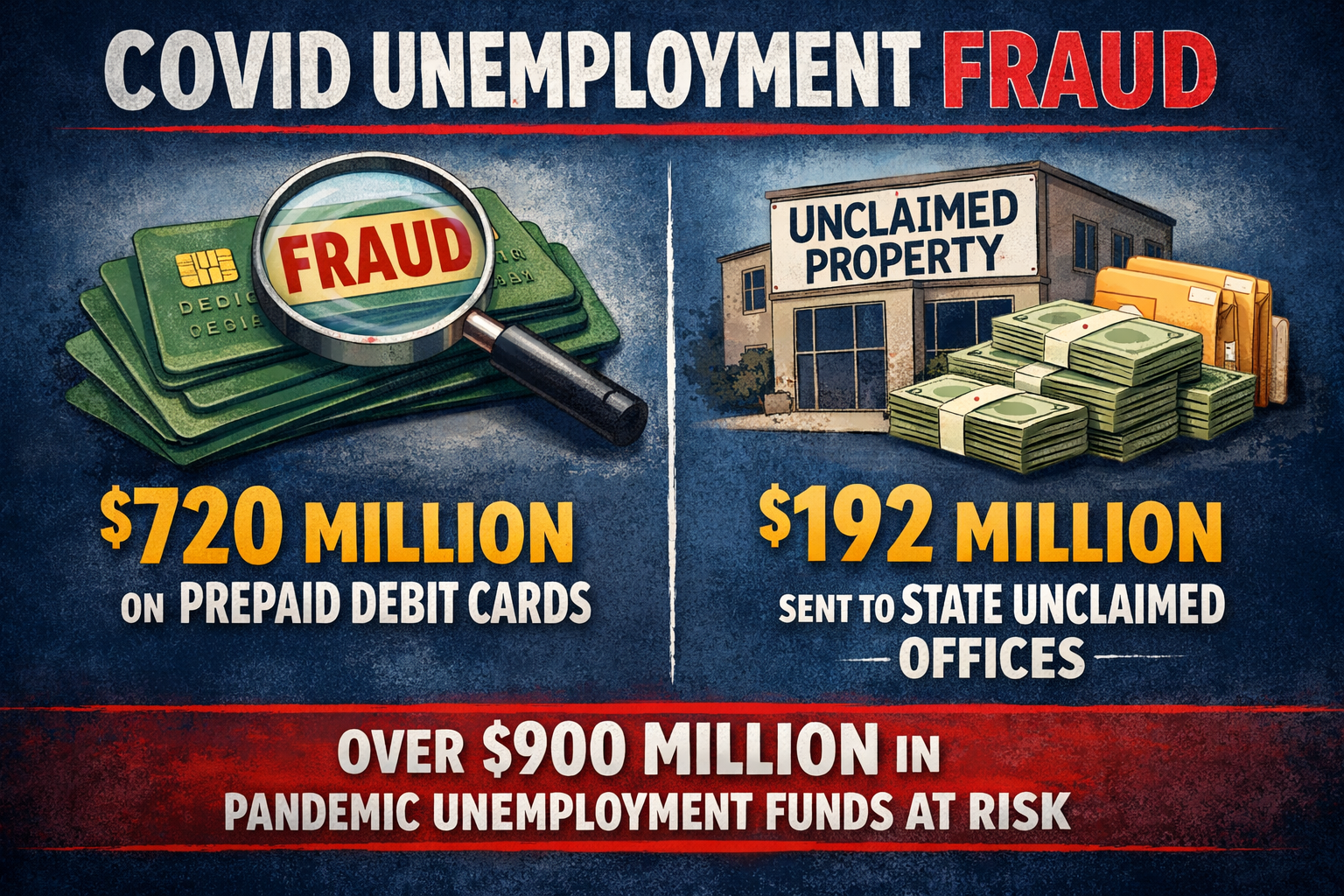
Roughly $720 million in unemployment insurance benefits is sitting on prepaid debit cards, officials said, while another $192 million was moved to state unclaimed property offices.

Roughly $720 million in unemployment insurance benefits is sitting on prepaid debit cards, officials said, while another $192 million was moved to state unclaimed property offices.
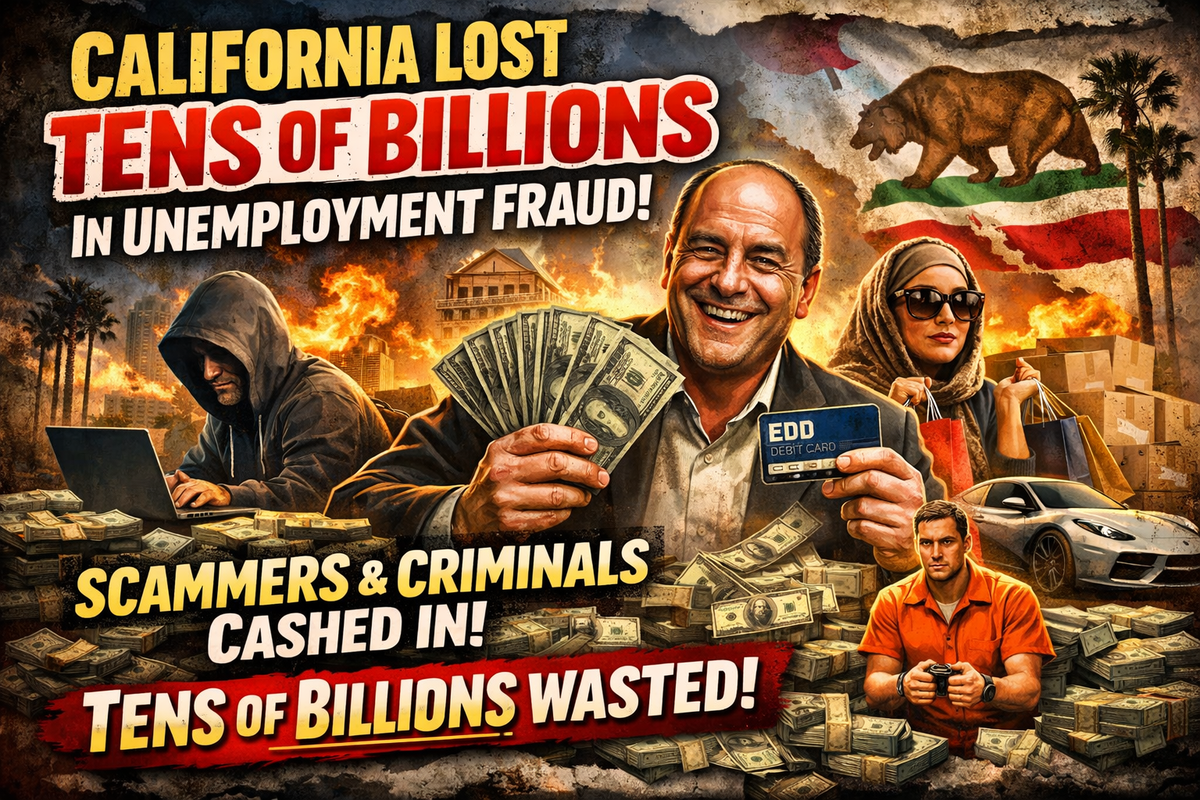
Starring a state that received $290 billion in pandemic relief and can't account for where huge chunks of it went, a Labor Secretary who just said "this ends now," and California officials whose defense is basically "it's not our fault we got robbed because nobody told us to lock the door."
Based on reporting by Josh Koehn, New York Post,
California — the state with the fifth-largest economy on the planet, the state that never shuts up about how progressive and advanced and forward-thinking it is, the state that lectures the rest of America on literally everything — lost tens of billions of dollars in fraudulent unemployment payouts during COVID.
Tens. Of. Billions. With a B. Multiple B's.
And when the Trump administration announced it's sending a strike team to investigate what happened to all that money, California's response was: "This is purely political."
Purely political. Tens of billions of taxpayer dollars vanished into the pockets of scammers and international criminal organizations, and when someone finally shows up to ask where the money went, California calls it a hit job.
That's like burning down your own kitchen, collecting the insurance check, losing the insurance check, and then screaming at the fire marshal for asking questions.
If you thought Minnesota fraud was bad, just wait until you see these California numbers: pic.twitter.com/9T6ruyUOGb
— David M. McIntosh (@DavidMMcintosh) February 20, 2026
California received nearly $290 billion in pandemic relief funds. The Employment Development Department — EDD, the state agency responsible for unemployment benefits, was one of the largest recipients.
During the pandemic, money was flying out of EDD like confetti at a parade. Benefits were "hurriedly deployed" — California's own words — with what they now admit was no anti-fraud guidance, no collaboration, and no technical assistance.
And the result? Fraud on a scale that makes your average Ponzi scheme look like a kid stealing quarters from a piggy bank.
How much was stolen? Nobody knows the exact number, and that alone should make you furious. Estimates range from "billions" to "tens of billions." The state's own improper payment rate was 12.06%. They're actually bragging about that number because the national average was around 14%.
"Hey, we only lost twelve cents of every dollar instead of fourteen! Give us a medal!"
Twelve percent of the money that was supposed to keep families alive during a pandemic went to fraudsters. And California is spinning that as a win.
Here's where it gets truly beautiful. California's official position — their actual, on-the-record, said-it-to-reporters defense — is that the fraud was "the result of a program poorly designed by the federal government."
The federal Pandemic Unemployment Assistance program, they say, "lacked the safeguards of traditional state unemployment insurance." The National Association of State Workforce Agencies warned them. The National Governors Association warned them. Nobody gave them tools. Nobody gave them guidance. They were "left to fend for themselves against international criminal organizations."
Left to fend for themselves. The State of California. Population 39 million. Annual budget north of $300 billion. Home to Silicon Valley, the largest concentration of technology companies on Earth. The state that has more tech talent per square mile than anywhere in human history.
And they couldn't figure out how to verify whether the people applying for unemployment benefits were real.
You have Google. You have Apple. You have Meta. You have every AI startup on the planet within driving distance. And you're telling me you couldn't build a fraud filter?
Let's be honest about what happened. The money spigot opened. The state saw an opportunity to distribute cash at scale with minimal oversight. They chose speed over security. And when international criminal rings figured out that California was basically an open ATM with no PIN, they drained it.
That's not the feds' fault. That's a state government that prioritized looking like it was doing something over actually doing something.
Now, to be fair, California says it hasn't been sitting on its hands. EDD officials told the Post they've launched "more than 2,300 investigations" and secured "670 convictions" with the help of a Fraud Special Counsel.
Six hundred and seventy convictions. For a fraud scheme measured in the tens of billions.
Do you know what 670 convictions represent when billions are missing? It's a rounding error. It's a parking ticket on a stolen Ferrari. It's the state equivalent of finding one shoplifter at Walmart and declaring the crime wave is over.
Twenty-three hundred investigations. And somehow tens of billions are still unaccounted for. Either those investigations aren't very good, or the scale of the theft is so massive that 2,300 investigations barely scratch the surface.
Either way, it's not the flex California thinks it is.
Labor Secretary Lori Chavez-DeRemer didn't mince words. She said the Biden administration "turned a blind eye" to the stolen money and announced the Department of Labor is sending investigators from both the national and regional offices to California.
The same model is already being applied in Minnesota, where officials believe up to $9 billion was stolen. Nine billion. In Minnesota. A state with a fraction of California's population and relief funding.
If Minnesota lost $9 billion, what did California lose? The state that received $290 billion? The state whose EDD was among the largest recipients of pandemic funds in the country?
Nobody knows. That's the point. That's why they're sending a strike team.
And California's response is to call it political.
Let me translate California's position into plain English:
"We received hundreds of billions of dollars in emergency relief. We distributed that money with minimal safeguards. International criminal organizations stole a significant portion of it. We caught a tiny fraction of the thieves. We don't know exactly how much was stolen. And now that someone wants to come look at the books, we'd like you to know this is a political attack and also it's the federal government's fault."
That's the defense. That's what they're going with.
Not: "We welcome the investigation and look forward to full accountability."
Not: "We owe it to California taxpayers to determine exactly where their money went."
Not: "We made mistakes during an unprecedented crisis and we're committed to transparency."
Nope. "Purely political." Blame the feds. Tout the 670 convictions like they mean something against a backdrop of billions in losses. And close with a passive-aggressive "we appreciate any support and cooperation in keeping the fraud door shut."
The fraud door. Buddy, the fraud door wasn't just open — it was off the hinges, propped against the wall, with a neon sign that said "FREE MONEY, NO ID REQUIRED" in six languages.
You didn't need a federal strike team to tell you that. You needed a mirror.
Not Gavin Newsom. Not the EDD officials. Not the Sacramento bureaucrats who designed the system with all the security of a screen door on a submarine.
Taxpayers pay for it. The same people who were struggling during the pandemic. The same people who waited weeks for their own legitimate unemployment checks while scammers were draining the system dry. The same people who are now watching their state government call accountability a "political hit job" because admitting the truth would mean admitting they failed on a scale that defies comprehension.
Tens of billions of dollars. Gone. And the state's position is: don't look at us, look at Washington.
Send the strike team. Open the books. Follow every dollar. And when California screams "political" — remember that there's nothing political about asking where the money went.
There's only something political about refusing to answer.
Original reporting by Josh Koehn, New York Post, February 19, 2026