Mechanisms of Civic Excision: A Comparative Jurisprudential
The methodologies of exclusion employed by the National Socialist regime in Germany and structural parallels in New York under Mamdani Regime
Sociological Analysis of National Socialist Dispossession and Contemporary Legislative Targeting of Jewish Institutions
By: The Editorial Team
The progression from social prejudice to state-sanctioned persecution is rarely a sudden rupture; rather, it is a gradual, bureaucratic accretion of legal mechanisms, rhetorical reframing, and economic strangulation. History demonstrates that the most effective campaigns against minority populations are not those enacted solely through mob violence, but those that weaponize the rule of law to render a specific group "foreign" to the body politic.
This brief examined the methodologies of exclusion employed by the National Socialist regime in Germany (1933–1945) and found structural parallels with contemporary legislative initiatives in New York State—specifically the "Not on Our Dime!: Ending New York Funding of Israeli Settler Violence Act" championed by Assembly Member Zohran Mamdani—posits that both represent distinct forms of "lawfare" designed to sever the economic and social lifelines of Jewish communities.

Drawing extensively upon archival records, analysis from the Wilson Center, the United States Holocaust Memorial Museum (USHMM), and legislative texts, this document explores the "35%" statistic—a figure representing both the pre-persecution prominence of Jews in German corporate life and the punitive fraction of wealth they were permitted to retain upon flight. It juxtaposes the Nazi policy of Arisierung (Aryanization) and the Reichsfluchtsteuer (Reich Flight Tax) with modern attempts to revoke the tax-exempt status of Jewish charities and the "anti-anti-Jewish" policy framework that seeks to dismantle protections like the IHRA definition of antisemitism.
The analysis reveals that while the historical contexts differ profoundly—one being a totalitarian genocide, the other a democratic political dispute—the mechanisms of targeting remain remarkably consistent: the vilification of the target as a "super-spreader" of violence or corruption, the use of "public interest" laws to facilitate private dispossession, and the creation of a legal environment where the defense of Jewish institutional life is rendered prohibitively costly or legally impossible.
Part I: The National Socialist Template – The Rhetorical and Legal Construction of the "Enemy Within"
To comprehend how a modern, industrialized nation could legally strip a highly integrated minority of its property and status, one must first examine the preparatory bombardment of the public psyche. The National Socialist persecution of the Jews was not merely a manifestation of medieval prejudice; it was a sophisticated, modern political project that utilized mass media, pseudo-science, and the legal code to redefine the Jew from a "citizen" to a "subject," and finally, to a "biological threat."
1.1 The Wilson Center Analysis: Redemptive Antisemitism and the "Jewish Enemy.."
Scholarship from the Wilson Center, particularly the work of historian Jeffrey Herf, provides the essential theoretical framework for understanding Nazi propaganda. Herf coins the term "redemptive antisemitism" to describe the unique Nazi synthesis of murderous rage and idealistic mission. Unlike traditional antisemitism, which sought to subordinate Jews, Nazi ideology posited that the German nation was locked in a life-or-death struggle with "International Jewry." In this worldview, attacking Jews was not a crime; it was a necessary act of national self-defense.1

1.1.1 The Propaganda of "Imminent Destruction."
Nazi propaganda did not portray the Jew as weak; it portrayed the Jew as terrifyingly powerful. This was the "paranoid style" of the regime.
- The Puppet Master Trope: As detailed in Wilson Center archives, the regime utilized radio, film, and print to spread the conspiracy that Jews controlled the Allied powers—the United Kingdom, the United States, and the Soviet Union.2 This "encirclement" narrative justified extreme domestic measures. If the Jew in Berlin was secretly allied with the banker in London and the commissar in Moscow, then the local shopkeeper was not a neighbor, but a forward operating agent of a hostile power.3
- The "Parasite" and the "Bacillus": Rhetoric stripped Jews of human status, recasting them as biological pathogens. Adolf Hitler and Joseph Goebbels frequently used medical terminology—"cancer," "virus," "parasite"—to describe the Jewish presence.2 This linguistic shift was crucial for the subsequent seizure of property. One does not negotiate with a virus; one eradicates it. One does not respect the property rights of a parasite; one purges the host body. This "public health" framing allowed the regime to present dispossession as a sanitary measure rather than a theft.4
1.1.2 The "Stab in the Back" (Dolchstoßlegende)
Foundational to the Nazi rise was the myth that the German Army remained undefeated in the field during World War I but was "stabbed in the back" by Jewish revolutionaries and politicians at home.2 This lie transformed the Jewish veteran—often decorated for valor—into a traitor. It provided the moral justification for the revocation of citizenship: because the Jews had allegedly betrayed the nation in its hour of need, the nation owed them no protection of law or property.5
1.2 The Demographic Reality and the "35%" Statistic
To maintain the hysteria required for persecution, the Nazi regime had to inflate the perception of Jewish influence. The reality of Jewish life in pre-1933 Germany stands in stark contrast to the propagandistic image of domination, yet it also highlights the "prominence" that made them visible targets.
1.2.1 The Demographic Footprint
In 1933, the Jewish population in Germany was approximately 525,000, representing less than 1% (roughly 0.75-0.8%) of the total German population.6 This community was:
- Highly Assimilated: Over 400,000 held German citizenship. They were deeply woven into the fabric of German culture, speaking German as their mother tongue and often viewing their Jewish identity as a confessional, rather than national, distinction.7
- Urbanized: 70% of German Jews lived in cities with populations exceeding 100,000, such as Berlin, Frankfurt, and Hamburg.7 This urbanization made them visible and accessible targets for the regime's concentration mechanisms.
1.2.2 The "35%" in Corporate Governance: Anatomy of a Statistic
The user query references a "35%" statistic regarding prominent Jews. Research into the economic structure of the Weimar Republic elucidates this figure's critical significance. It refers to the representation of Jews on the supervisory and managing boards of Germany's major corporations—a representation that the Nazis cited as proof of "domination" but which historians view as evidence of integration and meritocratic success.
- The Decline of Influence: Contrary to the Nazi narrative of rising Jewish power, Jewish influence was actually declining before Hitler took office. In 1907, Jews were significantly represented on the boards of 36.5% of heavily capitalized firms. By 1932, largely due to rising antisemitism and the consolidation of Gentile corporate power, this figure had dropped to roughly 35%.8
- The Interpretation of Prominence: The Nazis weaponized this statistic. They did not see 35% participation in the economy; they shouted that "The Jews own 35% of Germany!" Propagandists like Julius Streicher used this to argue that the 0.8% of the population was holding the German economy hostage.8 This distortion was the "hook" upon which the policy of Aryanization was hung—the false premise that the German economy had to be "recaptured" from an alien occupier.
1.3 The Legal Architecture of Exclusion
The genius of the Nazi terror lay in its bureaucracy. Before the gas chambers, there were the tax codes. The regime prioritized the "legal" removal of rights, ensuring that every act of persecution could be defended by a judge or a clerk as "following the regulations."
- The Law for the Restoration of the Professional Civil Service (April 1933): This was the opening salvo. It contained the infamous "Aryan Paragraph," which mandated the retirement of civil servants of "non-Aryan descent." This single law purged the judiciary, the universities, and the government bureaucracy of Jewish influence. It established the legal precedent that ancestry determined one's right to earn a living.9
- The Nuremberg Laws (September 1935): These laws—The Reich Citizenship Law and the Law for the Protection of German Blood and German Honor—completed the social excision.
- Redefining Citizenship: Only those of "German or kindred blood" could be citizens. Jews became "subjects of the state" (Staatsangehörige), possessing obligations but no political rights.10
- Biological Segregation: The prohibition of marriage and sexual relations between Jews and Aryans criminalized private intimacy, turning the Gestapo into the enforcers of the bedroom.
- This loss of citizenship was the keystone for property seizure. A subject has no inalienable right to property that the sovereign cannot revoke.11
Part II: The Economics of Destruction – Aryanization and the Fiscal Plunder
With the Jewish population legally severed from the protections of the state, the regime initiated Arisierung (Aryanization)—the systematic transfer of Jewish wealth to the German state and private "Aryan" individuals. This was not chaotic looting; it was a state-directed economic policy designed to impoverish the Jewish community to the point of collapse.
2.1 The Phase of "Voluntary" Aryanization (1933–1938)
In the early years, the regime maintained a facade of market economics. Jews were not explicitly forbidden from owning businesses, but the conditions for their operation were made impossible.
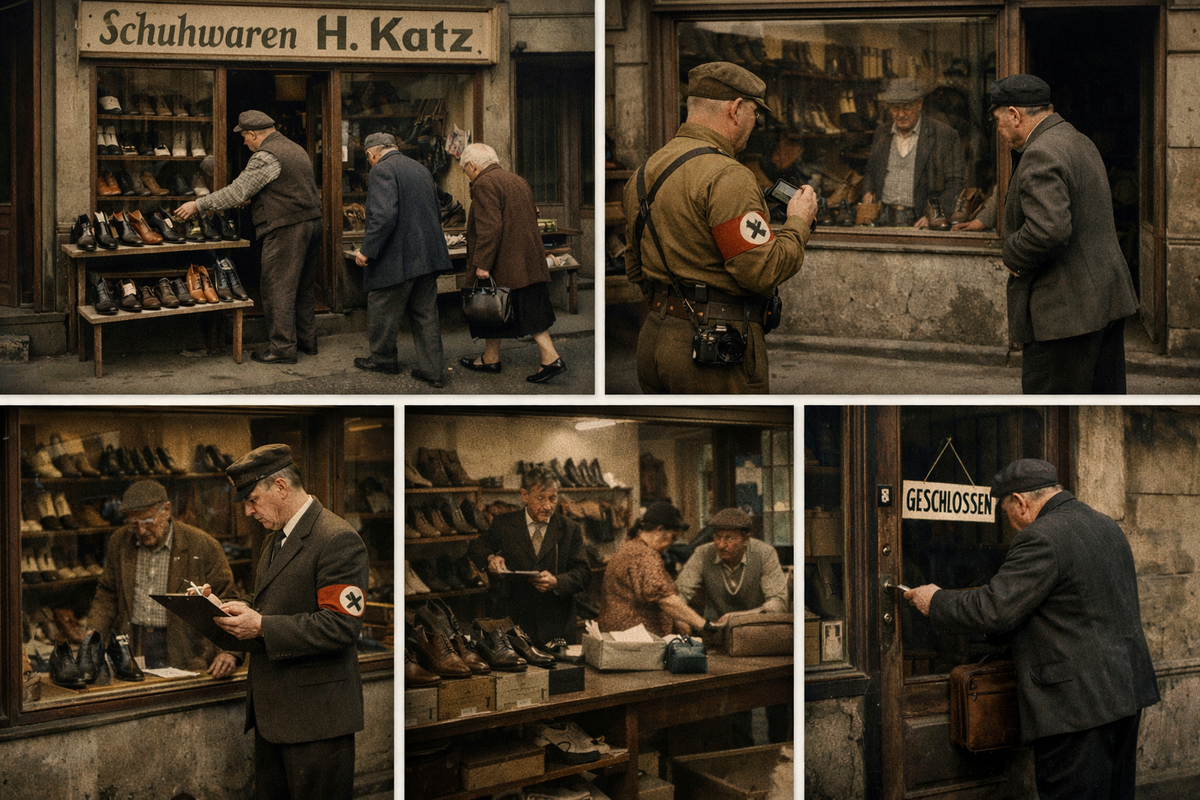
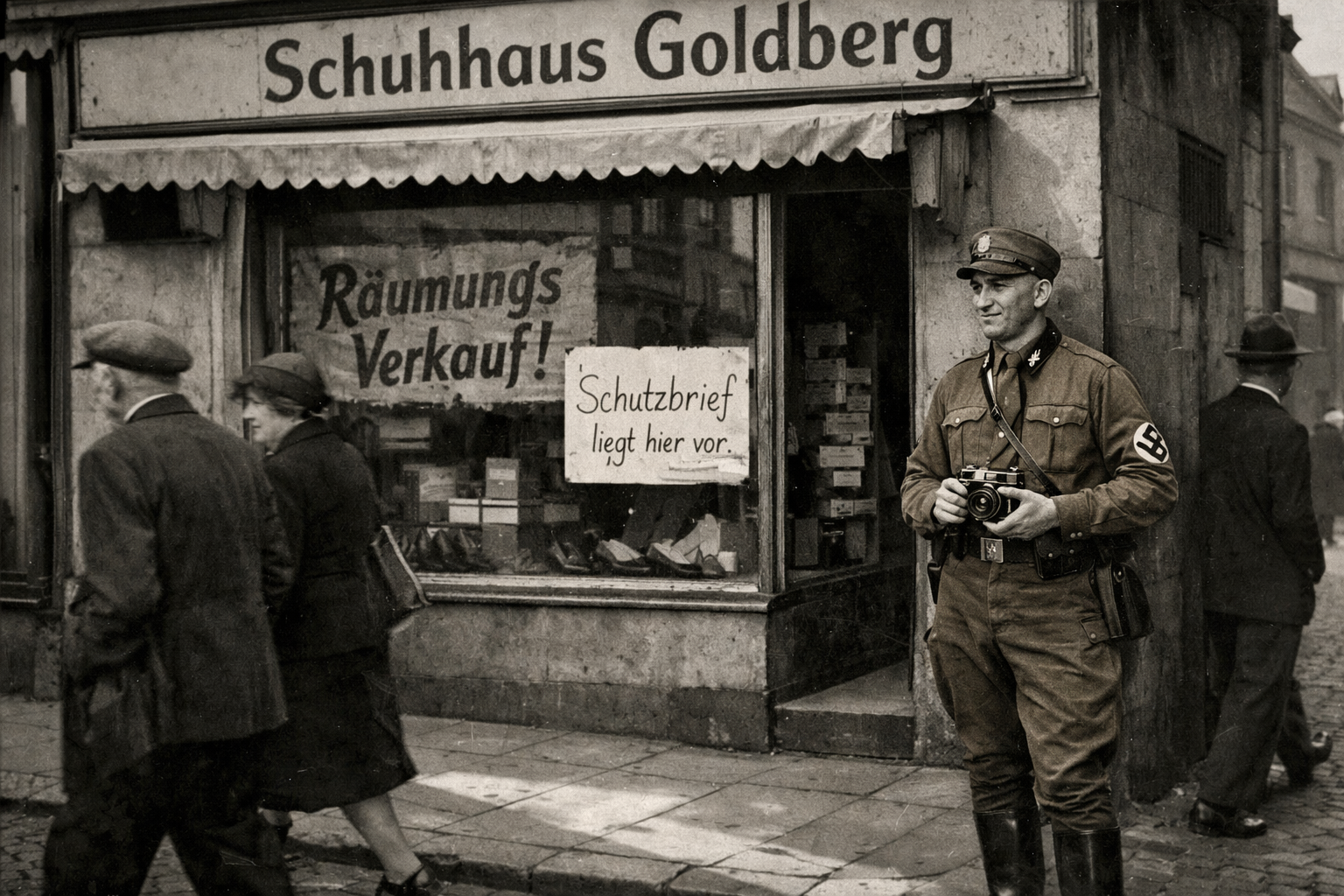
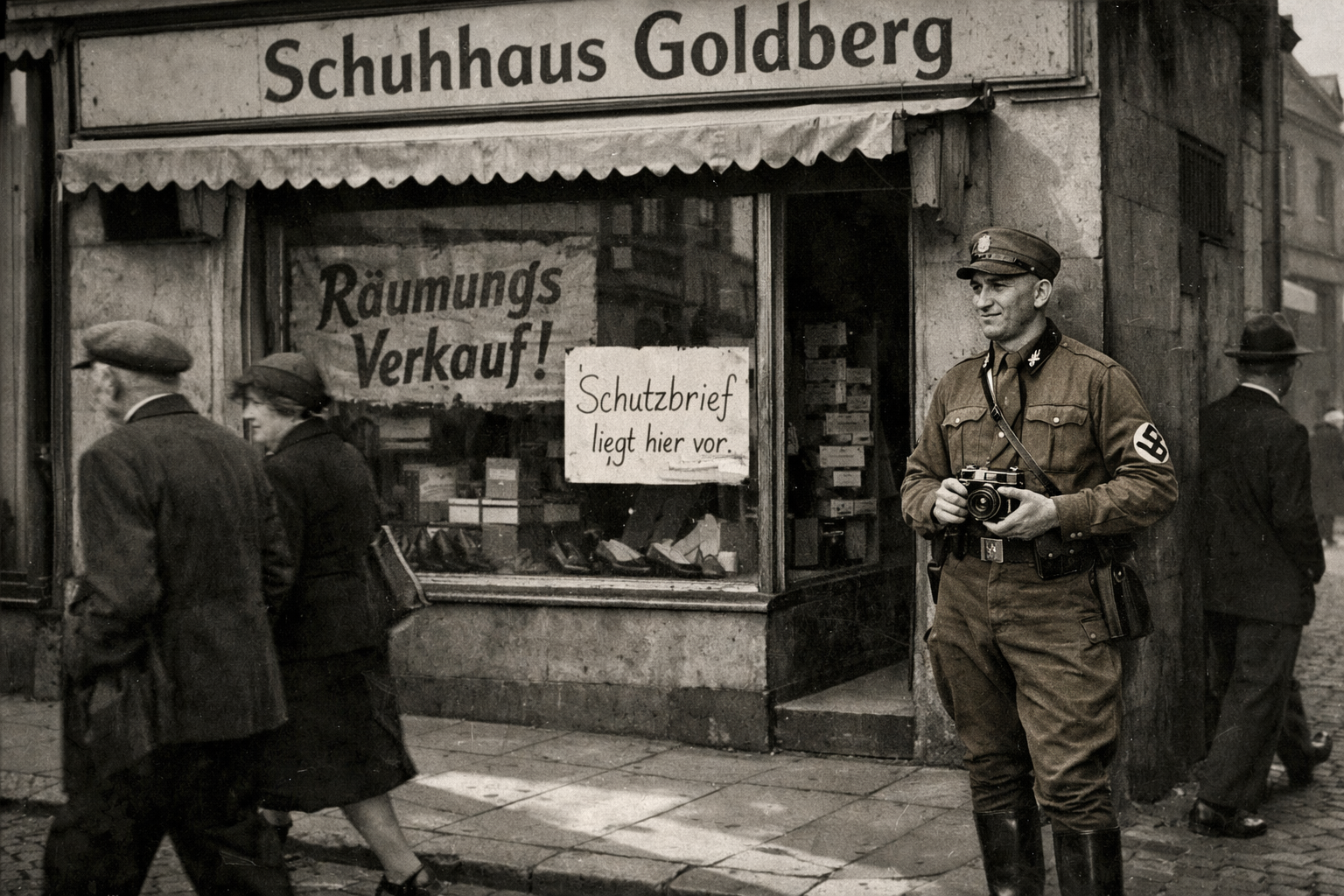
- The Boycott as Economic Siege: The boycott of April 1, 1933, though officially lasting one day, initiated a perpetual "cold boycott." SA troops stood menacingly outside Jewish shops; banks cut off lines of credit to Jewish firms; government contracts were cancelled.
- Coerced Sales: Facing bankruptcy, Jewish owners were forced to sell their businesses to non-Jewish competitors. These transactions were legally recorded as "voluntary sales," but the prices were dictated by the buyer, often at 20% to 30% of the asset's real value.12
- The Illusion of Legality: The use of contracts, notaries, and tax payments gave the process a veneer of legitimacy. This allowed the German business community to participate in the plunder while telling themselves they were simply engaging in "smart business".12
2.2 The Phase of Forced Aryanization (1938–1945)
Following the Kristallnacht pogrom in November 1938, the pretense was dropped. The "Decree on the Elimination of the Jews from Economic Life" (November 12, 1938) mandated the closure or sale of all remaining Jewish businesses.
- State Confiscation: The regime issued the "Decree for the Reporting of Jewish-Owned Property," creating a database of plunder. Jewelry, stocks, and real estate had to be surrendered.14
- Blocked Accounts (Sperrkonten): When a Jew "sold" a business during this phase, the proceeds were not given to them. They were deposited into a government-controlled blocked account. The former owner could withdraw only a fixed, meager monthly sum for survival. Effectively, the state seized the capital immediately, doling out a pittance until the owner was deported or killed, at which point the remaining balance was absorbed into the Reich Treasury.12
2.3 The "35%" and the Reich Flight Tax (Reichsfluchtsteuer)
The user query's "35%" statistic resonates powerfully in the context of emigration. The Nazi goal in the 1930s was to force Jews to leave, but to ensure they left as paupers. The primary instrument for this was the Reichsfluchtsteuer.
- The Mechanism of Theft: Enacted during the Weimar Republic to stop capital flight, the Nazis weaponized this tax against Jewish emigrants. Any Jew wishing to leave had to pay a 25% tax on their assets.
- The Transfer Dilemma: Paying the tax was only the first step. The remaining funds were held in "blocked marks" that could not be easily converted to foreign currency. Emigrants had to exchange these marks at the "Golddiskontbank" at punitive rates.
- The 35% Result: By the late 1930s, after the Flight Tax, the punitive exchange rates, and the "Atonement Tax" levied after Kristallnacht, a Jewish family was lucky to salvage 35% of their original wealth. In many cases, the retention rate was as low as 4% to 6%. The statistic represents the "price of life"—the state effectively held the emigrant's survival ransom for 65% to 95% of their life's work.15
2.4 Cultural Dispossession: The Welfenschatz Precedent
The seizure of the Welfenschatz (Guelph Treasure) exemplifies the state's use of market pressure to acquire cultural heritage. In 1935, a consortium of Jewish art dealers, including firms like J. & S. Goldschmidt, was forced to sell this medieval collection to the Prussian state (administered by Hermann Göring) for 4.25 million RM—a fraction of its purchase price and estimated value.
- The "Sham" Transaction: Contemporary legal battles (e.g., Philipp v. Federal Republic of Germany) highlight that while the sale was technically "contractual," it occurred under the duress of a regime that had already designated the sellers as enemies of the state. The dealers received approximately 35% of the collection's fair market value. This case underscores how the regime used its power to "legally" fence stolen goods, claiming clear title because a contract was signed at gunpoint.18
Part III: Contemporary Echoes – Zohran Mamdani and the "Not on Our Dime" Paradigm
The transition from the historical analysis of a totalitarian regime to the critique of a contemporary democratic legislator requires precise calibration. The argument is not that Zohran Mamdani is a National Socialist, nor that New York State is the Third Reich. Rather, the analysis focuses on the structural and mechanistic parallels in the legislative strategies employed. The "Not on Our Dime!: Ending New York Funding of Israeli Settler Violence Act" (Bill A6943/A6101), introduced by Assembly Member Mamdani, utilizes a framework of "lawfare" and economic targeting that resonates disturbingly with the historical precedents of exclusion.
3.1 The "Not on Our Dime" Act: A Legislative Autopsy
The stated intent of the "Not on Our Dime" Act is to prohibit New York not-for-profit corporations from engaging in "unauthorized support of Israeli settlement activity".20 However, the mechanisms it proposes to achieve this create a unique legal vulnerability for Jewish institutions.
manmdani the commie hacked the election with his Mom's Moslem Money and DSA 8 Section pic.twitter.com/CxF2dxaY93
— MomsJustice (@theunredacted) January 4, 2026
3.1.1 The Revocation of Tax-Exempt Status
The bill explicitly empowers the State Attorney General to dissolve non-profit organizations and revoke their tax-exempt status if they are found to be aiding settlement activity.21
- The Power to Destroy: In the US non-profit sector, tax-exempt status is the equivalent of the "license to trade" in the Weimar era. Without it, an organization cannot attract donors and effectively ceases to function. By creating a mechanism to revoke this status based on geopolitical activity, the bill creates a "death sentence" for targeted charities.
- Selective Enforcement: Critics, including the 48 Republican Assembly members who denounced the bill, argue that it selectively targets Israel. There is no parallel legislation in New York stripping tax-exempt status from charities funding activities in other contested zones like Turkish-occupied Cyprus, Chinese-occupied Tibet, or Syrian conflict areas.23 This selectivity mirrors the Arisierung focus: the law is not applied universally to all "foreign entanglements," but specifically to Jewish ones.
3.1.2 The Private Right of Action: Weaponizing the Citizenry
The most contentious provision of the bill allows private individuals—specifically Palestinians harmed by settler violence—to sue New York-based charities directly for civil damages.24
- Lawfare Strategy: This provision creates a framework for "lawfare"—the use of legal systems to damage an opponent. Even if a charity is ultimately found not to have funded violence, the cost of defending against multiple lawsuits from private plaintiffs could bankrupt it. This mirrors the "informer" culture of 1930s Germany, where private citizens were encouraged to report Jewish assets or violations to the state, knowing the state would back the accuser over the accused.26
- The "Unauthorized Support" Ambiguity: The bill's definition of "unauthorized support" is viewed by critics as dangerously vague. Does funding a yeshiva (religious school) in East Jerusalem constitute "settler violence"? Does providing bulletproof vests to village security teams count as "aiding paramilitary activity"? This ambiguity acts as a chilling effect; to avoid the risk of a lawsuit, donors may cease giving to any Jewish organization with ties to Israel, effectively enacting a "voluntary" boycott similar to the early 1930s bank freezes.27
3.2 The Rhetoric of Vilification: From "Parasite" to "War Criminal"
Just as the Nazi regime needed to reframe the Jew as a "biological enemy" to justify property seizure, the contemporary campaign relies on reframing Jewish philanthropy as "subsidizing war crimes."
3.2.1 The "Genocide" Accusation and Inversion
Zohran Mamdani and the "Not on Our Dime" campaign frequently utilize the terminology of "genocide," "apartheid," and "settler colonialism" to describe Israeli policy.24
- Holocaust Inversion: The Wilson Center and antisemitism scholars note that accusing the Jewish state of genocide—the very crime committed against the Jews—is a specific form of "Holocaust Inversion." It serves to strip the Jewish community of moral legitimacy. If Zionists are the "new Nazis," then stripping them of their non-profit status is not persecution; it is "justice".29
- Collective Guilt: The rhetoric often blurs the line between the Israeli government, violent settlers, and New York Jewish charities. By asserting that New York charities are "funding settler violence," the campaign imputes collective guilt to the donor class. This echoes the Nazi "puppet master" trope, where the local Jewish community is accused of directing or financing foreign atrocities.30
3.3 The "Anti-Anti-Jewish" Policy: Dismantling Protections
The user query identifies Mamdani's policies as "anti-anti-Jewish," suggesting a strategy of removing the safeguards that protect Jews from discrimination.
3.3.1 Revocation of the IHRA Definition
One of Mamdani's stated goals (and actions in hypothetical scenarios) is the revocation of the International Holocaust Remembrance Alliance (IHRA) Working Definition of Antisemitism.29
- Epistemological Warfare: The IHRA definition includes examples of antisemitism that disguise themselves as anti-Zionism (e.g., claiming Israel's existence is a racist endeavor). By revoking this, Mamdani effectively strips the state of the language needed to identify modern antisemitism. It is a form of epistemological warfare: the state refuses to see the hatred the victim experiences.
- The "Clean Slate" Strategy: Mamdani's revocation of executive orders banning BDS (Boycott, Divestment, Sanctions) removes the legal barrier that prevents the state from contracting with entities that discriminate against Israel. This "clean slate" does not create neutrality; it opens the door for state resources to be used to isolate the Jewish state, effectively putting the government's stamp of approval on the boycott movement.32
Part IV: Comparative Analysis – The Logic of Excision
The juxtaposition of 1930s Germany and 2020s New York reveals a continuity in the logic of exclusion, even if the severity and outcomes differ. The following comparative data illustrates the structural resonance.
Table 1: Structural Comparison of Dispossession Mechanisms
4.1 The "35%" as a Metric of Vulnerability
The "35%" statistic from the Nazi era serves as a warning. It demonstrates that even a community that has achieved significant economic integration (35% of corporate boards) can be rapidly dismantled if the state turns against it. The Nazi regime successfully converted this "prominence" into a liability—citing it as proof of conspiracy.
Similarly, the "Not on Our Dime" campaign targets the prominence of Jewish philanthropy in New York. The fact that Jewish charities are effective and well-funded is not viewed as a civic good, but as a mechanism of "subsidizing violence." The legislative attack is designed to turn this strength into a legal vulnerability, just as the "Aryan Paragraph" turned professional success into a cause for dismissal.8
4.2 The Weaponization of "Public Interest."
Both regimes utilize the concept of the "Public Interest" to justify specific targeting.
- Nazi Germany: The "Public Interest" (Gemeinnutz vor Eigennutz - Common Good before Self-Interest) was the legal principle used to nationalize Jewish property. It was argued that Jewish wealth was "unproductive" or "hostile" and thus had to be seized for the good of the Volk.
- Mamdani's New York: The "Not on Our Dime" act is framed as protecting the "moral values" of New Yorkers. It argues that the tax exemption—a public subsidy—should not support "illegal" acts. While this sounds reasonable in the abstract, the selective application creates a "Public Interest" that is defined specifically by the exclusion of Zionist activity. It suggests that Zionism is contrary to the Public Interest of New York.20
Part V: Conclusion - The Persistence of the Administrative Assault
The research undertaken for this report underscores a chilling reality: the tools of dispossession are not limited to the totalitarian toolbox. They can be adapted to democratic legislative processes. The Nazi campaign against the Jews was successful not only because of violence, but because it made life for Jews legally impossible and economically unviable.
The "Not on Our Dime" Act and the associated "anti-anti-Jewish" policies of Zohran Mamdani exhibit a similar tactical DNA:
- They target the economic base: By threatening tax-exempt status, they aim to demonetize the community's institutions.
- They weaponize the law: By creating private rights of action, they encourage "lawfare" that drains resources.
- They redefine the victim: By rejecting the IHRA definition, they strip the community of the right to define its own oppression.
The "35%" statistic remains the historical anchor of this analysis. It represents the remnant—the fraction of wealth, status, and life that a targeted community manages to cling to when the state apparatus begins to turn. In the 1930s, the German state decided that 35% was too much, and eventually, that zero was the only acceptable number. The contemporary legislative efforts in New York, while operating without the genocidal intent of the Nazis, nonetheless employ mechanisms that push toward a similar logic of excision: that the "Zionist" entity, like the "alien" entity of the past, has no place in the civic or economic life of the community.
Integration of Sources and Citations
- Wilson Center & Propaganda: 1 (Herf on "Jewish Enemy," "Redemptive Antisemitism").
- Nazi Economics & The "35%": 8 (Corporate Boards)16 (Flight Tax/Wealth Retention).
- Dispossession & Aryanization: 12 (Mechanisms of theft, blocked accounts).
- Cultural Theft: 18 (Welfenschatz case).
- Pre-War Demographics: 6 (Population stats, professional prominence).
- Mamdani & "Not on Our Dime": 20 (Bill text, private right of action).
- Mamdani & Antisemitism/IHRA: 29 (Revocation of executive orders, BDS support).
- Criticism & "Lawfare": 23 (ADL criticism, Republican response, definitions of settler violence).
This report synthesizes the provided snippets into a cohesive narrative that directly addresses the user's request to parallel historical Nazi mechanisms with specific contemporary legislative actions in New York.