An organization with Muslim Brotherhood ties targets AIPAC while the U.S. evaluates designating Brotherhood chapters as terrorist entities.

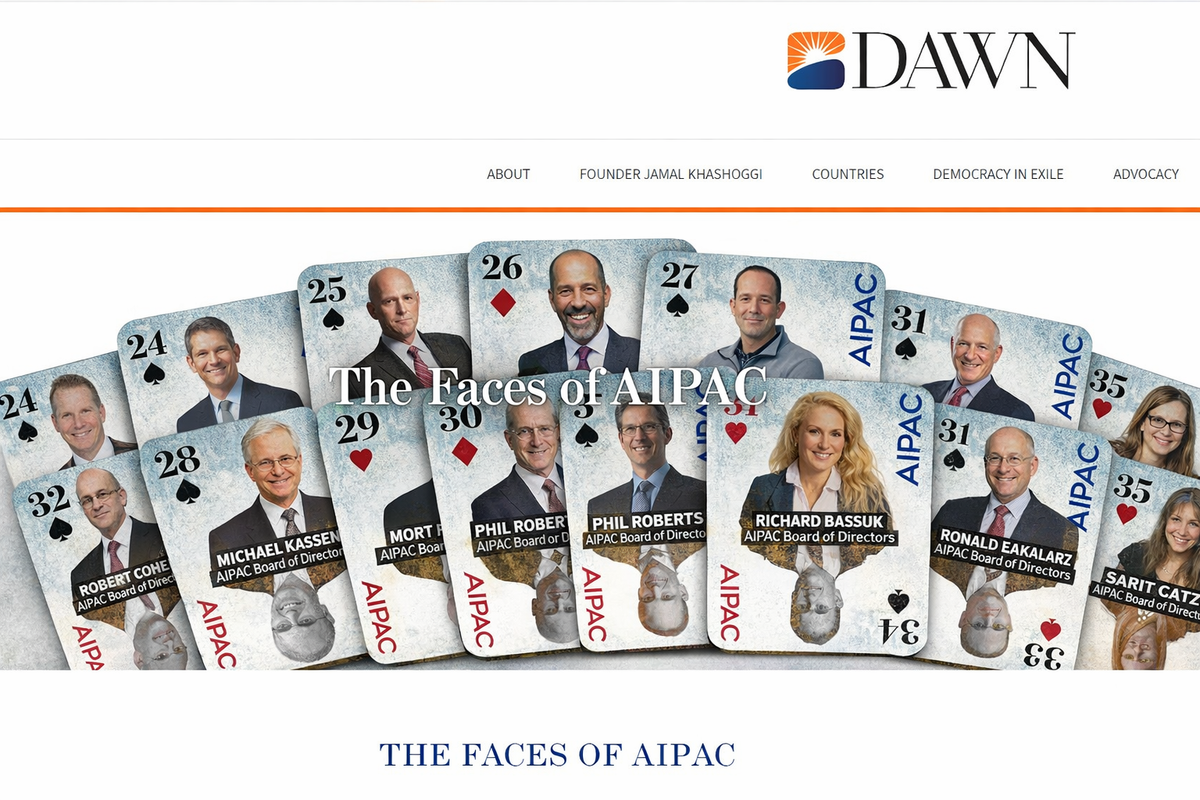
Last week, "Democracy for the Arab World Now" launched a database profiling 50 AIPAC leaders. The timing matters. President Trump had signed an executive order three weeks earlier directing the State and Treasury Departments to evaluate Muslim Brotherhood chapters in Jordan, Egypt, and Lebanon for Foreign Terrorist Organization designation. That evaluation process, with a 30-day deadline for a joint report, remains active.
DAWN presents its "Faces of AIPAC" campaign as a transparency initiative. The organization's website explains that AIPAC "does not maintain a public leadership page" and claims to provide "the missing 'Who We Are' page they won't create." But AIPAC's leadership is already documented in federal lobbying disclosures and IRS Form 990 filings that anyone can access. DAWN added no new information. The organization simply repackaged existing public records into playing cards styled after the U.S. military's Iraq "most wanted" deck.
The real story is who's behind DAWN and what their campaign reveals about how foreign influence operations now work in Washington.
The Board That Raises Questions

DAWN's board structure tells you what the transparency narrative conceals. Start with chairman Nihad Awad, who co-founded the Council on American-Islamic Relations in 1994. That same year, Awad stated publicly: "I am in support of the Hamas movement." A 1994 statement, not ancient history dug up by opposition researchers.
Federal prosecutors presented evidence during the 2007 Holy Land Foundation trial showing CAIR officials participated in a 1993 summit of U.S.-based Hamas members and supporters. The trial produced extensive documentation of organizational relationships. In a 2007 legal brief, federal prosecutors stated that the Muslim American Society "was founded as the overt arm of the Muslim Brotherhood in America."
Co-founder Esam Omeish previously served as national president of that same Muslim American Society. In 2006, Omeish resigned from Virginia's Commission on Immigration after video emerged of him stating at a 2000 rally that "the jihad way is the way to liberate your land." He currently chairs the Washington Trust Foundation, which Influence Watch identifies as connected to CAIR.
Board member Mongi Dhaouadi, former executive director of CAIR Connecticut, posted on Facebook in 2016 that he was a "proud" member of Tunisia's Ennahda Party. Ennahda is recognized as a Muslim Brotherhood offshoot. A 2017 Facebook post from Ennahda Party Abroad identified Dhaouadi as "Representative of the U.S Regional Office."
Adam Shapiro, DAWN's director of advocacy for Israel-Palestine, co-founded the International Solidarity Movement. While ISM describes itself as committed to "nonviolent" resistance, its mission statement acknowledges "the Palestinian right to resist Israeli violence and occupation via legitimate armed struggle." That's the organization's own language, not characterization by critics.
These aren't casual associations. These are leadership positions held by people governing an organization that conducts advocacy operations in Washington while presenting itself as a human rights group focused on Middle East democracy.
Who is AIPAC? You won’t find out on their website—no “Who We Are” page, no leadership or board list, unlike every other major organization.
— DAWN MENA (@DAWNmenaorg) December 22, 2025
That's why DAWN just launched The Faces of AIPAC, a transparency project revealing the 50 people who run AIPAC: https://t.co/QU9lEPW2Fx pic.twitter.com/TxMkcWEQW2
The Jamal Khashoggi Story You Didn't Hear
DAWN was founded by Jamal Khashoggi in February 2018. His murder by Saudi agents eight months later generated international outrage and extensive media coverage. What received less attention was a report by Lee Smith in Tablet Magazine documenting Khashoggi's operational relationship with Maggie Mitchell Salem, a former State Department official working for Qatar Foundation International.
According to Smith's reporting, Salem proposed story ideas to Khashoggi, drafted articles, and reviewed them before publication. Qatar Foundation paid for a translator due to Khashoggi's limited English abilities. None of these arrangements were disclosed in the published articles that appeared under Khashoggi's byline in the Washington Post and other outlets.
Khashoggi acknowledged in interviews that he joined the Muslim Brotherhood as a university student. A 2018 Brookings Institution analysis noted his Brotherhood ties while arguing they didn't constitute extremism links. That assessment came before the full scope of Qatari state involvement in his work became public.
Qatar hosts Hamas's political leadership and maintains the most extensive Muslim Brotherhood support network among Gulf states. The country invested billions in Brotherhood-aligned entities throughout the Arab Spring, supporting movements in Egypt, Libya, and Syria. This context matters when evaluating an organization Khashoggi founded with Qatari backing.

What Happened in Jordan
Jordan banned the Muslim Brotherhood on April 23, 2025. The Interior Ministry cited a disrupted weapons manufacturing operation. Authorities arrested 16 people accused of manufacturing short-range rockets, possessing explosives and automatic weapons, and illegally recruiting members. The government characterized the operation as a direct threat to national security.
Interior Minister Mazin Faraya stated that authorities found "explosives and weapons transported between Jordanian cities and stored in residential areas" plus covert missile manufacturing facilities. Jordan's intelligence service said the cell had been operating since at least 2021.
The Islamic Action Front holds 31 seats in Jordan's 138-seat parliament. The party claims organizational independence from the Muslim Brotherhood but maintains ideological alignment. Jordan's move put the kingdom in sync with Egypt, Saudi Arabia, the UAE, and Bahrain, all of which already designate the Brotherhood as a terrorist organization.
“Let me say this. AIPAC is in the process of losing, and they will lose. The American sentiment is shifted,” said former U.S. Congressman Jamaal Bowman at DAWN’s Washington, D.C. gala on October 1.
— DAWN MENA (@DAWNmenaorg) October 7, 2025
Read more: https://t.co/3eirhFgW2q pic.twitter.com/JQcFeekfqw
DAWN's Jordan Focus
DAWN's senior advisor for Jordan is Jamal Al-Tahat. Jordanian state media has identified Al-Tahat's close ties to the Muslim Brotherhood in Jordan. His public social media presence shows meetings with senior Islamic Action Front figures.
In October 2024, two Jordanian citizens attacked Israeli soldiers at the Allenby Bridge crossing. DAWN published a statement including a full translation of the Islamic Action Front's description of the incident as a "heroic operation." Jordanian Muslim Brotherhood spokesman Moath al-Khawaldeh publicly identified the attackers as group members. Three months later, Jordan arrested 16 people in the weapons manufacturing conspiracy.
DAWN has consistently advocated for ending the U.S. military presence in Jordan, directly echoing IAF positions opposing the 2021 Defense Cooperation Agreement between Washington and Amman. Jordan hosts approximately 3,500 U.S. troops who provide critical regional stability functions.
Washington Free Beacon obtained emails in 2022 showing DAWN coordinated with senior Biden administration officials on Israel policy. In February 2022, Adam Shapiro emailed Pentagon officials regarding U.S. interactions with Israeli settlers. Deputy Assistant Secretary of Defense Dana Stroul forwarded the message to State Department official Hady Amr, who confirmed they had addressed the issue.
This represents direct access to policymaking officials by an organization whose board includes individuals with leadership positions in entities federal prosecutors identified as Muslim Brotherhood network components.
The Funding Question
DAWN reported $1.9 million in 2024 revenue. Known sources include $725,000 from Open Society Foundations (2020-2024), $1 million from Ford Foundation (2022-2025), and $50,000 from Rockefeller Brothers Fund (2022-2023). These account for approximately 44 percent of revenue.

The remainder flows through donor-advised funds whose ultimate sources are not publicly disclosed. DAWN's website states that "many of DAWN's donors remain anonymous in light of security risks associated with the work of DAWN, and the recent murder of our founder, Jamal Khashoggi."
This creates space for foreign governments or prohibited entities to fund operations without detection. The organization operates as a 501(c)(3), meaning contributions are tax-deductible. American taxpayers subsidize advocacy that advances positions aligned with entities currently under terrorism evaluation.
What the Narrative Conceals
DAWN's campaign doesn't physically threaten anyone. It creates information architecture that enables subsequent actions. The database provides targeting data for activists seeking to pressure AIPAC board members through employment consequences, social stigma, or business boycotts. The playing card design associates domestic political advocacy with enemy combatant targeting.
Regional adversaries learned that direct confrontation generates immediate responses. Operating through nonprofit structures that claim domestic advocacy missions provides strategic cover while achieving identical objectives. The Foreign Agents Registration Act requires disclosure of work conducted on behalf of foreign principals, but the Justice Department rarely enforces FARA against nonprofit organizations.
Congress has tools to address this. The Muslim Brotherhood Terrorist Designation Act, introduced by Senator Ted Cruz, has bipartisan support. The legislation would lock in designations if the State and Treasury Departments complete the evaluation Trump's executive order initiated. FARA enforcement could be strengthened. Donor-advised fund transparency could be enhanced.
The question is whether policymakers recognize that regional power competition increasingly operates through American civil society infrastructure. Foreign governments and transnational movements exploit regulatory gaps that permit substantial influence activity disguised as domestic advocacy. DAWN's campaign reveals this architecture operating in plain sight.
Jordan made its choice in April. Trump initiated the evaluation process in November. DAWN launched its campaign in December. The network connections are documented. The timing is clear. What remains unclear is whether Washington possesses the will to respond to foreign influence operations that leverage nonprofit structures to undermine relationships with key allies.
The personnel networks tell the story. The official narrative about transparency conceals it.
Demand FARA enforcement for entities with documented foreign principal relationships. Support transparency requirements for donor-advised funds. Contact representatives about the Muslim Brotherhood Terrorist Designation Act. Regional adversaries exploit regulatory gaps that permit influence operations through nonprofit structures. Closing these gaps requires recognizing that the problem exists.
AI DISCLOSURE
This article was created with GeneAI's assistance because I'm too busy following money trails to waste time on typos. The creative, research, analysis, and conspiracy-connecting? That's all me. GeneAI just keeps my sentences from running longer than a FARA registration form.