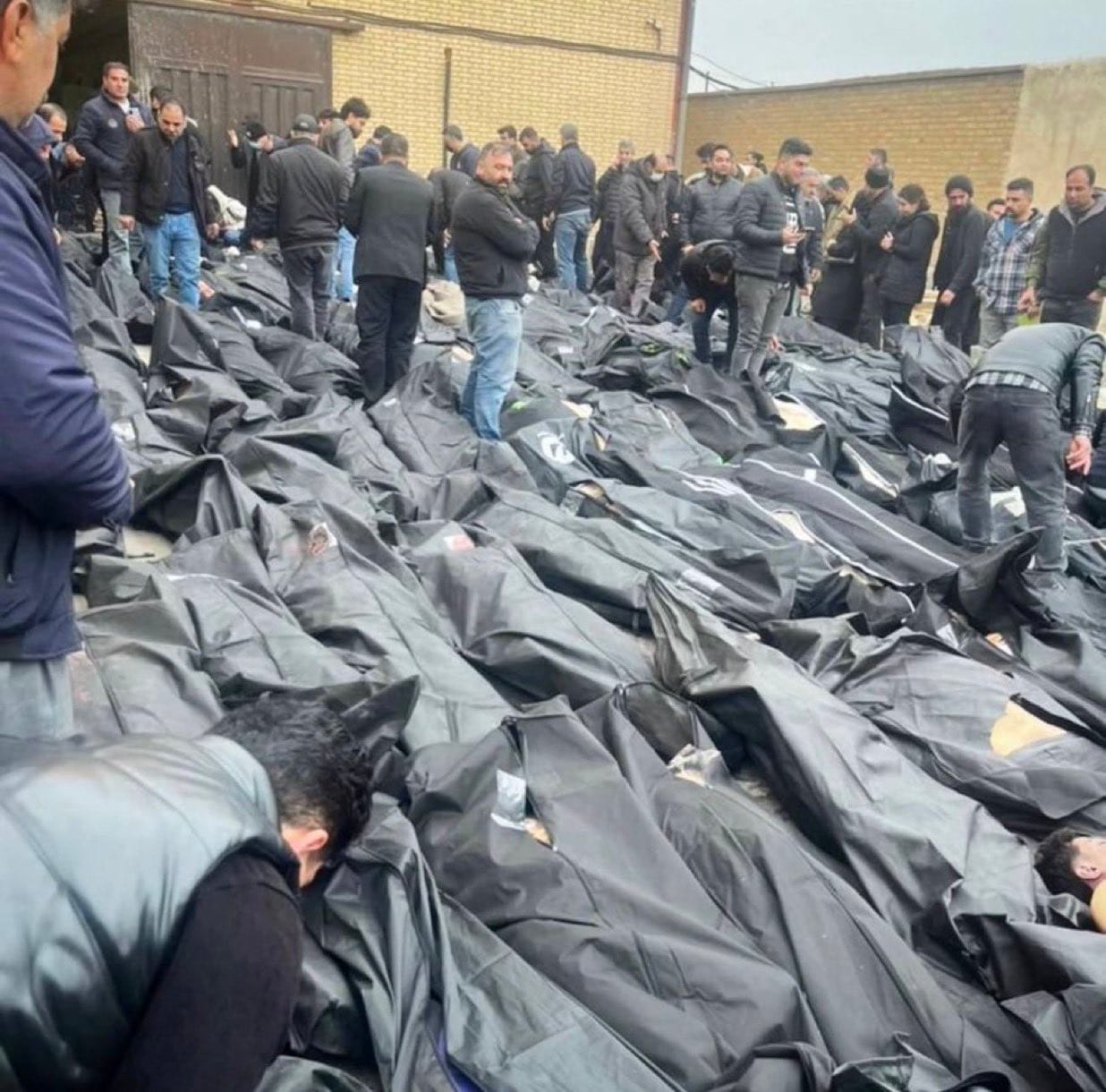
Iran's state media announced the "martyrdom" of Ali Khamenei on Sunday.

THE REGIME CONFIRMED WHAT ITS OWN FOREIGN MINISTER DENIED TWELVE HOURS EARLIER
Iran's state media announced the "martyrdom" of Ali Khamenei on Sunday. The 47-year-old Islamic Republic now has no supreme leader, no defense minister, no IRGC commander. Prediction markets say the office itself may not survive.
Late Saturday night, Iranian state media broke the story the regime had been trying to manage since morning.
"It is announced to the martyr-nurturing people of Iran that Grand Ayatollah Khamenei, the Supreme Leader of the Islamic Revolution, was martyred in a joint attack by the criminal United States and the Zionist regime," Nour News reported on Telegram. Press TV posted confirmation to X. IRNA followed. A 40-day mourning period was declared. Seven days of public holidays.
Twelve hours earlier, Foreign Minister Abbas Araghchi had told NBC News live that Khamenei was alive "as far as I know" and that "all high-ranking officials are safe, sound, and alive." The gap between those two statements is the story. The Iranian regime spent an entire day managing the information environment around the death of its own supreme leader. When it could no longer hold the line, it issued a martyrdom announcement and declared a holiday.
Trump's response on Truth Social was direct: "Khamenei, one of the most evil people in History, is dead. This is JUSTICE for all of the Americans, and others, he has killed or had killed over the years."
He added what he called the central development: "We are hearing that many of their IRGC, Military, and other Security and Police Forces, no longer want to fight, and are looking for Immunity from us."
Then, in a separate NBC News interview, Trump said: "The people that make all the decisions, most of them are gone."
What the Regime Confirmed
Iranian state media did not merely confirm Khamenei's death. They confirmed the deaths of his daughter, his son-in-law, and his grandson in the same strikes. Khamenei's family compound was destroyed. The Reuters-confirmed earlier report that he was at his office rather than a safe location when the strikes hit was also confirmed by Iranian state media outlet Fars News, which said he was "at his office within his residence, not a hiding place" when the strikes came.
That detail matters. The 86-year-old ruler of the Islamic Republic was at his desk when a US-Israeli strike killed him. He was not in a bunker. He was not evacuated in time. The intelligence that placed him there was Israeli, and Israeli Prime Minister Netanyahu was reportedly shown a photograph of the body.
The IDF confirmed seven senior Iranian officials and commanders killed. Ali Shamkhani, Khamenei's top nuclear security adviser: dead. IRGC Commander Mohammad Pakpour: dead. Defense Minister Amir Nasirzadeh: dead. Khamenei's personal chief of staff, Hejazi: dead, per the Israeli military. Four senior IRGC intelligence commanders named by Iran International: dead.
Khamenei's daughter. His son-in-law. His grandson.
That is not a decapitation. That is an erasure.
BREAKING: The Basij is deploying forces across Iran, on their way to terrorize Iranian civilians. pic.twitter.com/GbIkzADPoU
— Eyal Yakoby (@EYakoby) March 2, 2026
The Succession Problem Has No Clean Answer
Iran has a constitutional mechanism for succession. It does not have functional actors to run it in the current environment.
Under Article 111, the Assembly of Experts selects a new supreme leader. A provisional leadership council consisting of the president, chief justice, and a Guardian Council cleric manages the transition period. In theory, that council is now operative. In practice, the men Khamenei had personally designated as his four layers of emergency succession included officials who are now confirmed dead.
The man who emerged Saturday as the most senior surviving civilian official is Ali Larijani, the secretary of the Supreme National Security Council. Larijani is a founding IRGC member, a longtime Khamenei confidant, and the official who was given authority to communicate with American envoy Steve Witkoff when the White House tried to reach Tehran in January. He posted to X Saturday that Iran would give the US and Israel "an unforgettable lesson." He is not a cleric. He cannot become supreme leader under the existing constitutional framework.
Mojtaba Khamenei, the supreme leader's son, reportedly survived the strikes. He has IRGC ties, shadow influence, and factional loyalty. He also has no formal theological credentials, no administrative experience in his own name, and a father who explicitly told followers he did not want the office to become hereditary. Elevating Mojtaba would invite the exact dynastic-monarchy accusation that made the Shah's Iran illegitimate in 1979.
The Assembly of Experts chairman is a 92-year-old cleric named Ayatollah Movahedi Kermani. His status after Saturday's strikes is not confirmed.
Prediction markets, which sometimes price things the diplomatic community takes weeks to say out loud, are expressing the dissonance directly. Kalshi's contract on Iran's next supreme leader now prices "position abolished" at 49%. Hassan Khomeini, the revolutionary founder's grandson, is at 24%. Mojtaba Khamenei is at 14%. The market is saying that the most likely outcome of Khamenei's death is the structural end of the supreme leader institution itself.
BREAKING: The Islamic Republic has struck Bahrain. pic.twitter.com/Vnn3ZxSFqs
— Eyal Yakoby (@EYakoby) March 1, 2026
That outcome would not be a democratic transition. It would be a military one. The CIA assessed before Saturday's strikes that IRGC hard-liners could seize control if Khamenei were killed. That scenario, a post-clerical military junta running Iran's institutions, is now the second most likely outcome after institutional abolition. The CFR wrote two weeks ago that a military-led Iran would likely continue the most destabilizing policies. The IRGC, however, has no recognized commander. Pakpour is dead. His predecessor was killed in June 2025.
The question is not just who becomes supreme leader. It is whether any figure commands enough institutional loyalty, clerical legitimacy, and IRGC compliance to actually govern 93 million people under active military bombardment.
BREAKING: An Iranian suicide drone strikes a civilian are in the UAE. pic.twitter.com/38jBmj0WSl
— Eyal Yakoby (@EYakoby) February 28, 2026
Tehran Is Dancing and Mourning Simultaneously
This is not a contradiction. It is Iran.
CBS News had a producer on the ground in Tehran Saturday evening confirming that people were cheering in the streets as news of Khamenei's death spread. Dozens of residents reached by phone in neighborhoods across the capital described celebrations, people dancing, shouting. A Times of Israel report quoted an analyst from the Jewish Institute for National Security of America: "The killing of Khamenei, the longest-serving contemporary autocrat in the Middle East, makes it a lot more likely that once the bombing stops or slows, the street will again rise."
At the same time, Iranian state media was broadcasting pro-government demonstrations. Women in chadors holding Khamenei portraits. Officials in black. State-sanctioned mourning in the same city where private citizens were cheering from rooftops twelve hours earlier.
This duality is the actual picture of Iran in 2026. A GAMAAN survey from 2024 found that approximately 80 percent of Iranians favored ending the clerical system. More than 3,000 were killed in the government's crackdown on protests in January 2026 alone. Iran International documented that at least 1,800 people were killed in Tehran alone on a single night during that crackdown, per an emergency meeting of Tehran medical officials on January 9.
These are not abstractions. These are the people Trump was addressing when he said: "This is the single greatest chance for the Iranian people to take back their country."
Whether they can act on it depends on variables that no intelligence assessment can fully model: whether IRGC units in enough cities choose the Iranian people over the institution, whether the organized opposition can coordinate, whether Reza Pahlavi's message to security forces finds traction, and whether the bombing pauses long enough for a political opening to form.
Trump told CBS News that a diplomatic solution was now "much easier" than the day before, "obviously, because they are getting beat up badly." He said he knows who is running Iran but declined to name anyone. He said there are "some good candidates" for leadership. Asked directly who he wanted in charge, he said: "I don't know, but at some point they'll be calling me to ask who I'd like. I'm only being a little sarcastic when I say that."
BREAKING: Iranian State TV confirms that Ayatollah Khamenei is dead. pic.twitter.com/7VLoc8YgRJ
— Eyal Yakoby (@EYakoby) March 1, 2026
The IRGC's Choices
The IRGC now has to make the most consequential decision in its history with a decapitated command structure, a dead Defense Minister, a dead supreme leader, an active US-Israeli bombardment, a civilian population that is visibly celebrating the regime's losses, and an explicit immunity offer on the table from the American president.
Trump posted that he is "hearing" IRGC members are already looking for immunity. That may be psychological operation. It may be reporting. Both can be true simultaneously.
What is not ambiguous is the institutional math. The IRGC's value proposition to its members has always been: loyalty to the supreme leader in exchange for privilege, pay, business interests, and institutional protection. The supreme leader is dead. The Defense Minister is dead. The IRGC's own commander is dead. The privilege and pay still exist, for now. The institutional protection depends on whether the institution survives.
Unit-level commanders across Iran's 31 provinces are now running that calculation with no clear guidance from above. Some will fight. Some will watch. Some may defect. The ratio of those three choices, multiplied by geography and proximity to urban protest centers, is the variable that determines whether the Islamic Republic exits 2026 as a restructured military state, a transitional government, or something the world has not fully modeled.
The Strikes Continue
Trump said the bombing would continue "throughout the week or as long as necessary." CENTCOM has reported zero American combat casualties through the end of Day One. Operation Epic Fury is ongoing.
The IDF said it struck 500 targets on Saturday with approximately 200 fighter jets. Netanyahu said thousands more targets would be hit in the coming days. The Houthis announced resumption of Red Sea attacks. Kataib Hezbollah in Iraq threatened to attack US bases. Iran's retaliatory missiles, fired at Israel, Saudi Arabia, Qatar, Kuwait, Bahrain, Jordan, the UAE, and Syria, were largely intercepted, though one person died in the UAE and four were injured in Dubai.
The Strait of Hormuz situation remained fluid. Iranian media described it as "practically closed." Ships were avoiding it. No formal announcement had been issued from a surviving Iranian authority with clear command standing.
The US Embassy in Bahrain closed Sunday. Markets open Monday.
BREAKING: A child is rescued from rubble in Tel Aviv.
— Eyal Yakoby (@EYakoby) February 28, 2026
Iran is targeting children. pic.twitter.com/VM0fN1iia3
What Iran's Confirmation Changes
For 47 years, the Islamic Republic's legitimacy rested on one central claim: that it represented an ordained Islamic governance system, instituted by Khomeini and continued by Khamenei, serving God and the Iranian people as their divinely authorized stewards. That claim required a supreme leader to make it operational.
Iran's own state media called Khamenei's death a "martyrdom." That framing is significant. It is designed to confer religious legitimacy on his death and position his killers as enemies of Islam. It may work with some constituencies. It will not restore the chain of command. It will not raise Shamkhani from the dead. It will not provide the IRGC with a supreme commander whose authority they are constitutionally bound to obey.
The 47-year project of the Islamic Republic was built on a specific theory: that clerical authority, backed by revolutionary force, could govern a modern nation of 93 million indefinitely. Today, Iran's own state television announced that the man at the center of that theory was killed at his desk.
What replaces him will be determined by Iranians, not by any external declaration. What happens next in that country is the most important open question in Middle Eastern history since the Islamic Revolution itself.
The regime confirmed what it spent all day trying to deny. The clock on what comes after started counting the moment they made that announcement.