Mamdani Declares War on Wealthy Part-Time Residents with Historic Pied-à-Terre Tax
The pied-à-terre tax is not radical. It is predictable. One-party cities face perpetual shortfalls. They reach for the next pot of money. Real estate remains tempting because values soared for decades. Now, politicians treat appreciation like a public piggy bank.


Mayor Zohran Mamdani stood in front of a camera on April 15, 2026. He announced New York City’s first pied-à-terre tax. The target: luxury apartments worth more than $5 million owned by people who do not live in the city full time. The annual fee hits empty units. Mamdani used Ken Griffin’s $238 million penthouse at 220 Central Park South as the example. Governor Kathy Hochul backs the plan. Officials say it will raise at least $500 million. That money helps close a $5.4 billion fiscal gap for the next year.
The video came with music from Succession. Wealthy families. Empty towers. Amoral games. Mamdani said the system is unfair to working New Yorkers. The rich store wealth in city real estate but skip the daily grind. Now they will pay.
Happy Tax Day, New York. We’re taxing the rich. pic.twitter.com/Wky2LFXC9W
— Mayor Zohran Kwame Mamdani (@NYCMayor) April 15, 2026
Look at the numbers first. The gap stands at $5.4 billion. The new tax promises $500 million. That covers less than 10 percent. City spending did not shrink. No major programs got cut. The solution is new revenue from a narrow group. Mamdani took office January 1, 2026. He ran on taxing the rich. He delivered weeks into the term. Hochul faces her own budget pressure in Albany. Both Democrats lead a city and state long controlled by one party. Deficits grew under that watch.
Timing raises questions. The announcement landed on Tax Day. Mamdani scored points with his base. “Tax the rich” plays well where many feel squeezed. Hochul gets help filling her gap without broad tax hikes that hit more voters. City agencies keep budgets intact. Unions and contractors who rely on city dollars stay fed. The $500 million flows to free childcare, cleaner streets, safer neighborhoods. Those are nice promises. Track records matter more. New York spent billions on similar pledges before. Subways still break down. Streets still collect trash. Crime stats still worry families in outer boroughs.
The rich who own these pieds-à-terre lose money. Some will sell. Some will relocate full time or avoid New York altogether. Ken Griffin already bought the place. Citadel runs major operations here. Others park capital in Manhattan glass towers. Empty units sit while values climb. That part is real. But the policy assumes owners will simply write checks and stay. History says capital is mobile. Florida and Texas court these people with no state income tax. New York already lost residents after past tax pushes.
Past proposals tell the pattern. Similar pied-à-terre taxes failed in 2014 and 2019. Real estate groups like REBNY opposed them. Revenue estimates ranged from $372 million to $665 million depending on assumptions. None passed. This time Hochul and Mamdani say it will stick. The plan affects about 13,000 properties. Enforcement questions follow. Who defines “full-time” resident? How does the city verify days spent in the apartment? Audits on billionaires’ schedules sound messy. Many units sit in LLCs or trusts. Property values get contested yearly. Lawyers tie it up in court. Past wealth taxes in New York and other states often missed targets or drove people out.
Who benefits from this narrative? Mamdani scores points with his base. Hochul avoids broader fights. City agencies keep budgets intact. Unions and nonprofit contractors who rely on city dollars stay fed. The political class appears tough on wealth while protecting their spending machine. Public sector unions face no market test. Taxpayers do.
The rich lose money on paper. Some will sell. Others relocate. Studies from the Manhattan Institute tracked past outflows after tax hikes. People and firms moved headquarters or residences. Landlords raise rents on full-time units to offset risks. Developers pause projects. Jobs tied to luxury construction slow. Working families who want to buy in the city face tighter supply. The very people Mamdani says he helps end up with fewer options and same broken services.
What pattern does this reveal? Politicians face gaps. They created many through spending growth. Comptroller reports show expenditure increases of $4.14 billion in FY 2026 and $5.39 billion in FY 2027. These include chronically underbudgeted costs for shelter, public assistance, and special education. Instead of cutting, officials slice off new revenue pieces. First the millionaires. Then the next group. Each time the pitch is fairness. Each time working people get told the money fixes their problems. Results rarely match. San Francisco tried similar targeted taxes. Deficits persisted. Services stayed uneven. Chicago and others followed. Revenue rises. Problems remain. New taxes follow.
"They are the authoritarians who seek to keep us pressed beneath their thumbs, because they know that once we shake ourselves loose, we will never be held down again" - Zohran Mamdani speaking at the New York is Not For Sale rally in Queens. pic.twitter.com/aj3gVeB9Wk
— Oliya Scootercaster 🛴 (@ScooterCasterNY) October 27, 2025
Accountability sits with the officials who control the budget. Mamdani runs City Hall. Hochul runs the state side. They decide where the $500 million actually lands. Will it reduce the gap or just slow its growth? Past budgets show spending often expands to meet new money. No independent oversight locks the funds to specific outcomes. Voters see announcements. They rarely see line-by-line results years later.
These properties still pay property taxes. They support local jobs in maintenance and services. They add to the tax base without using full city services. Full-time residents use schools, hospitals, policing every day. Part-time owners use less. The tax flips that logic.
🚨 JUST IN: Zohran Mamdani voters CAN'T BELIEVE that their favorite communist has flipped on how he will handle President Trump.
— Eric Daugherty (@EricLDaugh) November 20, 2025
BEFORE: "I will be Donald Trump's WORST NIGHTMARE."
NOW: "I intend to tell President Trump I will work with him!"
SCAMMED! pic.twitter.com/i0aXvS83Pk
Look closer at enforcement. The city must identify owners, track residency, value units yearly, fight appeals. That costs money. Collection rates on new targeted taxes often fall short. California’s mansion tax experiments delivered mixed results at best. New York risks the same.
The $238 million Griffin penthouse makes great visuals. One man, one trophy. Easy target. Reality is thousands of units across price points. Some owned by foreign buyers. Some by executives with legitimate business here. Some by retirees. Broad brush risks capital flight.
Who benefits long term? Not the subway rider stuck underground. Not the parent waiting for safer parks. The political class benefits. They appear tough on wealth. Media cycles fill with “tax the rich” stories. Public anger at billionaires grows. Actual governance gaps stay buried.
This is institutional incentives at work. Politicians maximize revenue with minimal political cost. Target a small, unpopular group. Promise broad benefits. Deliver neither full fix nor real reform. New York tried versions of this for years. The $5.4 billion gap proves the approach fails to balance books.
🚨 JUST IN: President Trump has launched an ATTACK on Communist NYC Mayor Zohran Mamdani — insinuating he may WITHHOLD FEDERAL FUNDING to the city
— Nick Sortor (@nicksortor) April 16, 2026
DO IT, 47!
STOP FUNDING THE PET PROJECTS OF A FOREIGN COMMUNIST!
Take America’s largest city back! pic.twitter.com/aTsg6UtkEB
Citizens should ask harder questions. Where did the $5.4 billion shortfall come from exactly? Which departments overspent? Which contracts ballooned? Before new taxes, show the cuts or efficiencies first. Mamdani and Hochul skipped that step.
The pied-à-terre tax is not radical. It is predictable. One-party cities face perpetual shortfalls. They reach for the next pot of money. Real estate remains tempting because values soared for decades. Now, politicians treat appreciation like a public piggy bank.
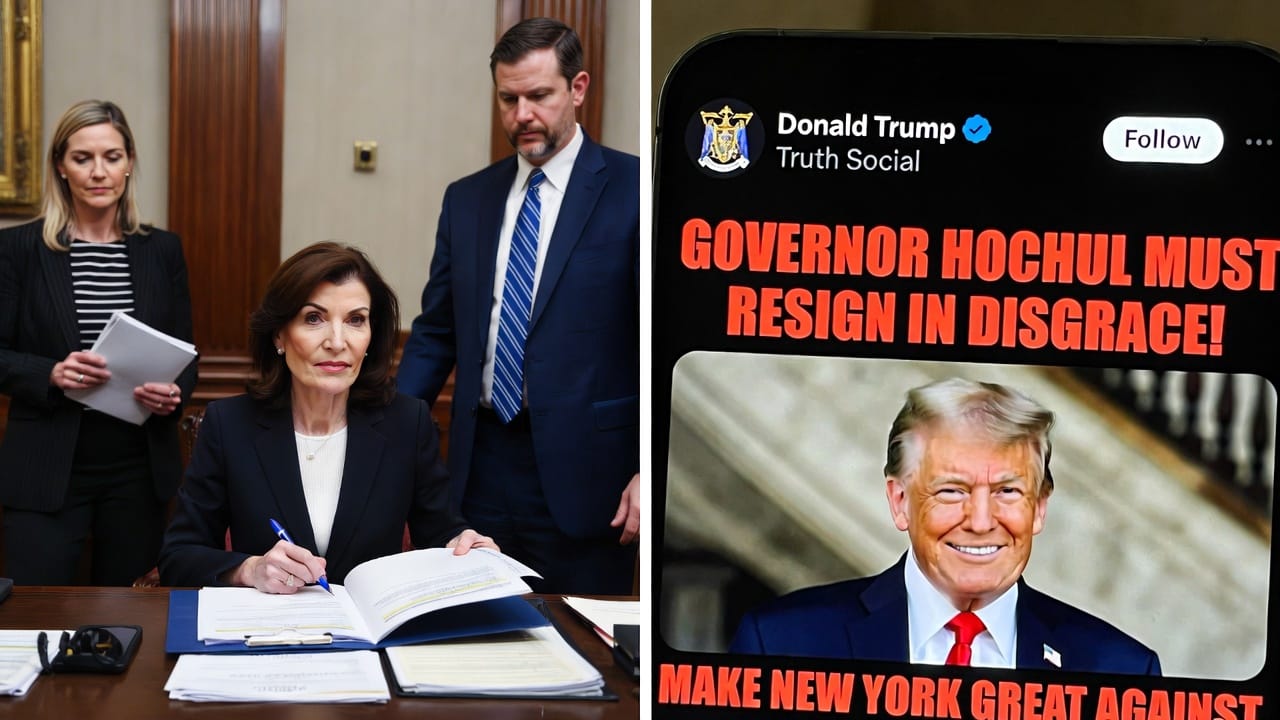
Trump raged on Truth Social on April 16 because he sees the pattern from the other side. Developers face higher costs, slower permits, and hostile rhetoric. Capital responds by going elsewhere. New York’s edge was always talent and deal flow. Taxes alone do not kill cities. Combined with crime, disorder, and poor services, they accelerate decline.
Mamdani closed his video with confidence. The unfair system ends today. History suggests it simply shifts. The rich adjust. The city adapts with new rules. Working New Yorkers still wait for the cleaner streets and safer blocks that were promised.
The real test comes in twelve months. Did the $500 million close part of the gap without new shortfalls? Did services improve measurably? Or did the machine simply absorb the cash and ask for more next cycle?
Track the numbers. Ignore the soundtrack. Follow who benefits when the government treats private wealth as the solution to public failure. That is where the story really sits.
This piece relies solely on public records: NYC Mayor’s Office announcement April 15, 2026, Governor Hochul’s statement same date, Comptroller reports on the $5.4B gap, historical legislative records from 2014 and 2019 proposals, REBNY and independent appraiser estimates, and Trump’s Truth Social post April 16, 2026. No anonymous sources. No partisan funding. Full transparency on every dollar figure and date.