NYC's First Muslim Mayor Just Used the Prophet Muhammad to Justify Sanctuary Law

Let's Talk About What He Left Out.
Zohran Mamdani stood before 400 faith leaders, quoted the Quran, and told America to take notes from a 7th-century warlord. The media largely cheered. Here's the full story.
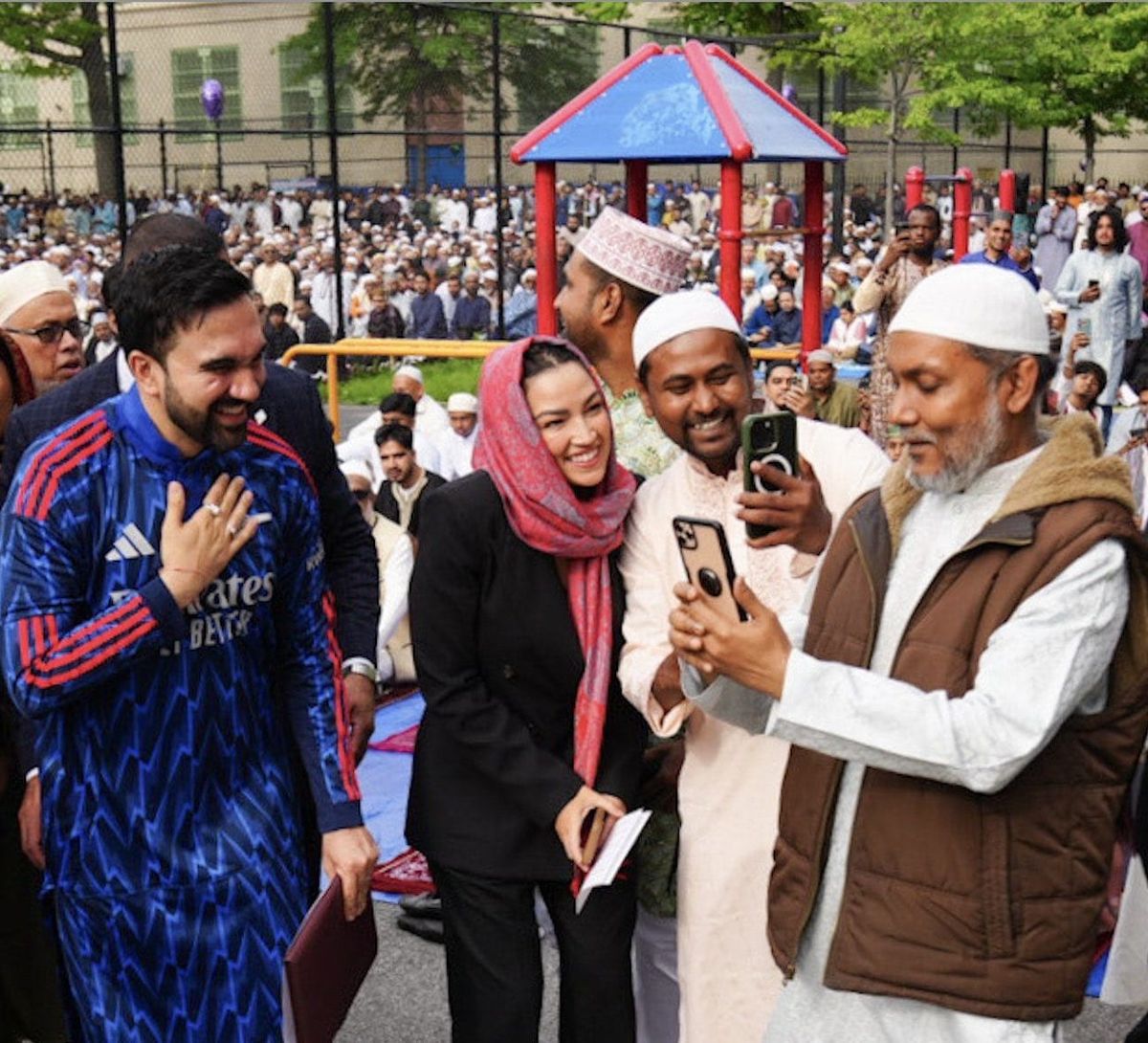
On the morning of February 6, 2026, New York City Mayor Zohran Mamdani walked into the city's annual Interfaith Breakfast, stood before roughly 400 religious leaders, and did something no American mayor had done quite so nakedly before. He didn't just invoke his personal faith. He used it as a policy engine, publicly citing the Prophet Muhammad's migration story as a governing framework for a sanctuary city executive order he was about to sign.
"I consider my own faith, Islam, a religion built upon a narrative of migration," Mamdani told the assembled crowd. He quoted the Quran, Sura An-Nahl 16:42, on behalf of those who "emigrated in the cause of Allah after being persecuted". Then he walked to a desk and signed an executive order erecting new barriers between city agencies and federal immigration enforcement. The whole performance was tight, deliberate, and theologically loaded.
The press called it stirring. Few asked the obvious follow-up question.
BREAKING: Zohran Mamdani says America should follow the example of Islam and “Prophet Muhammad” on migration.
— Dr. Maalouf (@realMaalouf) February 6, 2026
Fun fact: after conquering Mecca, Muhammad deported the non-Muslims and banned them from entering the city ever again.
pic.twitter.com/NyTKAU6AB4
The Hijra He Described
The Hijrah, the Arabic word for migration, refers specifically to Muhammad's journey from Mecca to Medina in 622 CE. Mamdani framed it as a refugee story: "Prophet Muhammad was a stranger too, who fled Mecca and was welcomed in Medina." It's a real piece of Islamic history. Muhammad and his early followers faced genuine persecution in Mecca. The migration was real. The welcome in Medina was real.
What Mamdani described is accurate as far as it goes. The Hijrah is the foundation of the Islamic lunar calendar. It represents, as Islamic scholars describe it, "a carefully planned migration" and "a new way of life" organized around a brotherhood of believers rather than blood kinship. By that telling, it's a story of community, refuge, and moral solidarity. A fine interfaith talking point.
But a mayor governing 8 million people who invokes a 1,400-year-old religious narrative as the basis for defying federal immigration law owes his constituents more than the highlight reel.
Zohran Mamdani asistió a las oraciones del viernes en una mezquita donde el imán oró por la muerte de todos los infieles.
— Isaac (@isaacrrr7) June 2, 2026
Esto no recibió la suficiente atención.pic.twitter.com/pc63PPWKTP
What Comes After the Welcome
Here is the part that didn't make the interfaith breakfast program.
and Within a decade of the migration, Muhammad led or authorized somewhere between 27 and 29 military campaigns, what Islamic historians call "ghazawat." The Banu Qaynuqa, the Banu Nadir, and the Banu Qurayza, three Jewish tribes in and around Medina, were successively expelled or destroyed in the years following the Hijrah. The Banu Qurayza episode, dated to around 627 CE, ended with the execution of hundreds of the tribe's men, a fact recorded in classical Islamic sources including Ibn Ishaq's "Sirat Rasul Allah," one of the earliest biographical accounts of Muhammad.
By 629 CE, just seven years after the initial flight from Mecca, Muhammad returned not as a refugee but as a conqueror, taking the city with an army of 10,000. Islamic historians themselves describe this as a "conquest." That is not a smear. It is the source material.
None of this appeared in Mamdani's speech.
Zohran and his Hamasniks are ok with the 50+ Muslim majority and never dare to speak against them.
— Gene Mikhov (@genegmb) June 8, 2026
His only issue is the sole Jewish one.
pic.twitter.com/Gm8oROtVPj
The Executive Order Behind the Sermon
Let's talk about what the religious theater was actually selling.
The executive order Mamdani signed that morning placed new constraints on city agencies cooperating with Immigration and Customs Enforcement. This is the core of the sanctuary city framework: a legal wall between local government and federal immigration law, forcing the Trump administration, which has made deportation a centerpiece of policy, to operate in New York largely without city cooperation.
That is a legitimate policy debate. Serious people disagree about sanctuary laws. There are real civil liberties concerns. There are also real public safety arguments on the other side, and real federal authority questions that courts continue to hash out. Mamdani is entitled to his position.
What he is not entitled to do, without scrutiny, is use the pulpit of the mayoralty to wrap a contested policy in theological bulletproofing. When a government official says, in effect, "my religion commands this policy," he has made that religion's full historical record fair game. And the full record of the Hijrah and what followed it is considerably more complicated than a parable about welcoming strangers.
The Bigger Pattern
This is not about Mamdani's personal faith. A man's religion is his own business. The problem is when faith becomes a trump card in civic debate, when invoking the Prophet short-circuits scrutiny and turns policy disagreement into a form of blasphemy.
The media's response to the interfaith breakfast speech was largely celebratory. Stories noted that Mamdani had quoted the Quran in defense of immigrants. The framing was warm, pluralistic, and multicultural. Missing was any of the basic journalistic reflex that applies, say, when a Christian politician invokes the Bible to justify a policy. When that happens, reporters ask: which parts of the Bible? The whole thing, or just the parts that support your agenda?
New York City currently houses an estimated 400,000 to 500,000 undocumented immigrants, one of the largest such populations in the United States. The sanctuary order has real financial and law enforcement consequences. The city is already in a fiscal crunch. These are serious stakes dressed up in Quranic verse at a faith breakfast while the cameras rolled.
New Yorkers are worried their city is lost to ISLAM with Mayor Mamdani allowing and Promoting the Muslim public prayer to the city's Prospect Park. We don’t need or want an Islamic Takeover!
— Johnny Midnight ⚡️ (@its_The_Dr) March 20, 2026
Islam is not compatible with America, and Zohran Mamdani should be deported. pic.twitter.com/gYDpOfZqzv
Who Benefits
Mamdani benefits. He locked in his progressive and Muslim-American base with a single dramatic gesture. He positioned himself as both a civil liberties warrior and a man of faith, two identities that are very useful in New York City Democratic politics heading into any future electoral cycle.
The 400 faith leaders in the room benefited. They got to be part of a historic moment, the first Muslim mayor of America's largest city invoking scripture in defense of the vulnerable.
Federal immigration enforcement agencies, the Trump administration, and the roughly half of New York City residents who have consistently told pollsters they have concerns about sanctuary policies, got a sermon.
The undocumented immigrants caught in this policy fight benefit in the short term from the executive order's protections. Whether the order survives federal legal challenge is another question Mamdani did not raise at the breakfast table.
Muslim Brotherhood event, USA 2025:
— Mor Edge Insight (@MorEdge_Insight) June 8, 2026
“We may end up with about 50 members of Congress in the next six years…
The essence of dismantling the system of injustice is to replace it with the people who represent the Prophet ﷺ.”
Tlaib and Omar in congress. Another one joining soon… pic.twitter.com/lK5a59fUxD
Accountability Questions Nobody Asked
Was it appropriate for an American mayor to use a religious text as the explicit justification for a government executive order? Did any of the 400 faith leaders in that room ask what the complete Hijrah story, including the military campaigns that followed, should tell us about migration policy? Has any New York City reporter pressed Mamdani on the distinction between a personal faith commitment and governing policy derived from religious doctrine?
The answer to all three is: not on the record, not in any reportable way, and no.
That should bother you regardless of where you stand on sanctuary cities.
If this kind of accountability journalism matters to you, share it with someone who won't. Subscribe for weekly deep dives on the stories that get cleaned up before they reach your feed.
One email, no algorithms, no PR varnish. Hit the button below.