The Hijacked Nursery: How Terrorist Media Weaponized Childhood Innocence
The shocking story of how "Tomorrow's Pioneers" hijacked childhood innocence using beloved mascots to teach hatred and martyrdom. We investigate the systematic psychological abuse and its long-term consequences.

“Give me four years to teach the children and the seed I have sown will never be uprooted.” — Vladimir Lenin (1923)
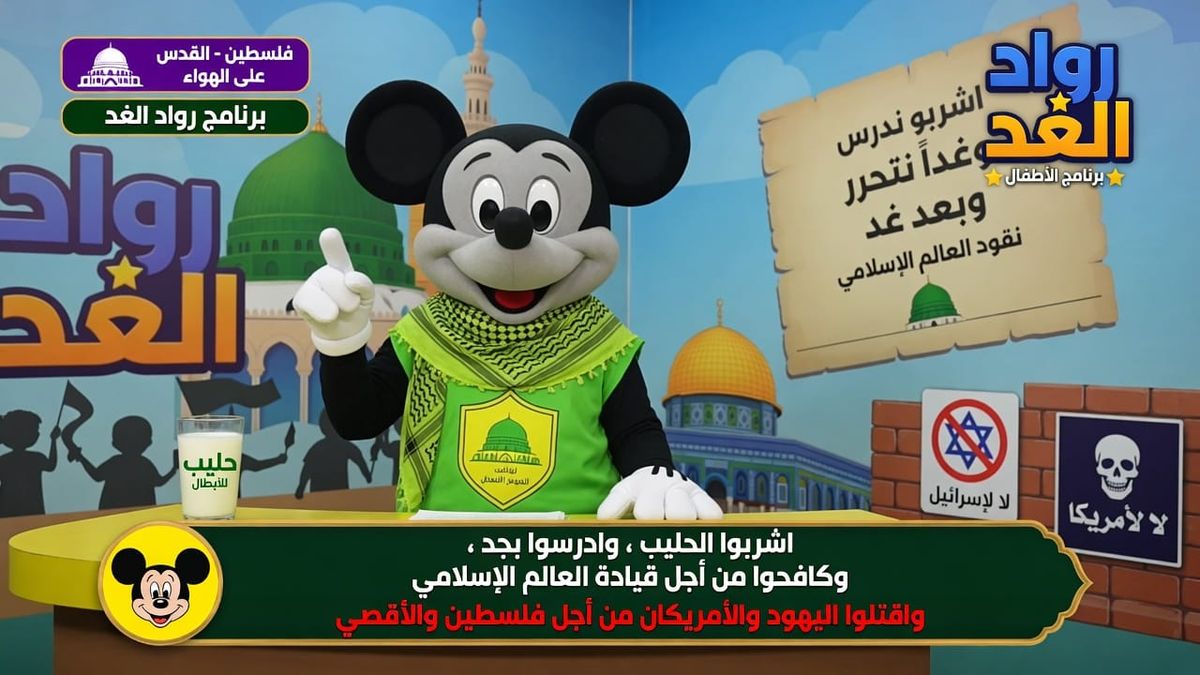
When parents place a toddler in front of a screen, they assume a tacit social contract: that the animated icons beaming into their living rooms represent safety, wonder, and moral clarity. For generations, globally recognized characters have served as universal babysitters, gentle guides teaching the alphabet, social cohesion, and empathy. But between 2007 and 2009, an unprecedented psychological experiment unfolded on television screens across the Gaza Strip, systematically shattering that contract. Broadcast by Al-Aqsa TV, the Hamas-affiliated children’s television program Tomorrow’s Pioneers (Ruwād al-Ghad) did not merely misuse familiar pop-culture imagery; it executed a deliberate, institutionalized campaign to hijack early childhood development and re-engineer young minds into instruments of violent warfare.
Farfour the mouse has gone viral again recently.
— John Aziz (@aziz0nomics) August 15, 2025
Hamas in 2007-2009 tried to make a kids' TV show called "Tomorrow's Pioneers", but ended up making jihadist propaganda aimed at children, teaching children to wage jihad against Israel.
That's how we got to where we are today. pic.twitter.com/WRz3E2OoX2
By cloaking violent martyrdom in the cheerful tropes of Saturday morning television, the show's producers exploited the natural trust of elementary-school audiences. Our investigative team conducted a deep dive into historical archives, broadcast transcripts compiled by media monitoring groups, and academic literature on youth radicalization to dissect how an administrative state apparatus turned children's television into a recruitment pipeline.
The Mouse That Preached Martyrdom
At first glance, Tomorrow’s Pioneers mimicked the production aesthetics of beloved educational franchises like Sesame Street or Mister Rogers' Neighborhood. The set featured vibrant, primary-colored backdrops, lively sing-alongs, and direct call-in segments where young children recited poetry. The show was anchored by an 11-year-old girl named Saraa Barhoum and co-hosted by Farfour, an unlicensed, oversized costumed mouse whose iconic round ears, white gloves, and high-pitched vocal cadence were unmistakable facsimiles of Mickey Mouse.
Yet, instead of teaching basic literacy or kindness, Farfour used his familiar appearance to deliver explicit extremist propaganda. In broadcast episodes archived by the Middle East Media Research Institute (MEMRI), Farfour was seen simulating the firing of AK-47 assault rifles, throwing crude grenades, and lecturing young callers on global Islamic domination. The character urged children to dedicate their lives to armed struggle, preaching that ultimate glory lay in violent martyrdom.
When the international community and copyright owners leveled fierce criticism—leading Walt Disney Company CEO Robert Iger to state that the company was "appalled by the use of our character to disseminate that kind of message"—the network responded not by reforming the content, but by weaponizing the character's death. In the June 2007 season finale, Farfour was written out of the show in a graphic sequence where an actor playing an oppressive foreign agent beat the mouse to death on screen. Saraa informed her young audience that Farfour had died a "martyr" defending his land, using child grief to reinforce violent ideology.
"Tomorrow's Pioneers" on Hamas TV brainwashes kids to murder Jews, glorify martyrdom, and push Islamic supremacy.
— Yossi BenYakar (@YossiBenYakar) May 26, 2025
But wait, there’s more: another "educational" Palestinian show, "The Pioneers of Tomorrow," teaches toddlers to kill. Yes, toddlers.
Israel has been fighting… pic.twitter.com/se7gVOG0dw
The Recyclable Mascots of Extremism
The murder of Farfour was not an ending; it was the opening movement of a recurring strategy. Over the next two years, director Hazim Al-Sha'arawi and Al-Aqsa TV executives systematically replaced the fallen mouse with a succession of equally recognizable animal mascots. Farfour was succeeded by his "cousin" Nahoul, a high-pitched, oversized bumblebee. Nahoul explicitly told child viewers to assault enemies, declaring in subsequent airings that young viewers should stone adversaries until their faces "turn red as a tomato".
When Nahoul was written off as dying from a lack of medical access, he was replaced by Assoud, a rabbit character bearing a striking resemblance to Bugs Bunny. Assoud declared his intention to "eat" political adversaries and vowed to liberate Jerusalem before he, too, was killed off in a hospital scene, leaving Saraa to mourn yet another martyr on air. The cycle continued with Nassur, a predatory bear character who exhorted children to join armed wings.
This strategic rotation served a precise psychological purpose. As terrorism scholar Dr. Mia Bloom of Georgia State University documents in her study Small Arms: Children and Terrorism, terrorist organizations utilize familiar, friendly avatars because children absorb messaging without cognitive resistance. "For terrorist organizations, the recruitment of children is an investment in the future generation—a transgenerational 'long game' designed to ensure survival through deep psychological indoctrination," Dr. Bloom notes regarding youth exploitation strategies. By normalizing violent death across multiple mascots, the producers desensitized impressionable viewers to mortality itself.
The Psychological Toll on a Generation
The consequences of this systematic indoctrination extended far beyond the studio walls. The show's child host, Saraa Barhoum, was herself both an instrument and a victim of this propaganda apparatus. In contemporary media interviews, the young girl reflected a deeply fragmented identity, stating that she aspired to become either a physician or a martyr—equating professional healing with violent death.
Psychological researchers studying child recruitment emphasize that when authority figures collapse the distinction between normal developmental aspirations and suicidal violence, the child’s moral framework is fundamentally altered. The show explicitly targeted toddlers during their most formative developmental window—the period when basic empathy, trust, and conflict-resolution skills are hardwired into the brain. By embedding militarism into daily children's programming, Al-Aqsa TV laid the psychological groundwork for future generations of combatants.
A 9yo child calls the show and reads a prophecy about the extermination of Jews.
— Ridvan Aydemir | Apostate Prophet (@ApostateProphet) November 18, 2023
This is a 2007 scene from Tomorrow's Pioneers, a Hamas-run kid's show broadcast in Gaza and the West Bank. pic.twitter.com/ZRFlB2EXQw
Vigilance Against the Exploitation of Youth
The legacy of Tomorrow’s Pioneers remains one of the most chilling examples of media-driven child abuse in modern history. It demonstrates how readily extremist organizations can subvert popular culture, educational formats, and early-childhood trust to serve ideological ends.
As digital distribution channels proliferate globally, the techniques pioneered on television in Gaza have migrated to social media platforms, encrypted chat rooms, and online gaming spaces. Protecting childhood innocence requires unyielding institutional vigilance, rigorous media monitoring, and an uncompromised commitment to holding media operators accountable. When adults weaponize the nursery, the international community cannot afford to look away—because a society that teaches its children how to die forfeits its own future.
📬 Share, Comment, and Support Our Work
Share this. Restack it. Forward the email. That's the whole ask.
Support the work. The reporting linked above took weeks of tracing records, filings, and on-the-record statements. It doesn't happen on faith. If you find it useful, become a paid subscriber and help fund the next one.