The Audacity Caucus: Mamdani Assembles a Cabinet of the Radical, the Failed, and the Openly Anti-Cop

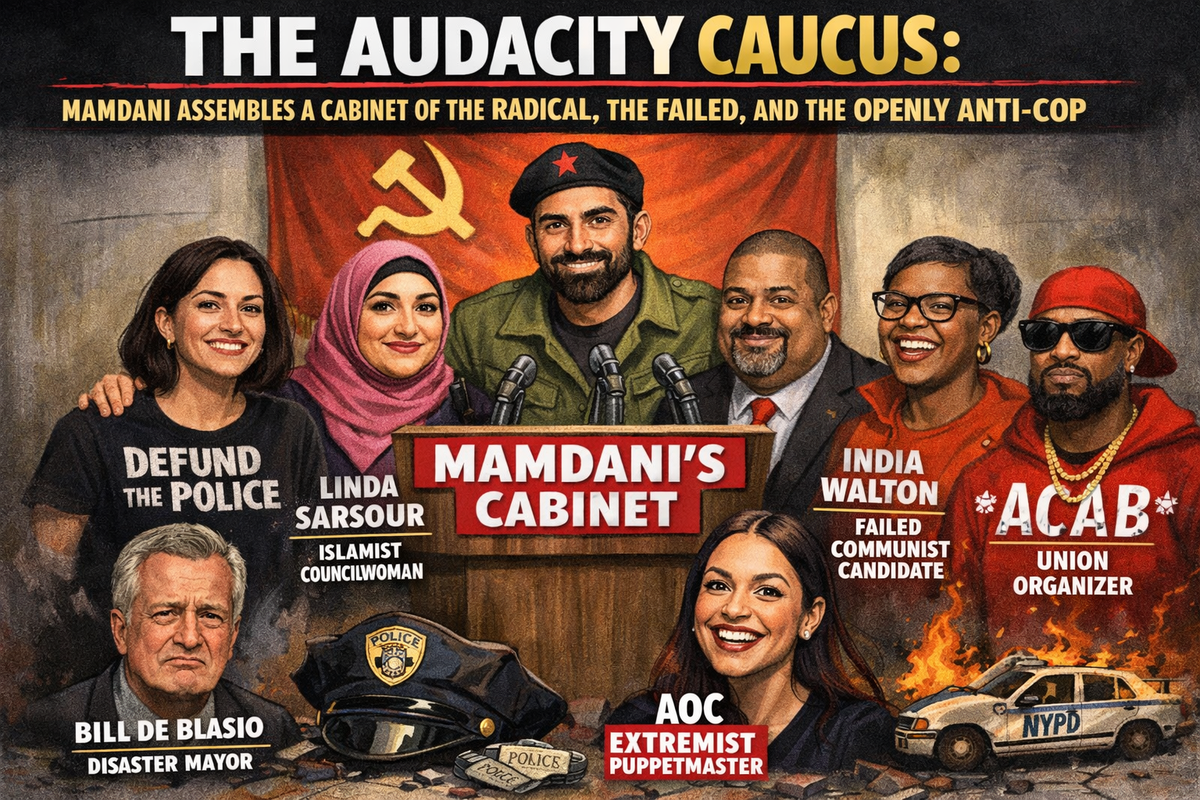
A democratic socialist mayor-elect doesn't just pick controversial advisers—he collects them like a conspiracy theorist collects evidence
"The revolutionary vanguard is distinguished by its complete immunity to irony." — Christopher Hitchenswho
Let's establish what we're looking at here: Zohran Mamdani, the democratic socialist about to become mayor of New York City, has appointed a man convicted of armed robbery to advise him on criminal justice policy. Not as a cautionary tale. Not as an exhibit in a museum of bad judgment. But as an actual adviser to the 20-member "Committee on the Criminal Legal System."
This is not a metaphor. This is not performance art. This is a man named Mysonne Linen, 49 years old, who spent seven years in state prison for robbing cab drivers at gunpoint, being handed genuine influence over how the largest police department in America operates.
The audacity isn't accidental. It's the entire point.

The future of New York's criminal justice system, apparently, lies in the hands of someone who once believed armed robbery was an acceptable career path.
The Promising Young Felon
Here's how the story goes, at least the version Linen now sells: he was a promising rapper with a Def Jam Records deal pending when, in 1999, he and his crew decided that robbing taxi drivers was a reasonable business model. Specifically, they robbed two cab drivers—Joseph Eziri on June 8, 1997, and Francisco Monsanto on March 31, 1998—at gunpoint. The Bronx prosecutors didn't view this as a youthful indiscretion. They handed him a sentence of seven to 14 years.
He served seven of them. Released on parole in July 2006, Linen spent the next two decades doing what felons do when they need to rebrand themselves: he became an activist. Violence interrupter. Founded Rising Kings, a nonprofit that teaches inmates at Rikers. Partnered with anti-Israel activist Linda Sarsour to create "Until Freedom," a social justice organization. Very inspiring. Very redemptive. Very convenient.
In other words, Mysonne Linen took his criminal past and converted it into cultural capital—the kind of credential that makes you valuable in certain progressive circles, particularly those circles that view the criminal justice system as the enemy and criminals themselves as merely its victims.
No genuine remorse, no accountability to the cab drivers he robbed, no recognition that maybe—just maybe—there's something obscene about using your prison time as a launching pad for influence over police policy—nothing.

credentials
The Entire Rogues' Gallery
But Linen isn't an outlier here. He's the emblematic choice, the poster boy for what happens when you give a democratic socialist with genuine anti-police ideology the keys to the city.
Look at the broader pattern Mamdani assembled across his 17 transition committees with 400 staffers:
Professor Alex Vitale, now on Mamdani’s “community safety” transition team, makes light of the backlash over DEI and CRT in schools and the parental-rights fight with this suggestion:
— Stu Smith (@thestustustudio) November 25, 2025
“We should give teachers guns so parents quit harassing them about what books they assign.” pic.twitter.com/FB0MH3wMK1
Alex Vitale, a Brooklyn College sociology professor, heads the "Committee on Community Safety." His credentials? A 2017 book arguing that NYPD "broken windows" policing is inherently racist and systemically corrupt. In other words, a man whose entire intellectual project centers on the claim that aggressive policing is fundamentally illegitimate has been put in charge of advising on community safety. The irony is so thick you could cut it with a police baton—which, presumably, is exactly what Vitale would argue justifies his appointment.
Zakiyah Shaakir-Ansari, a "far-left activist" and co-director of the Alliance for Quality Education, serves on the "Committee on Youth & Education." Her distinction? She's praised Assata Shakur—the escaped convict now living in Cuba who murdered New Jersey state trooper Werner Foerster and was granted asylum. Teaching the next generation of New York children under the tutelage of someone who lionizes cop-killers. No child safety, no educational standards, no consideration that maybe—just maybe—there's a problem with this—nothing.
Zohran Mamdani sparks outrage by tapping radical who praised notorious cop-killer Assata Shakur for education transition team https://t.co/NTmTfzBgLS pic.twitter.com/e2GJcnEqp3
— New York Post (@nypost) December 6, 2025
Ben Furnas, described as the "car-hating head of Transportation Alternatives," chairs the "Committee on Transportation, Climate, & Infrastructure." His agenda includes proposals to essentially shut down automobile traffic through the city with what can only be described as hostage-taking masquerading as climate policy. The head of an organization dedicated to making life measurably worse for working-class New Yorkers who depend on cars to move goods, get to work, and survive in a city that's already financially hostile to the non-wealthy, now advises on infrastructure. Brilliant.

The architects of a "different" New York—different from what residents actually wanted, that is.
The Failed Bureaucrat and the DSA Inner Circle
Then there's Susan Herman, the director of Bill de Blasio's catastrophically failed $1 billion ThriveNYC initiative—a program that promised to help homeless and mentally ill New Yorkers and delivered little more than a taxpayer fleecing. She's now on the "Committee on Community Safety." In other words, a woman with a documented track record of managing a billion-dollar program into irrelevance has been tasked with advising on safety in a city currently experiencing a homelessness crisis. No competence, no accountability, no apparent awareness of what "failure" means in terms of disqualification—nothing.
NYC-Democratic Socialists of America (DSA) co-chair Gustavo Gordillo was credited with helping Mamdani win his primary... so what's he like?
— Canary Mission (@canarymission) October 6, 2025
Like most of the DSA - he HATES Israel, LOVES Hamas and HATES America most of all! It's weird Mamdani can't find one person not brimming… pic.twitter.com/jxeiSbLayY
And then there's the DSA inner circle itself: Gustavo Gordillo and Grace Mausser, co-chairs of the New York City Democratic Socialists of America, named to economic development and small business committees respectively. These aren't appointments to controversial committees. These are appointments of party loyalists to positions where they can funnel resources, contracts, and opportunities to the ideological faithful. It's not corruption in the traditional sense—it's worse. It's principled corruption, the kind that comes wrapped in the language of "system transformation" and "radical democracy."
The Law Enforcement Revolt (Such As It Is)
Naturally, the actual professionals tasked with enforcing law in this city are apoplectic—though in the polite, bureaucratic way of career law enforcement officials who know better than to sound too alarmed.
Benny Boscio, president of the Correction Officers' Benevolent Association, offered what amounts to a professional death notice: "It is both disheartening and deeply disturbing that individuals who are convicted felons and have a history of breaking the law are being given the opportunity to help shape the future of New York's criminal justice system." Translation: you've appointed a criminal to advise on crime policy, and we, the people who actually work in prisons, think this is insane.
John Chell, recently retired Chief of Department of the NYPD, was blunter: "It's just another appointed adviser that has a questionable past, which is in line with some of his other recent appointees who were anti-police and establishment." And then the kicker: "The optics and reality here point to a potential erosion of public safety in New York City."
Translation: we're watching a man with a documented ideological hostility toward policing assemble an advisory team that shares that hostility, and we're terrified of what happens when these people actually get control of policy.
The Larger Implication
What Mamdani is telling us—not through his words but through his appointments—is that he views traditional law enforcement as an enemy force. He views the people who work in criminal justice as obstacles to transformation rather than partners in it. He's explicitly excluding them from his advisory process, which means he's explicitly announcing that his approach to criminal justice will not account for the perspectives of the people who actually implement criminal justice policy.
This is governance as revolutionary theater. It's the aesthetics of radical change without the apparatus to actually manage a city of 8 million people. It's appointing Mysonne Linen to advise on crime while crime is actually happening, while actual New Yorkers are actually experiencing actual danger, while the police are actually trying—however imperfectly—to keep the city functioning.
The Jews Fight Back organization's response—"Insane. New York City is being handed over to radicals, extremists and outright terrorists"—is hyperbolic. It's also not entirely wrong. What's being handed over isn't the city itself, but the rhetorical and policy apparatus of how we think about crime, safety, and justice. And it's being handed to people whose track records suggest they're profoundly uninterested in the actual, lived experiences of the people those policies will affect.
No accountability, no humility, no recognition of what it means to govern—nothing.
🚨 Mamdani Transition Team Member: “Defund” Is Losing the Narrative War
— Stu Smith (@thestustustudio) December 19, 2025
Zohran Mamdani transition team member and CUNY professor Lumumba Bandele just said the quiet part out loud on a recent podcast: the movement that pushed “defund the police” has spent the last five years… pic.twitter.com/mxGS93Hs67
The Waiting Game
Linen and representatives for Mamdani did not respond to requests for comment. Which tells you everything you need to know about how confident they are in defending these choices. When your appointments can't be justified through argument or evidence, silence becomes the default position.
The city watches. The police watch. The cab drivers—the ones Linen robbed, the ones whose profession he assaulted—presumably watch with a particular mixture of resignation and dread.
New York is about to find out what happens when you elect a mayor whose advisory team includes a man convicted of robbing cab drivers and you put him in charge of criminal justice policy. The answer, based on the evidence assembled here, is probably not going to be reassuring.