The eight percent who decided what New York believes
A DSA sweep built on single-digit turnout is being read as a mandate. It is actually a measure of how little organized resistance New York's largest constituencies, especially its Jewish community, put up.

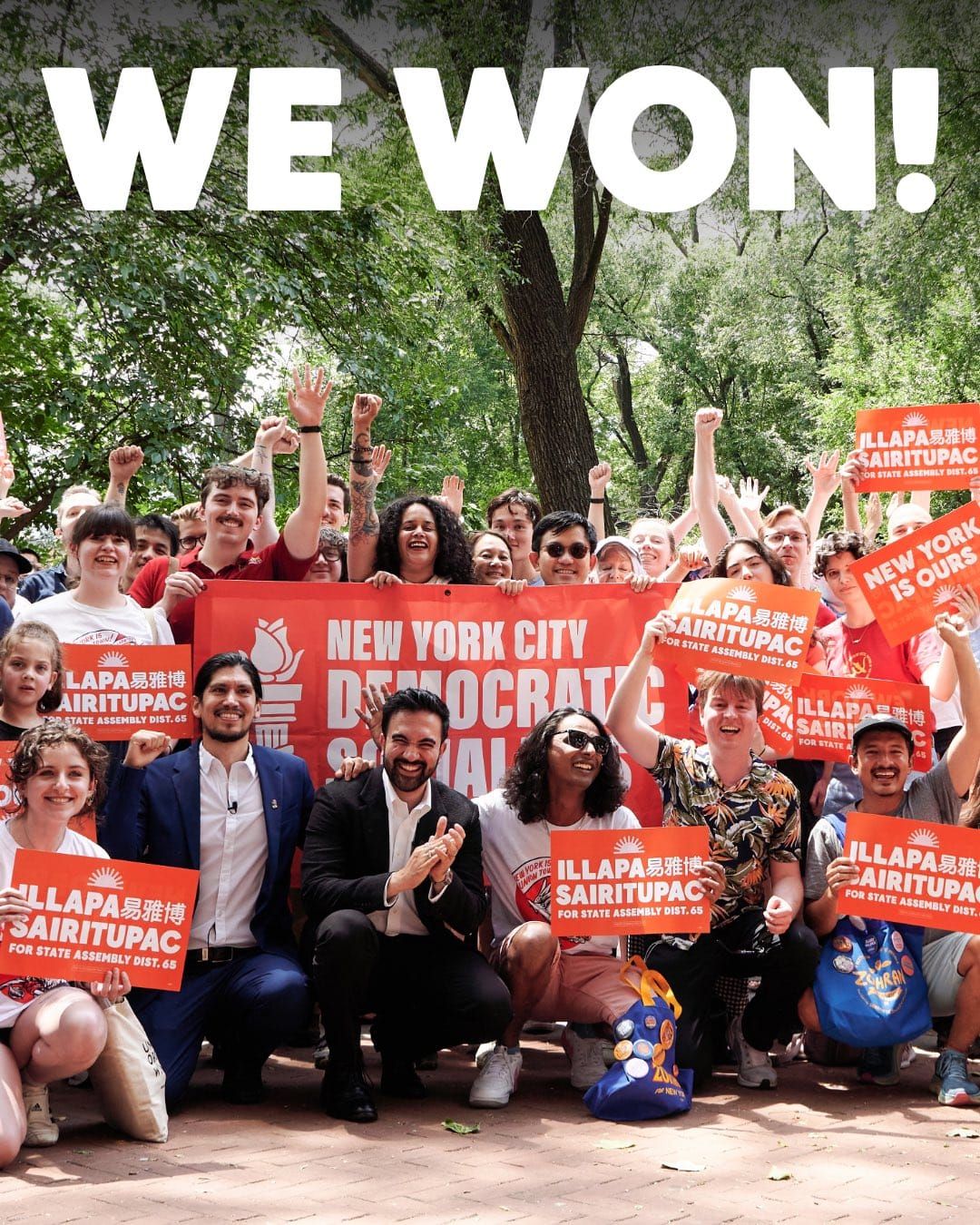
A DSA sweep built on a turnout most New Yorkers didn't show up for is not a mandate. It is a test of whether anyone still believes a city's identity is worth defending.
Roughly eight percent of the registered residents of New York's 13th congressional district turned out to hand Darializa Avila Chevalier a commanding win over a sitting congressman, Adriano Espaillat. Across the city's other contested races, the numbers were not much better. Claire Valdez. Aber Kawas. A slate of Democratic Socialists, installed by a sliver of the electorate, now stands positioned to define what New York is for a generation.
They are celebrating the Democratic primary victories of a Palestinian Muslim candidate who said America deserved 9/11, and a Haitian convert to Islam who led a group aiming to ‘eradicate America’… in New York.
— Dr. Maalouf (@realMaalouf) June 24, 2026
What the hell is wrong with them? pic.twitter.com/5DEgVJjRoE
This is not a story about a movement winning the city. It is a story about a city that stopped showing up to defend itself, and what fills a vacuum like that.
It would be comforting to call this an aberration, a low-turnout fluke produced by uninspiring opponents and a primary calendar nobody pays attention to. Some of that is true. But the comfort in that explanation is doing real work to obscure something worse: the eight percent who voted were not a fluke. They were the only ones who understood that the election was actually about something. Everyone else assumed the city would simply continue being New York no matter who ran it, the way a person assumes the ground will hold no matter how hard they jump. That assumption is the actual subject of this piece, because it is no longer true, and the people who exploited its falseness understood that before anyone else did.
What the slogan actually says
Chevalier reportedly wiped her hand on an American flag because she forgot napkins. Treat that detail the way you would treat a Soviet joke: not as an isolated gaffe but as a tell, a piece of code that signals which audience the speaker is performing for. The flag is not incidental to American civic identity. It is one of the only remaining objects that the overwhelming majority of Americans, across every line of race, class, and religion, still agree means something. Treating it as a napkin is not edgy. It is a loyalty test administered to your own base, and the people who pass it understand exactly what they are saying: the old civic religion is dead, and we are not interested in resurrecting it.
This matters specifically and acutely for Jews, because the American civic religion, imperfect and unevenly applied as it has always been, is the only system under which a Jewish community in diaspora has ever flourished at the scale New York's has. Pluralism, equal citizenship, a state that does not ask you to subordinate your identity to a single approved narrative: this is not abstract civics.
This is the operating system that made it possible for the largest Jewish community outside Israel to exist in relative safety and to build, in this city specifically, an entire civilization of institutions: synagogues, schools, hospitals, publishing houses, a press. When a winning electoral coalition treats the symbols of that operating system with contempt, the contempt does not stay contained to the symbol.
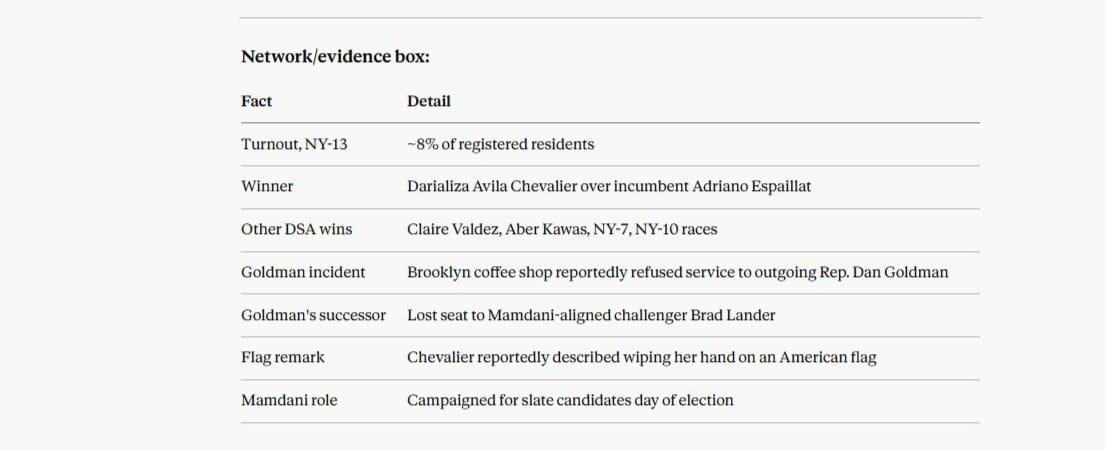
A Brooklyn coffee shop reportedly refused service to Dan Goldman, the sitting congressman who lost his seat to a Mamdani-aligned challenger, apparently because he is Jewish and supports Israel. Set aside, for a moment, whether this was illegal. Ask instead what kind of civic atmosphere makes a business owner feel safe doing it openly. That atmosphere does not appear by accident. It is cultivated, deliberately, by years of rhetoric that recasts ordinary Jewish political participation, supporting the existence of a Jewish state, as a form of moral contamination requiring social quarantine. The candidates who won this week did not invent that rhetoric. They are its current electoral expression.
The community that forgot how to organize
Here is the harder thing to say, and the more necessary one. The Jewish community of New York, the largest in the nation, behaved this week the way it has behaved for years: as though political influence were a birthright rather than a muscle that atrophies without use. It assumed the Democratic Party would remain, at minimum, neutral, the way it assumed the ground would hold. It did not organize a turnout operation to match the one that just reshaped the City Council and is now reshaping Congress. It did not, in any serious way, contest these primaries on the ground, precinct by precinct, the unglamorous work that actually produces eight percent turning into eighteen percent.
New York just keeps getting better and better! Congratulations to all the new Jihadists in government! pic.twitter.com/LI99gOG1SF
— Lyle Culpepper (@ShutupLyle) June 24, 2026
This is not a call to assimilate into a political party that has shown, repeatedly, where its sympathies lie. It is a call to recognize that political power in a democracy is not granted in exchange for institutional prestige or historical suffering. It is built, year over year, block by block, the way every other constituency that wants power in this city has had to build it.
The DSA slate did not win because New York secretly agrees with them. It won because it organized a small, committed electorate while everyone who might have opposed it assumed someone else would handle it.
💥Stephen A. Smith on Zohran Mamdani🇺🇸
— Jason Cohen 🇺🇸 (@JasonJournoDC) June 24, 2026
"If the Democratic Party becomes HIM, you have no chance ... on a national basis in terms of the presidency, in Senate seats, seats in the House — you have NO chance."
"You might have a Democratic Socialist sprinkled here and there — but…
No one else handled it. The Republicans did not produce candidates capable of giving shape to the frustration that clearly exists among Hispanic families uneasy with the new vocabulary of gender, Black New Yorkers exhausted by a politics that insists on their permanent victimhood, immigrant landlords squeezed by rent policy dressed up as justice. That frustration is real and it is large, and right now it has no organized home in this city.
A civilization does not fall because a hostile minority seizes it. It falls because a complacent majority declines, generation after generation, to notice that seizure requires only the absence of resistance.