The Montreal Ambush: What the Manifesto Reveals About the Next Phase of Violence
If this reporting matters to you, share it with someone who needs to read it. Subscribe for follow-up coverage as investigators release more. Questions, tips, or corrections: reply directly to this post.
A cop is dead. A neighborhood is shaken. And a 100-page document is sitting in an evidence bag.
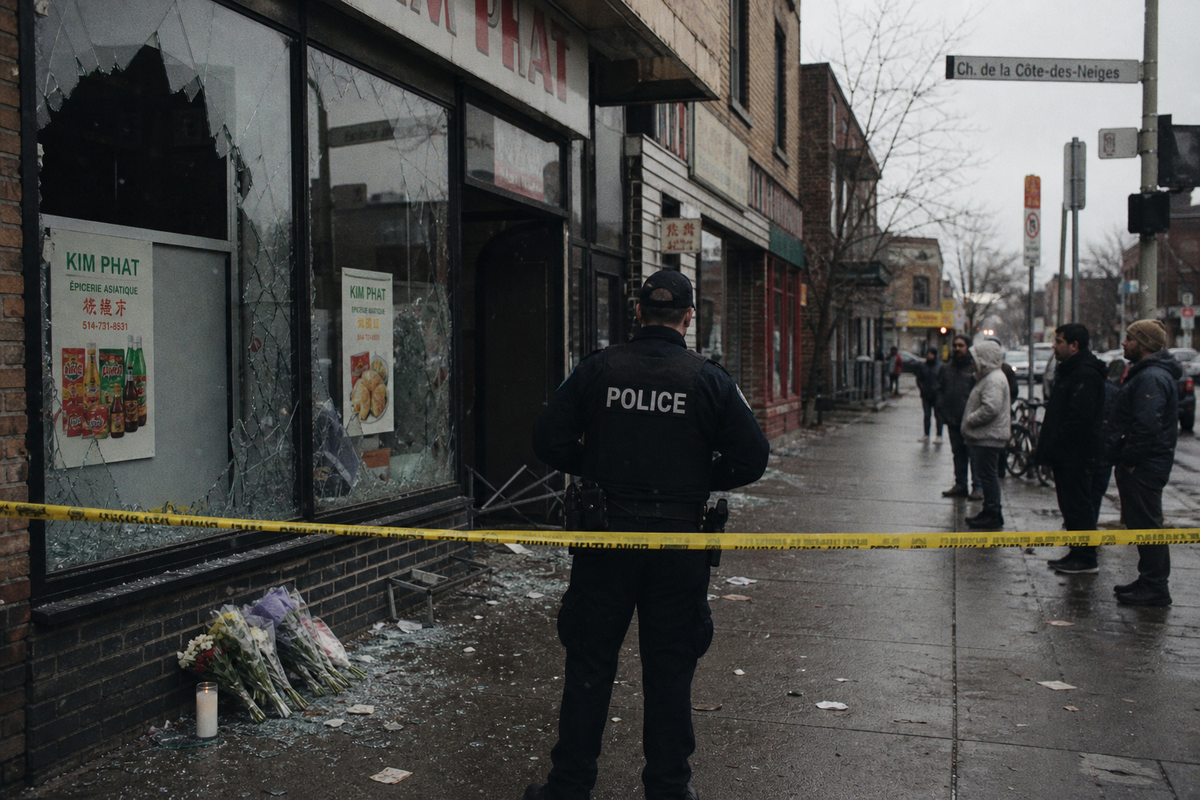
By Monday afternoon, Montreal Police Chief Fady Dagher was standing at a podium trying to explain something that had not happened in his city in 24 years. A uniformed officer, a woman, was dead. A civilian was dead. The suspect was dead. Residents of Côte-des-Neiges had spent three hours locked inside their apartments after a gunman in military camouflage appeared near a grocery store on de Courtrai Avenue and opened fire on the first two officers who arrived.
Thirty shots, witnesses said. The footage is not easy to watch.
🚨 HORROR FOOTAGE: TERROR IN MONTREAL - ARMED SUSPECT IN CAMO CLOTHING OPENS FIRE ON POLICE pic.twitter.com/OJYWY50547
— Breaking911 (@Breaking911) June 22, 2026
"It's a tragedy. It's a nightmare," Dagher said. He was not wrong. He was also not finished being tested, because the harder questions were already forming before the press conference ended.
What Investigators Found
The shooter is dead. That much is settled. What is not settled is why he did this, and what he was thinking in the weeks and months before he showed up dressed for combat in one of Montreal's most densely populated neighborhoods.
Canadian law enforcement sources told CNN that investigators recovered what they believe is a manifesto written by the gunman. It runs more than 100 pages. It espouses incel ideology.
One hundred pages. That is not a note. That is a project. Someone spent real time on it, organized thoughts into arguments, and arrived at conclusions that apparently ended with him ambushing police officers near a Chabad community center, a handful of kosher restaurants, and several Jewish day schools.
Quebec Public Security Minister Ian Lafrenière told reporters, "We don't really know what the motive of this individual was." That is the honest answer for hour three of an investigation. It becomes a different kind of answer if it is still the official position three weeks from now.
🇨🇦 Rabbi Michael Moshe Mizrahi killed in Montreal shooting
— Visegrád 24 (@visegrad24) June 22, 2026
A man killed in a shooting incident in Montreal today has been named as Rabbi Michael Moshe Mizrahi, a member of the local Chabad center.
Rabbi Mizrahi, a well-known member of Montreal’s Jewish community who regularly…
The Neighborhood Is Not a Footnote
Côte-des-Neiges is not just any Montreal borough. It is the most densely populated in the city and carries one of the largest Jewish populations in Canada. The shooting unfolded within walking distance of Jewish institutions that anchor the community's daily life.
Rabbi Motti Seligson told the Jewish Telegraphic Agency that local Chabad representatives did not believe the Jewish community was specifically targeted. Several residents sheltering in place said the same thing. That testimony matters and should be reported honestly. Community perception, though, is not the same as a completed forensic picture. Both things can be true at once: the neighborhood may not have been selected as a target, and the neighborhood still needs to be treated as a fact inside the investigation, not a sensitiviity to work around in press statements.
The last Montreal officer killed on duty was Benoît L'Ecuyer, 29, shot on February 28, 2002. Twenty-four years of institutional memory do not include this kind of event. That gap matters when you are trying to understand how a department, a city, and a province respond.
BREAKING: Dramatic footage from Montreal shows heavily armed officers searching for an armed suspect after shots were fired and at least 1 officer was injured.
— Yehuda Teitelbaum (@chalavyishmael) June 22, 2026
Residents near the Lubavitch community in Côte-des-Neiges have been ordered to shelter in place. pic.twitter.com/wMu9WF0Q37
What Hate Radicalization Does to a Society
The incel movement did not come from nowhere and it does not stay online. It starts as grievance, usually personal, usually involving rejection, and it finds communities that transform private pain into political theory. The theory goes like this: society is rigged, women are corrupt, men who fail in the sexual marketplace have been cheated, and the people enforcing the social order, including police, are the enemy. Elliot Rodger wrote 107 pages before the 2014 Isla Vista attack. Alek Minassian posted a tribute to Rodger before driving a van into pedestrians in Toronto in 2018.
These are not copycat crimes in the simple sense. They are acts carried out by men who located their private failure inside an ideological framework that told them violence was a rational response. The framework spreads because it is available, cheap, and emotionally satisfying to a certain kind of person in a certain kind of pain.
What this does to a society is not just the body count, though the body count is real and immediate and a Montreal family is tonight without a daughter and a colleague and an officer. What it does over time is corrode the shared assumption that public space is safe, that uniformed personnel are not targets, and that the stranger walking toward you is not running a calculation about whether you deserve to live. Those assumptions are what make a city function. They are fragile in ways that are easy to underestimate until they break.
There is a specific damage it does to Jewish communities, even when, as appears to be the case here, they were not the primary target. When violence happens in your neighborhood, near your schools and your synagogues, the geography becomes part of your nervous system. You start doing the math on where you park, which entrance you use, whether your kid's school has a buzzer. This is not paranoia. It is the rational adaptation of a community that has learned, across a very long history, that proximity to violence has consequences even when you were not the intended victim.
All jews around the world need to get their carrying license. This is a must. The same way you pray every day. Arming up and learning how to shoot is a must. pic.twitter.com/bFfTuxfEDu
— just me 🇺🇸 🇮🇱 (@PhuckYourVax) June 22, 2026
What Comes Next
The manifesto will be examined. Investigators will look at the shooter's online activity, his associations, the forums he frequented. They will try to determine whether he was known to any security service, whether any flag was ever raised and ignored, or whether he was simply invisible until he was not.
Chief Dagher and Minister Lafrenière owe the public a real accounting on those questions. Not today. Today they are managing a crime scene and a grieving department. But soon.
The officer who was killed has not yet been publicly named. When she is, her story will be told in the compressed, sorrowful language of official tribute. She will deserve more than that. So will the civilian who died beside her.
Montreal is a city that had not lost a cop in 24 years. It is trying, today, to understand how that changed in thirty shots on a Monday afternoon.
Sources: CNN, BBC, Times of Israel, Montreal Gazette, VINnews, Chabad.org, Lethbridge Herald, NY Post, June 22, 2026. Identities of officer, victim, and suspect unconfirmed at publication. Motive under active investigation
Our enemies want to destroy our civilisation and establish a communist society.
— Visegrád 24 (@visegrad24) June 21, 2026
To do that they are trying to dismantle the nation, family, private schools, religion… everything which creates the human conscience,
says Slovenian PM @JJansaSDS in a V24 interview. 🇸🇮 pic.twitter.com/mwQFl0XDDt