THE MYTH THAT BUILT A REGIME AND THE RECORD IT REQUIRES

All factual claims from Theroux have been cross-referenced, where possible, against the underlying primary sources he cites.based on Tablet Remembering a CIA Coup in Iran That Never Was
As Operation Epic Fury reshapes Iran, the Islamic Republic's foundational grievance narrative is being reactivated by outlets that have never examined its factual basis. This is what that examination shows.
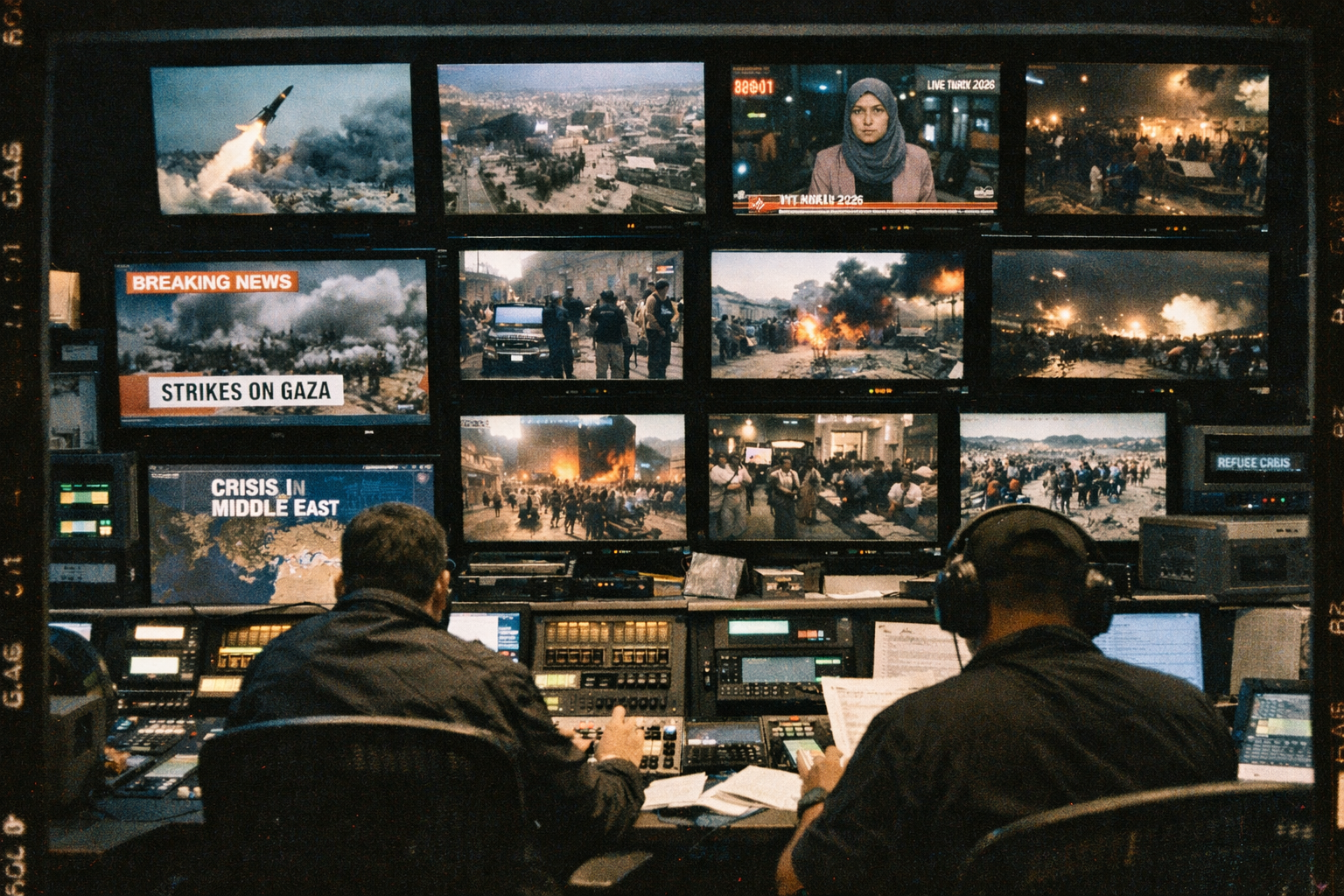
By Sunday morning, as Iranian state media was announcing 40 days of mourning for the martyred Supreme Leader, the historical frame was already being deployed in op-eds, chyrons, and social media threads across the Western information environment.
The framing is so well established, so thoroughly embedded in how American journalists, academics, and policymakers discuss Iran, that most people who invoke it have never examined the actual record it claims to represent. They have read Kinzer, or Obama's memoir, or a Columbia syllabus, or an Al Jazeera backgrounder, and absorbed the framework as historical consensus.
It is not a historical consensus. It is a layered construction, built citation by citation over 70 years, that serves identifiable institutional interests, contradicts the available primary source record, and has been specifically weaponized by the Islamic Republic to delegitimize every American action in the region, including the one happening right now.
Here is what the primary sources actually show.
What Mossadegh Was and Was Not
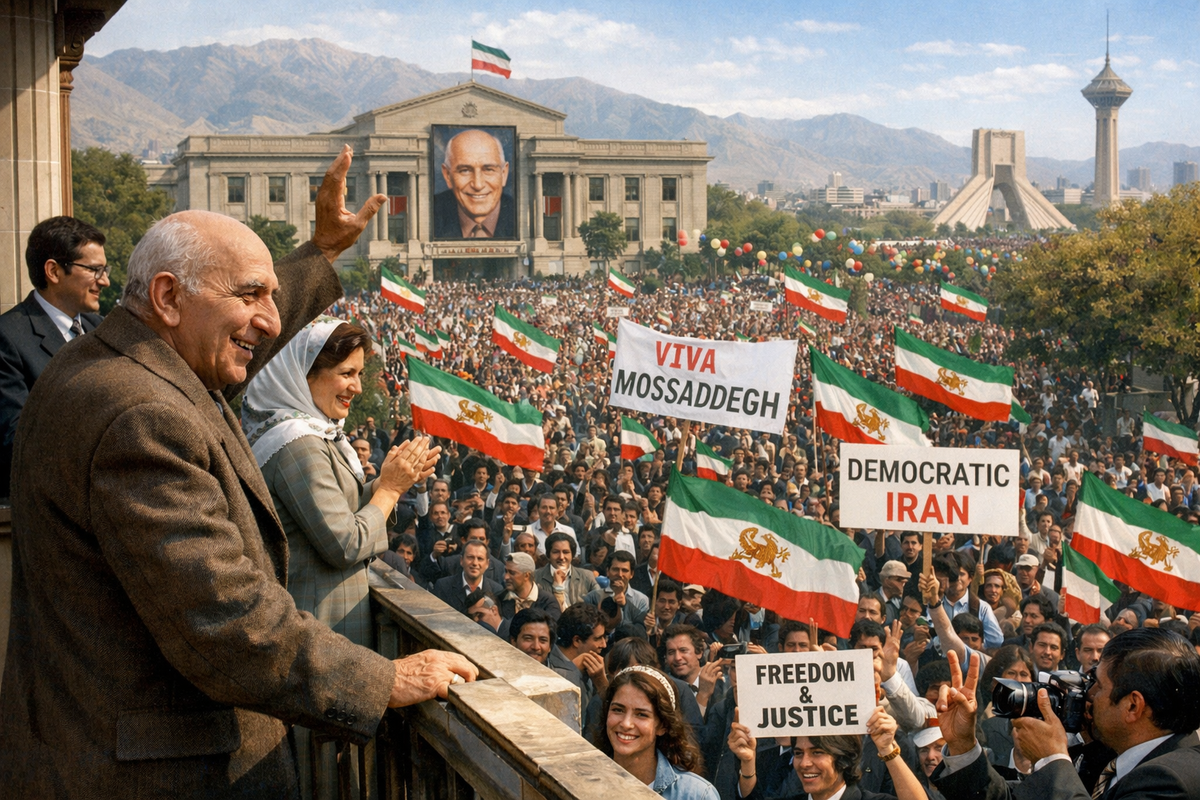
Mohammed Mossadegh became Iran's prime minister in 1951. He did not win an election. In Iran's constitutional monarchy, Article 46 of the Supplemental Constitutional Law was explicit: "The Ministers are appointed and dismissed by the decree of the King." The prime minister was chosen by the shah, and a parliamentary straw vote, called a raye tamayel or "vote of inclination," was taken to align king and legislature behind the appointment. The shah chose Mossadegh expecting him to decline. He accepted. The parliament expressed no objection. The shah issued the formal appointment decree.
This is the constitutional procedure. Peter Theroux, a 20-year CIA career intelligence officer, was awarded the Career Intelligence Medal, documented in a meticulous 2023 Tablet Magazine examination of the 1953 recordthe . As he put it: "The sequence of events is significant: The shah chose a prime minister, the parliament consented, and the shah appointed him." The parliamentary vote was analogous to, but weaker than, US Senate confirmation of cabinet appointments. No one calls a Senate-confirmed Secretary of State "democratically elected."
Between 1953 and 1979, the Shah would appoint and dismiss 10 more prime ministers, including Mossadegh twice. None of those transitions is described in any historical literature as a coup.
Mossadegh was also not a democrat in practice. Once in power, he sparred with the shah over control of the War Ministry, resigned in protest as a brinkmanship tactic, got his job back along with emergency powers, and used those powers to cut the army's budget by 15%, purge 136 officers, appoint loyalists including his own nephew as assistant defense minister, and legislate by decree for six months. He dismissed the Supreme Court. When he lost support in the Majles, he sought to dissolve it by referendum, even though that power was constitutionally reserved to the shah alone. His referendum had no secret ballot: yes and no votes were cast in separate locations. His former National Front coalition allies called him "worse dictator than Reza Shah." Majles Speaker Ayatollah Kashani, who had helped bring him to power, denounced him publicly.
This is not a secret. It is in the Iranian historical record. It is simply not in the Western journalistic account.
 Gene Goodwin
What the CIA Actually Did
The TPAJAX operation, as described in the US government's own declassified records including the National Security Archives' "Secret History of the Iran Coup, 1953" and the CIA history staff's "Zendebad, Shah!" partially declassified in 2017, was an influence operation designed to persuade the shah to use his existing constitutional prerogative to dismiss Mossadegh and replace him with General Fazlollah Zahedi.
The operation's primary field actor was Kermit "Kim" Roosevelt, grandson of Theodore Roosevelt, a CIA officer who would later publish a memoir titled Countercoup: The Struggle for the Control of Iran. That memoir is, by the consensus of serious Mossadegh historians, a monument to strategic narcissism. Roosevelt places himself at the center of every significant event. He describes evenings with the shah that "stretch the imagination." He admits to fabricating a message from President Eisenhower to the shah when the real one failed to arrive. He published the book the same year the Islamic Revolution succeeded, providing the nascent regime with a document that seemed to confirm its founding grievance narrative, written by an American who was proud of what he claimed to have done.
The problem is that what Roosevelt claimed bears a limited relationship to what the declassified records show.
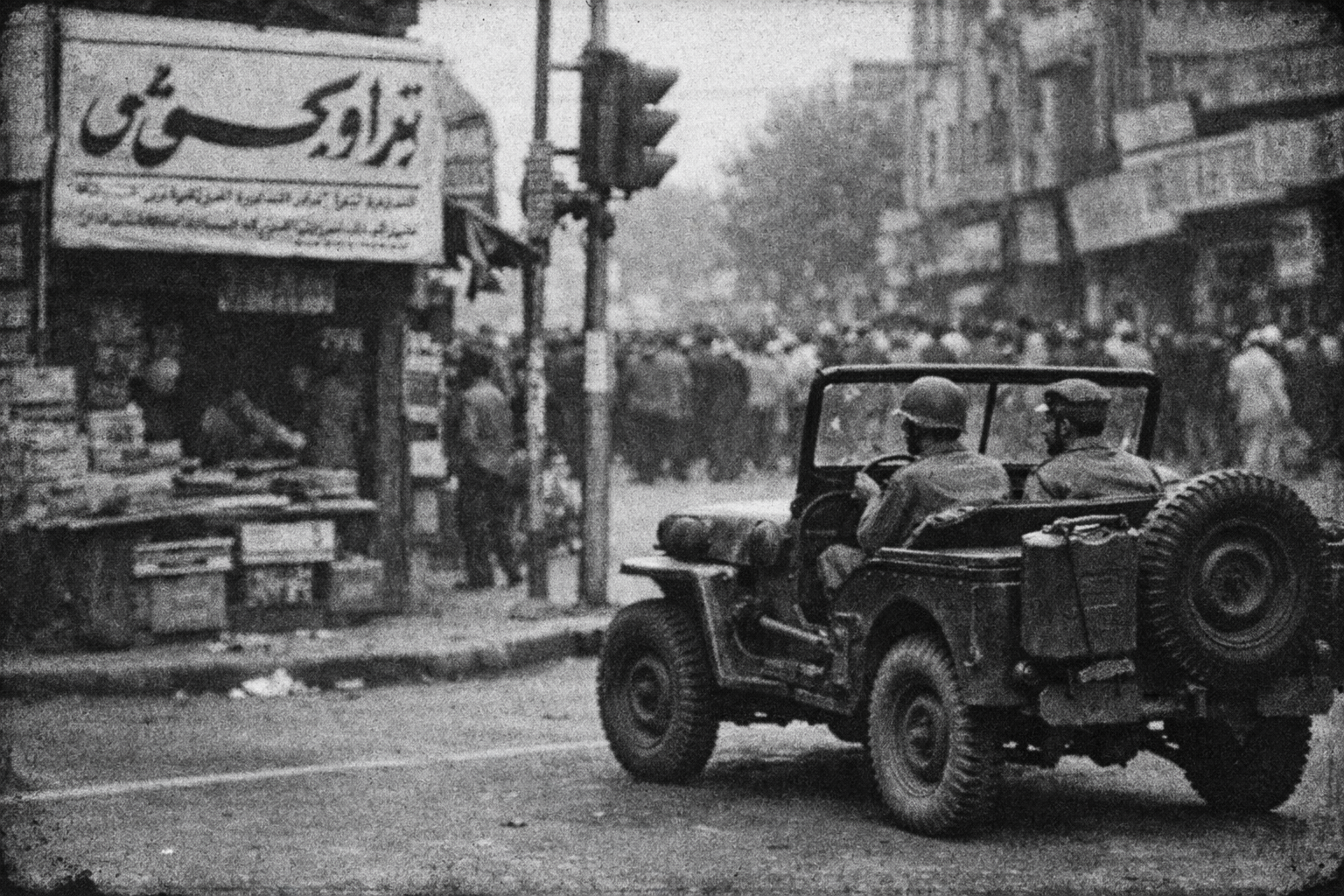
On the night of August 15, 1953, Colonel Nassiri arrived at Mossadegh's house with the royal edict dismissing him and appointing Zahedi. The operation failed immediately. Mossadegh had been tipped off, almost certainly by a Tudeh communist penetration of the Imperial Guard. He signed a receipt for the edict but refused to comply. Nassiri was arrested. The CIA's response was to pass a memo to Eisenhower, conceding failure and assessing that the US would "probably have to snuggle up to Mossadegh."

Roosevelt, asked to return to Washington, chose to stay in Tehran without authorization and improvise.
What actually toppled Mossadegh on August 19 was a domestic political collapse years in the making. The army brass had already independently assessed its options against him and approached the British Embassy for support, before the CIA was fully engaged. Grand Ayatollah Borujerdi in Qom, Ayatollah Behbehani in Tehran, and Ayatollah Kashani had all turned against him. The bazaar had turned. The shah had the constitutional authority to dismiss him at any point and had repeatedly refused to exercise it, believing Mossadegh would collapse on his own.
Iranian historian Ervand Abrahamian, no apologist for American power, wrote the most detailed account of the movement to oust Mossadegh and scarcely mentioned the CIA across a dozen dense pages. The CIA station in Tehran, per Theroux's account of Abrahamian, "held secret meetings and moved some money around." That is what the primary record shows. The army network meeting at the Officers Club "lacked neither motivation nor money." The CIA's money helped, at the margin, in getting specific senior officers to commit. Roosevelt himself was not present at the events of August 19.
Swiss-based Iranian historian Darioush Bayandor, whose 2010 book Iran and the CIA: The Fall of Mossadegh Revisited is considered the most impartially sourced account, concluded that the Shah's dismissal order was not unconstitutional, but was "a feature of a foreign scheme to bring about a change of government." That verdict, which is the harshest serious historical judgment available, still does not support "the CIA overthrew Iran's democratically elected government." It supports: a legally executed constitutional dismissal occurred in a context partially shaped by a foreign influence operation whose first attempt had already failed.
This is not a trivial distinction. In law, in history, and in diplomatic consequence, it is the distinction that determines everything.
How the Myth Was Built
The Roosevelt memoir came first. It established an American at the center of the story claiming credit for results that the available evidence does not support. It was self-serving in multiple directions: toward Roosevelt's own legacy, toward CIA institutional pride, and inadvertently toward the Islamic Revolution's founding narrative.
Stephen Kinzer's 2003 book All the Shah's Men relied heavily on Roosevelt and added the subtitle An American Coup and the Roots of Middle East Terror. Kinzer blamed Mossadegh's fall not only for the Islamic Revolution but for the September 11 attacks. His 2018 reissue contained a preface titled "The Folly of Attacking Iran," warning against what he called "the idea of attacking Iran and seeking to decapitate its regime." That idea, as of February 28, 2026, is no longer an idea.
Columbia University professor Hamid Dabashi's encapsulation became a representative academic version of the narrative: "The CIA, aided by British intelligence, mounted, paid for, and executed a military coup, overthrew the democratically elected government of Mosaddeq." Theroux identified four factual errors in one sentence. Dabashi published this at an Ivy League institution whose students and faculty will be writing the Iran coverage of the next decade.
Barack Obama invoked the Mossadegh narrative in his Cairo speech. He repeated it in his memoir A Promised Land, using the "democratically elected" formulation more than once. His JCPOA negotiating framework was built in part on the principle that American historical culpability for 1953 required accommodation of Iranian grievances in 2015. The Cambridge History of Iran, citing Roosevelt's memoir as a primary source, declared the CIA's role "incontrovertible."
Former Iranian Ambassador to Germany Hossein Mousavian, who served during the Mykonos Cafe massacre of Iranian dissidents by the regime, wrote in Iran and the United States that Mossadegh led "Iran's first democratically elected government." His book simultaneously denied Tehran ordered the Mykonos killings. Both claims appear in the same volume.
The pattern across all of these texts is what Theroux's CIA colleague described as "an overinflated view of U.S. power and influence" combined with a systematic erasure of Iranian agency. In every telling, Iranians did not remove Mossadegh. Americans did. The Iranian army officers who moved against him, the clerics who denounced him, the coalition partners who abandoned him, the bazaar merchants who turned against him, and the constitutional monarch who finally exercised his lawful authority are all background figures or absent entirely. The American is the actor. Iranians are acting upon.

Reuel Gerecht, former CIA operations officer, identified the political economy of the myth clearly: "The focus on '53 among Iranians is primarily a reflection of left-wing, tiers-mondiste critique of American power after the Vietnam War went south, starting in the West before it started in Iran, and the growing dissatisfaction among Iranian leftists, most tellingly the Islamic left, with the course of the revolution. Imagining Mossadegh triumphing allowed them to see a democratic Iran where the Shah and Khomeini, Khamenei, Rafsanjani, et al, get deleted."
The myth gave the Islamic Republic something it needed badly: a founding grievance that was America's fault and therefore justified every subsequent act of hostility toward American interests. It gave the American left something it needed: a framework in which American power is the original sin that explains all subsequent suffering, and accommodation is the only moral response. These two institutional needs produced the same narrative, from different directions, for different reasons.
Iranian rapper Hichkas understood what this myth was and who it served. When Khamenei blamed the 2022 protests on American and Israeli interference, invoking the 1953 template, Hichkas posted a response that was retweeted 50,000 times: "And you can shove that Mossadegh tale you've lived off of for a lifetime."
What the Myth Does Right Now
The "1953 CIA coup" narrative is not historical curiosity this week. It is active diplomatic and journalistic infrastructure.
Every backgrounder explaining "why Iran hates America" for audiences watching Operation Epic Fury coverage will invoke it. Every European foreign minister calling for restraint will reference it. Every academic quoted on CNN will use it as a frame. The UN Human Rights Council will cite it. It will appear in the resolutions of every international body that convenes to address the conflict.
It will do what it has always done: position the Islamic Republic as a victim of American aggression with legitimate historical grievances, rather than as an authoritarian theocracy that spent 47 years killing its own people, building proxy armies across four countries, firing ballistic missiles at seven of its neighbors, and pursuing nuclear weapons while announcing its intention to eliminate a member state of the United Nations.
The regime that is now firing what it calls the most devastating offensive in IRGC history, with a dead supreme leader, a dead defense minister, a dead army chief of staff, and a self-authorizing military firing missiles without a functioning constitutional command structure, will be framed as the successor to Mossadegh's democratic aspirations.
The record does not support this framing. It never did. The record shows an inept visionary who overplayed his hand, who was removed by domestic opponents he had spent two years alienating, with marginal American assistance that failed on its first attempt and succeeded mostly because everything else was already collapsing.
The myth that replaced that record served Khamenei for 36 years. He used it in speeches, state media, and diplomatic communications to explain every protest, every sanction, every hostile act as a continuation of the original American sin. His regime's entire legitimacy rested on the proposition that a foreign power had stolen Iranian democracy in 1953 and that the Islamic Revolution had reclaimed it.
Iranian rapper Hichkas, posting to 50,000 retweets in 2022, understood something that Columbia professors and American presidents did not. The people living under the Islamic Republic's revolutionary authority were not asking to restore Mossadegh's legacy. They were asking to be free of the regime that built itself on his myth.
Khamenei is dead. The myth he lived off will outlast him. The journalists and policymakers now deploying it as context for Operation Epic Fury are not providing history. They are providing cover.
The record is available. It has always been available. The question is whether anyone will read it before the next op-ed goes to press.
The 1953 narrative is being deployed right now in real time to explain Operation Epic Fury to audiences who have no idea the factual record contradicts it. Share this piece with anyone who sends you a "remember 1953" thread. Subscribe for continued coverage that starts with the primary sources. The series continues as long as the story does.
Primary analytical source:
Peter Theroux, "Remembering a CIA Coup in Iran That Never Was," Tablet Magazine, March 5, 2023. Theroux is a translator, writer, and 20-year US government intelligence career officer awarded the Career Intelligence Medal. His deconstruction of the Mossadegh narrative is the analytical foundation for this article and is quoted and paraphrased throughout with attribution. All factual claims from Theroux have been cross-referenced, where possible, against the underlying primary sources he cites.