The Palestinian Grievance Industrial Complex
UNRWA doesn't want to solve the Palestinian refugee crisis. Neither do the Americans running panel circuits off it. Inside the People's Forum machine, where Vermont property owners demand right of return and assassination attempts become "the situation."

UNRWA doesn't want to solve the Palestinian refugee crisis. Neither do the Americans running panel circuits off it.
Start with the tell.
At the April 27 People's Forum event in Manhattan, Mohsen Mahdawi took the stage to explain why Hasan Piker wasn't there. Piker, the DSA-adjacent Twitch streamer cosplaying proletarian consciousness, had dropped out citing safety concerns. Threats, he said, from the right and from the left.
🚨 BREAKING: Hasan Piker dropped out of tonight’s event at The People’s Forum over safety concerns.
— Stu Smith (@thestustustudio) April 27, 2026
Mohsen Mahdawi said Hasan was facing attacks from “the right and the left,” and framed Hasan's absence as part of a broader “war on truth.”
Only in these circles does an… pic.twitter.com/LYjhUp7y04
Mahdawi called it a "war on truth."
The same Mahdawi who, in discussing the assassination attempt on the President of the United States, reached for the phrase "the situation in the White House." As though a gunman targeting the American head of state were a weather event, a bureaucratic development, a thing requiring no particular moral clarity. In these circles, that kind of language isn't a slip. It's a credential.
Now look at what UNRWA actually is, because it explains everything else in the room that night.
The United Nations High Commissioner for Refugees runs the global refugee apparatus with one mandate: resolution. Resettlement, integration, the end of refugee status. UNRWA operates under an entirely different logic. Established in 1949 for roughly 700,000 Palestinian Arabs displaced in the 1948 war, it has never sought resolution. It has sought expansion. Its rolls now exceed five million people, descendants of the original population, carrying inherited refugee status under rules that apply to no other displaced people on earth. UNRWA's operational model is not a ladder out. It is a holding pattern with a budget line.
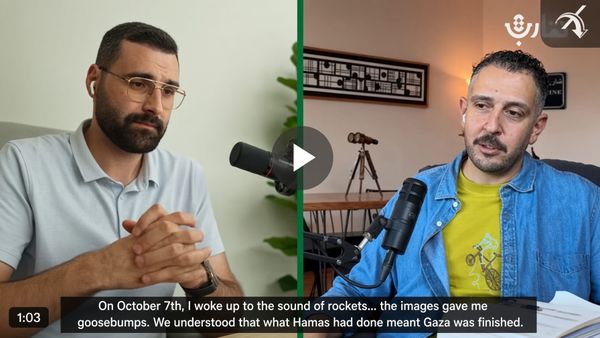
Nick Laparra's career orbits this holding pattern. Panel moderator. Advocate. Podcaster. His work pushes the right of return, the demand that descendants of 1948 Palestinians be permitted to settle inside Israel's borders, as the non-negotiable baseline of justice. Laparra was at the People's Forum on April 27, moderating Panel II, a tableau of youth power politics and socialist vision. His presence was not incidental. He is a node in a network that requires Palestinian refugee status to remain unresolved, because resolution would end the careers built on its perpetuation.
Look at the roster at these events and the pattern becomes obvious.
Mahdawi was born in a West Bank refugee camp. He is now a Columbia graduate student who owns property in Vermont's Upper Valley and fought publicly and successfully for U.S. citizenship before his brief ICE detention last April became a cause célèbre. His biography is a story of successful integration into the American system. By UNRWA's own definitional framework, he is a success story. In activist circles, he is treated as living proof of ongoing dispossession.
🚨 Harlem DSA Candidate Says Black Trans Women Are the “Most Marginalized,” Then Calls for Wealth Redistribution
— Stu Smith (@thestustustudio) April 28, 2026
Conrad Blackburn, a public defender and union organizer running for Harlem’s District 70 Assembly seat, is campaigning as a proud democratic socialist with NYC-DSA’s… pic.twitter.com/BT2cgit4TJ
Kat Abughazaleh was born in Dallas, Texas, to a Palestinian-American father and American mother. Raised in America. Educated in America. She ran for Congress in Illinois' 9th district after recently relocating to the district. Her campaign frames her as a fighter against fascism and billionaire power. Her connection to the Palestinian refugee experience is genealogical, not biographical. This does not stop her from functioning as a refugee identity avatar in the movement ecosystem. She placed second. She will be back.
Former Columbia professor A. Kayum Ahmed supplied the evening's theological underpinning. When the subject of armed resistance came up, Ahmed did not equivocate. He theologized. Understand resistance holistically, he instructed. Rent increases are violence. Denied health insurance is violence. Capitalism is violence. Therefore resistance to these systems, including armed resistance, must be understood in the same holistic frame. This is not analysis. It is a permission structure. Broaden the definition of violence until any act against the system falls within the scope of legitimate defense. Ahmed, who has described Israel as a colonial settler state from Columbia classrooms, is not arguing in a vacuum. He is building the intellectual scaffolding for what comes next.
The mutual admiration for NYC Mayor Zohran Mamdani running through the evening connects the threads. Mamdani, whose politics encompass anti-capitalism, pointed opposition to Israel, and sympathy for the networks these panelists represent, is both a political ally and a symbol. Speakers praised him by name. The suggestion circulated that a future event might be hosted at Gracie Mansion. The boundary between activist infrastructure and municipal government, in this vision, is a temporary administrative inconvenience.
The history these panels never get to matters enormously.
When Israel was established in 1948, roughly 850,000 Jewish refugees were expelled from Arab countries across the Middle East and North Africa. They lost property, businesses, communities, lives built over generations. They were absorbed by Israel and diaspora networks without a dedicated UN agency, without hereditary refugee status passed to their grandchildren, without a right of return demand backed by annual UN resolutions. Their dispossession is not on the People's Forum agenda. It has never been on the People's Forum agenda.
Palestinian leadership rejected the 1947 partition plan. Rejected the 2000 Camp David offer. Rejected Olmert's 2008 proposal. Each rejection was a strategic choice, and each choice had consequences for the Palestinian people those leaders claimed to represent. The activists running today's panel circuits inherit that political tradition without accounting for it. They demand maximalist outcomes while condemning the Israeli responses to maximalist demands. The math only works if you never examine both sides of the ledger.

Laparra's operation depends on the ledger staying closed. If the Palestinian refugee crisis were resolved, through integration, through a negotiated state, through the end of hereditary UNRWA status, the apparatus would have nothing to sell. Careers built on perpetual grievance require perpetual grievance. This is not a conspiracy. It is an incentive structure, and incentive structures produce the behavior you observe.
Mahdawi lives in Vermont. Abughazaleh was born in Texas. Laparra runs panels in Manhattan. Ahmed had a tenured professorship at an Ivy League institution. These are not the profiles of people for whom the system has failed. These are the profiles of people for whom the system has worked, who have turned the suffering of others into professional and political capital while demanding that others, elsewhere, be permitted to upend a sovereign nation's demographic composition.
The war on truth Mahdawi invoked is a war on clarity. Clarity about what UNRWA actually does. Clarity about who benefits from unresolved status. Clarity about what right of return means in practice for a state of nine million people. Clarity about what holistic armed resistance frameworks are designed to justify.
Piker didn't show. The machine ran anyway.
It always does.
Nick Laparra of @UNRWA demands that all Palestinians have their land and homes returned back to them.
— Documenting Jew Hatred on Campus at Columbia U (@CampusJewHate) April 28, 2026
Hey @PeoplesForumNYC and Nick Laparra,
Mahdawi owns a house in Vermont and is begging to stay in the USA, including becoming a citizen. And Kat Abughazaleh is actually from… pic.twitter.com/NIm8gldoC6
 Gene Goodwin