The Permanent Revolution of the Perpetually Aggrieved

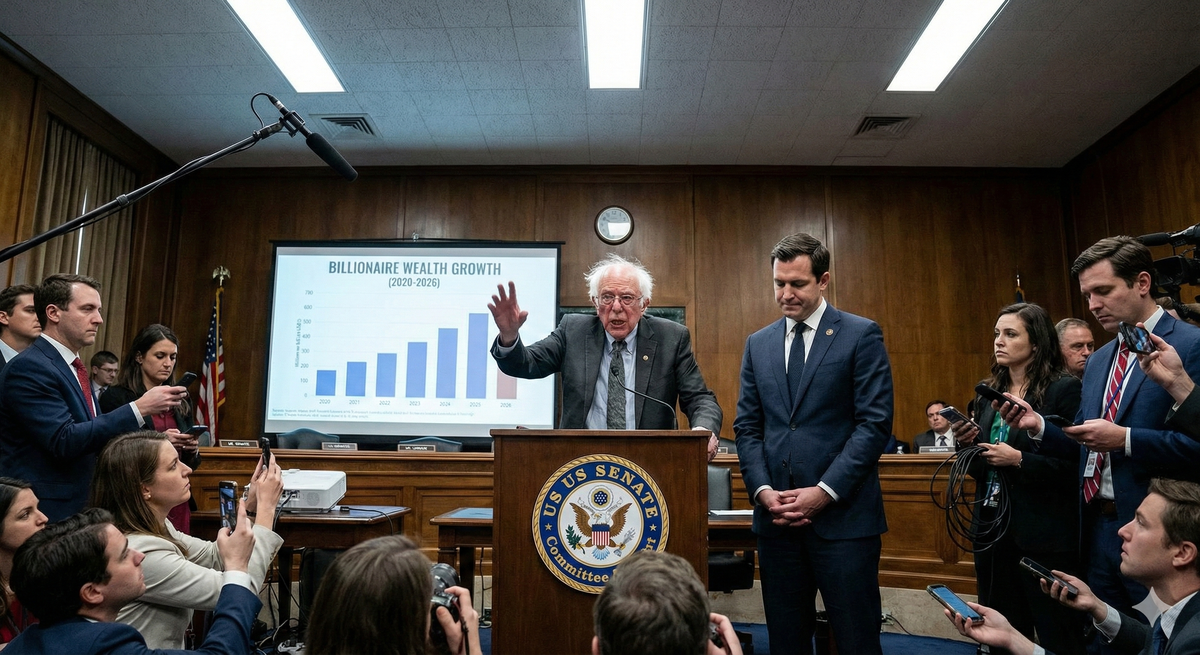
Bernie Sanders is 84 years old. He has been proposing the same wealth tax since roughly the Carter administration. At some point, you have to admire the consistency.
There is something almost touching about Bernie Sanders. While the rest of the Democratic Party has spent the past decade lurching between identities — woke, post-woke, anti-woke, confused — Sanders has remained stubbornly, magnificently himself. The hair, the mittens, the righteous indignation at the existence of billionaires: unchanged, unmoved, apparently unaware that several of his most passionate 2016 supporters are now billionaires themselves. He is a monument to ideological constancy in an age of whiplash. He is also, it must be said, completely wrong about almost everything, but there is something to be said for the purity of the commitment.

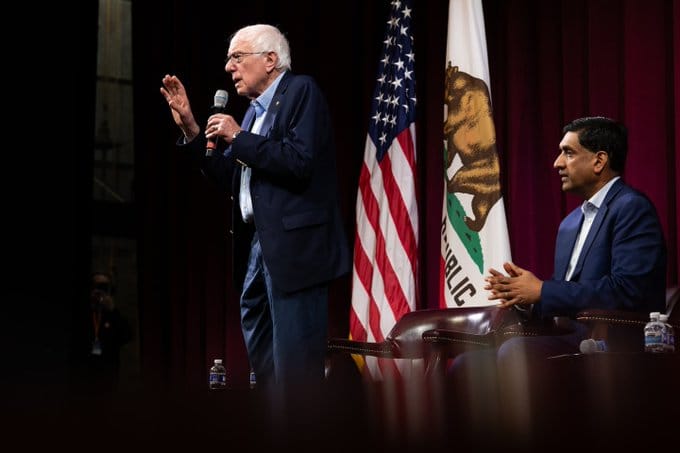
This week, Sanders and California Congressman Ro Khanna — a man whose chief recent contribution to public discourse has been amplifying Epstein-adjacent conspiracy theories — unveiled what they are calling the Make Billionaires Pay Their Fair Share Act. It would impose a 5 percent annual wealth tax on billionaires and distribute the proceeds as cash payments of $3,000 per person to households earning under $150,000. Elon Musk, worth $833 billion, would owe $42 billion. He would retain, Sanders notes with an air of generous restraint, approximately $792 billion. One assumes Musk will be devastated.
“So where are the pro-terror radicals? Raise your hand if you're a pro-terror radical.”
— 5th Gen AZ Family (@bullfrog35) September 29, 2025
— Ro Khanna
Let the record show:
Ro raised his hands. pic.twitter.com/RVXIsmkxTh
The bill has essentially no chance of passing. Republicans control both chambers, and even if they didn't, wealth taxes face significant constitutional challenges that the bill's proponents tend to wave away as minor inconveniences. France, as the National Taxpayers Union Foundation helpfully points out, tried a broad wealth tax and abandoned it in 2018 because it was administratively nightmarish and prompted 60,000 millionaires to simply leave. France, recall, is a country that genuinely tried. These things do not deter Sanders, who has been proposing variations of this plan for the better part of four decades. The bill is not legislation so much as a statement of faith — a liturgy for those who believe that the existence of very rich people is, in itself, the problem.
As @BernieSanders’ National Co-Chair, I unequivocally condemn the attacks on Bloomberg’s campaign offices.
— Ro Khanna (@RoKhanna) February 25, 2020
Our campaign fueled by grassroots donors is building the coalition needed to defeat Trump.
Sanders is just speaking about facts in not letting money buy an election. pic.twitter.com/Zqof7SVeaL
What makes this week's exercise more interesting than the usual Sanders press release is the accompanying orchestration. Almost simultaneously with the Sanders-Khanna announcement, the New York Times published a sprawling four-byline investigation into what it called "America's New Gilded Age." The timing, as the Free Beacon's Ira Stoll drily notes, appeared rather coordinated. The Times piece and the Sanders press release hit the same notes with the same instruments in something approaching perfect harmony. Both expressed horror at wealth concentration. Both dwelled lovingly on named billionaires. Both implied — without quite saying — that the accumulation of private fortunes represents a kind of civilizational emergency.
The comparison of language is instructive. The Times: "One of the central quandaries the country now faces is how to govern in an era when such vast wealth both controls a large part of the economy and is increasingly used to access political power." Sanders: "One of the most important moral and economic issues of our time is the urgent need to confront the obscene level of income and wealth inequality that we are currently experiencing." Other than the word "obscene," which appears only in the Sanders version, these sentences are functionally identical. A newspaper of record and a socialist senator's press shop, producing prose so similar as to be interchangeable. This is either remarkable coincidence or something more embarrassing.
🚨 Rep. Ro Khanna Defends ArabCon, Mocks Critics of “Pro-Terror Radicals”
— Stu Smith (@thestustustudio) September 27, 2025
At ArabCon, Rep. Ro Khanna (D-CA) opened by taunting critics of the conference:
“So where are the pro-terror radicals? Raise your hand if you're a pro-terror radical.”
He went on to frame the backlash as… pic.twitter.com/vd6ARrYP4R
The Times piece leans on statistical methods developed by economists Thomas Piketty and Emmanuel Saez to estimate income distribution. It does not mention that Saez — along with his frequent collaborator Gabriel Zucman — wrote the letter accompanying the Sanders-Khanna bill arguing for the wealth tax. The circle is quite tight. The economists provide the data that the Times uses to establish that inequality is catastrophic. The same economists then provide intellectual cover for the legislation designed to address the catastrophe their data revealed. The Times, meanwhile, reports on the catastrophe using the economists' data while declining to note that those same economists are actively lobbying for a specific political remedy. This is not journalism coordinating with advocacy. This is journalism becoming indistinguishable from advocacy while maintaining the formal trappings of the former.
$28,600.
— Bad Hombre (@Badhombre) February 15, 2026
That’s how much Reid Hoffman has directly donated to Ro Khanna.
That is why Ro Khanna is afraid to even mention Reid Hoffman.
Ro Khanna will sell his soul to a child rapist for less than $30K.
Everyone has their price, but that’s pretty cheap by any standard.
There is also the small matter of what the Times's analysis omits. The piece manages to blame the 2017 Trump tax cuts for minting hundreds of new billionaires. Piketty was writing his wealth tax manifesto in 2014, three years before those cuts. More significantly, the Times piece contains no mention of Federal Reserve monetary policy — no zero interest rates, no quantitative easing, no decade-long suppression of borrowing costs that drove asset prices into the stratosphere and did more to concentrate wealth in equity holders than any tax policy. The Kansas City Fed holds its annual symposium in Jackson Hole, Wyoming, which happens to be one of the billionaire enclaves the Times is investigating. The irony is apparently lost on all involved.
Then there is the question of who is doing the complaining. The New York Times Company trades above $81 a share — a record high, the Free Beacon notes. Its enterprise value sits around $12.4 billion. The Sulzberger family has maintained editorial and financial control through six generations, a feat of dynastic wealth preservation that would make the Medicis nod approvingly. The paper of record, owned by one of America's more durable old-money dynasties, is publishing four-byline investigations into the horror of new American fortunes. The undertone, as Stoll puts it, is one of old-money horror at the arrivistes. One detects in the Times's "stunning velocity" and "colossal leap" the unmistakable register of people who got there first and would prefer the door be closed behind them.
1/3 of the US stock market is in “his district,”but won’t be in another 10 years because of Ro Khanna’s support of asset seizure of post tax wealth and unrealized gains taxes that will kill startups
— Garry Tan (@garrytan) January 14, 2026
Destroy California startups and you set back American innovation by a decade https://t.co/9JQitFicFK pic.twitter.com/3HMP1qMdYQ
None of this means the underlying questions are unimportant. Wealth concentration is a legitimate subject for democratic debate. The relationship between money and political power is a genuine problem in American life. A society in which a handful of individuals hold resources exceeding the GDP of medium-sized countries is not obviously healthy. These are real concerns, and a serious press might investigate them seriously — examining the role of monetary policy, the distortions created by regulatory capture, the ways in which existing institutions tend to entrench rather than challenge concentrated power.
You don't speak for Americans.
— Apple Lamps (@lamps_apple) March 1, 2026
You speak for the Islamic regimes' Iran lobby, NIAC
You disgusting, vile traitor. pic.twitter.com/efFibzQT9O
What is happening instead is something different: a coordinated morality play in which French economists, Vermont socialists, California congressmen, and the New York Times have all agreed in advance what the villain looks like (new, tech-adjacent, Musk-adjacent, right-leaning), what the solution is (a wealth tax that France abandoned as unworkable), and what kind of coverage constitutes journalism (data sourced from advocates, presented without disclosure, in language indistinguishable from the press releases it purports to cover independently).
🚨SICKENING!! Democrat Ro Khanna is averaging 17 stock trades per day at $16,500 per trade with a trading volume of over $562 million dollars!
— Michelle #AmericaFirst (@MichelleRM68) November 9, 2025
Why are Reps like Ro & Nancy Pelosi allowed to use their office to become multimillionaires? It's CRIMINAL!!👇 pic.twitter.com/ZewFlUDYJp
Bernie Sanders, at least, has the virtue of honesty. He wants the money, he wants to spend it, he thinks billionaires are bad. He has thought this for forty years. He will think it for whatever years remain to him. There is a clarity to the position that is almost refreshing.
The New York Times would like you to believe it has reached its conclusions independently, through rigorous investigation, guided only by the data. The data, of course, was provided by the same people lobbying for the policy the investigation recommends.
The least they could do is admit they're all in the same room.
🧵1.🚨MORE EVIDENCE
— SKDoubleDub (@SKDoubleDub33) March 2, 2026
There is a VERY REAL color revolution happening right now on US soil guided by former federal employees including USAID and USIP and their national & international partners and mobilized by convenings like the 22nd Century Initiative conferences and the… https://t.co/bDH9SNoSM1 pic.twitter.com/E9uUFkMIiL