The Procedural Virtue of Releasing Murderers: How New York's Sanctuary Infrastructure Operates Regardless of Outcomes


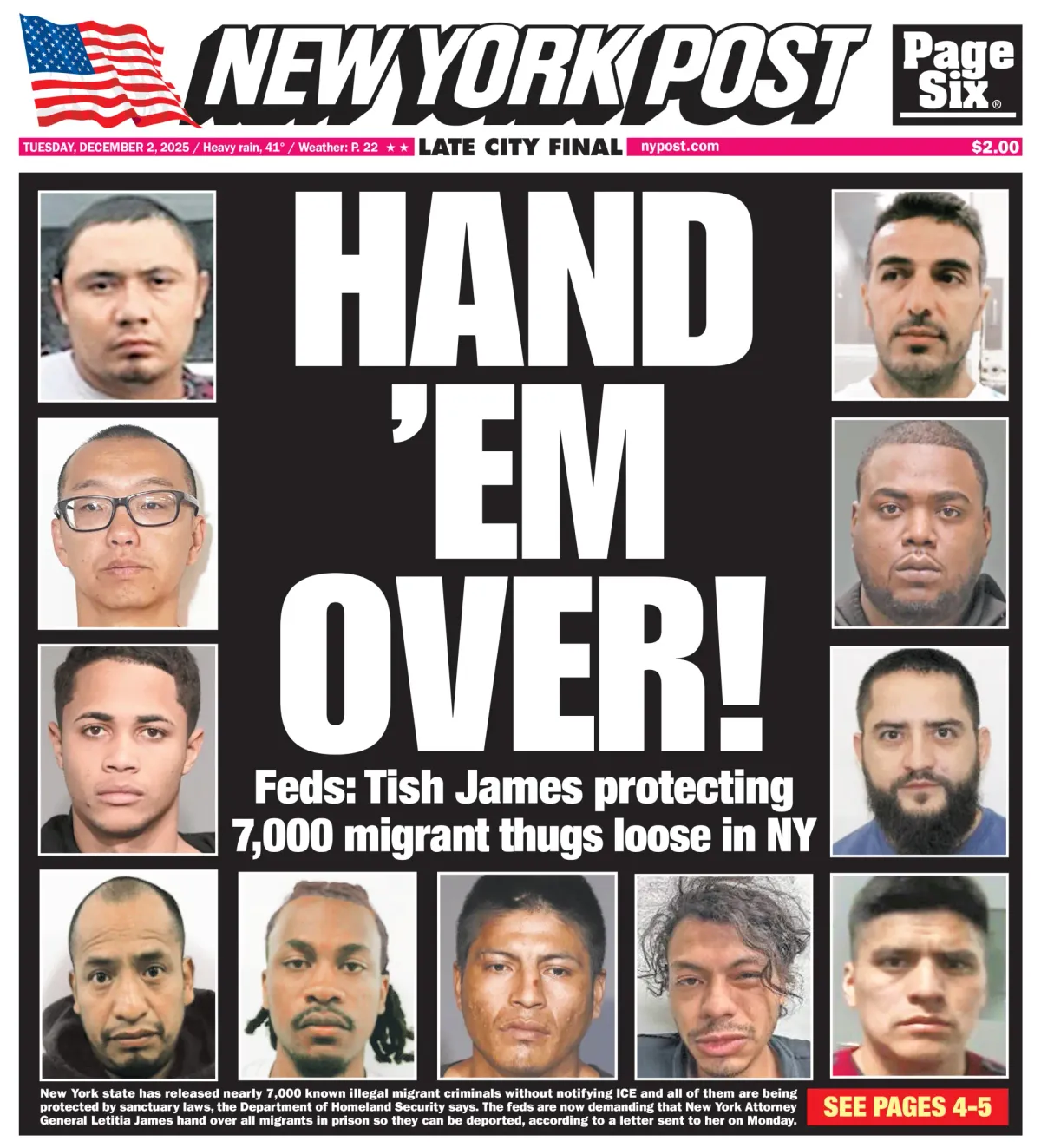
Based on reporting by Chris Nesi, New York Post, December 1, 2025
Since President Trump took office in January 2025, New York state and local authorities have released 6,947 illegal immigrants with active ICE detainers back onto the streets. The list of crimes committed by these individuals includes 29 homicides, 2,509 assaults, 199 burglaries, 305 robberies, 392 drug offenses, 300 weapons offenses, and 207 sexual predatory offenses. An additional 7,113 illegal immigrants with active ICE detainers remain in custody, their release prevented only by the duration of their current sentences.
These numbers come from a December 1 letter sent by acting ICE Director Todd Lyons to New York Attorney General Letitia James. The letter demands that the state turn over the 7,113 still in custody to federal immigration authorities for deportation. It also demands an explanation for why New York continues releasing criminal aliens back into communities rather than transferring them to ICE custody upon completion of their state sentences.
The answer is procedural. New York's sanctuary laws prohibit state and local law enforcement from cooperating with federal immigration enforcement. The framework was established by a 2017 executive order signed by then-Governor Andrew Cuomo, which bars law enforcement officers from using "resources, equipment, or personnel" to help federal officials enforce immigration laws. New York City maintains its own, more robust sanctuary policies that further restrict NYPD and Department of Correction cooperation with ICE.
The stated rationale for these policies is protecting immigrant communities from deportation and encouraging cooperation with local law enforcement without fear of immigration consequences. The actual effect is that criminal aliens—including convicted murderers, rapists, and child predators—complete their state sentences and walk back onto New York streets rather than being transferred to federal custody for removal from the country.
The procedural mechanism operates with impressive consistency. Jesus Romero Hernandez, a 27-year-old Mexican national, had been deported from the United States seven times before New York authorities released him in January 2025 from Tompkins County Jail. He'd served 179 days for attacking an Ithaca police officer with a machete. Despite a signed federal immigration detainer and warrant, the Tompkins County Sheriff's Office refused to honor the request and let him go. ICE arrested him again on November 5 and removed him from the country for an eighth time.
Vyacheslav Danilovich Kim, a 24-year-old Uzbekistan resident, was convicted in Albany County on charges including rape in the second degree, use of a child under 17 in a sexual performance, and patronizing a person less than 15 for prostitution. He was sentenced to time served and five years probation in February 2023. Despite an ICE detainer, Albany County probation officers refused to assist federal authorities in locating or arresting him. ICE finally caught him in September 2024 as he was leaving an appointment with his probation officer and deported him.
Steven Daniel Henriquez Galicia, a 25-year-old Dominican national who entered the U.S. illegally in 2016, was arrested in the Bronx last year for attempted murder after he allegedly fired at least one shot at a man and woman in the lobby of a residential building. The Bronx District Attorney requested $300,000 bond. A judge released him on cashless bail. Despite an ICE detainer, he walked free. ICE arrested him on September 20 in the Bronx.
Anderson Smith Satuye Martinez, a 21-year-old Crips gang member and Honduran national with a prior assault conviction, was arrested on August 19 for criminal possession of a weapon and a controlled substance. Police found him with a loaded .380 Ruger pistol. Despite an ICE detainer, he was released on cashless bail. ICE arrested him on September 11 in the Bronx.
The pattern holds across hundreds of cases. Criminal aliens complete their sentences or make bail. ICE lodges detainers requesting that local authorities hold them for transfer to federal custody. Local authorities release them anyway. ICE must then expend resources hunting them down in the community, often after they've committed additional crimes.
The procedural logic is maintained regardless of outcome. It doesn't matter that Jesus Romero Hernandez had been deported seven times and attacked a police officer with a machete—the Tompkins County Sheriff's Office followed procedure by refusing to honor the federal warrant. It doesn't matter that Vyacheslav Kim was convicted of raping a child—Albany County probation followed procedure by refusing to help locate him. It doesn't matter that Steven Galicia fired a gun in a residential building—the judge followed procedure by granting cashless bail despite the district attorney's objection and the pending ICE detainer.
This is how institutions operate when procedural compliance becomes more important than substantive outcomes. The procedure—sanctuary policy—must be followed. That the procedure results in releasing child rapists and attempted murderers back onto the streets is irrelevant to the procedural question. The officials following the procedure can claim they're simply adhering to policy. The officials who designed the procedure can claim they're protecting immigrant communities. No one needs to take responsibility for the machete-wielding illegal immigrant who's been deported seven times because everyone followed the correct procedure.
Attorney General Letitia James exemplifies this procedural displacement of responsibility. When ICE sent her a similar letter on September 12 demanding cooperation, she responded by deferring the inquiry to Governor Kathy Hochul's office. Detainer requests, James explained, "are handled differently depending on local laws and policies, creating a range of lawful practices we cannot address in our capacity as the Attorney General." In other words: not my department. The procedure says this is someone else's problem.
Governor Hochul, for her part, testified before the House Oversight Committee in 2025 that New York "can and will" work with federal immigration officials under certain circumstances—including when individuals have been convicted of a New York State crime. Yet the 6,947 criminal aliens released since January were convicted of New York State crimes. The procedure apparently contains exceptions to the exceptions, or perhaps the exceptions only apply when convenient, or perhaps Hochul's testimony was simply for show while the actual procedural mechanisms continue operating as designed.
NYC: Anti-ICE protesters Throw Trash and Garbage Cans to block ICE Agents Cars in Lower Manhattan, Arrests and Pepper spray.
— Oliya Scootercaster 🛴 (@ScooterCasterNY) November 29, 2025
Video by Ken Lopez @FreedomNTV Desk@freedomnews.tv to license pic.twitter.com/cVlWtU8je3
The procedural infrastructure benefits multiple institutional interests simultaneously. Progressive advocacy groups maintain their policy victory—sanctuary laws remain in place, sending the message that New York protects immigrants. Law enforcement officials follow procedure and avoid the political controversy that would erupt if they cooperated with ICE. Judges grant cashless bail as criminal justice reform advocates demand. Prosecutors can claim they requested higher bail even as judges ignore them. Everyone has procedural cover.
The only interests not served are those of the New York residents who live in the same communities where convicted murderers, rapists, and gang members are released. But public safety, unlike procedural compliance, is difficult to measure and easy to defer. If a released criminal alien commits another crime, officials can claim the problem is insufficient rehabilitation programs, inadequate mental health services, systemic racism in the criminal justice system, or federal immigration policies—anything except the sanctuary procedures that released him in the first place.
Since Hochul took office in 2021, New York's Department of Correction and Community Supervision has transferred 1,300 incarcerated migrants to ICE after completing their local sentences, according to the governor's office. That sounds like cooperation until you compare it to the numbers. Nearly 7,000 released in eleven months of 2025 versus 1,300 transferred in four years suggests that cooperation is the exception, not the rule. The procedural infrastructure ensures that the vast majority walk free.
New York City's sanctuary policies are even more restrictive than the state's. The NYPD and Department of Correction can only honor ICE detainers if the individual has been convicted of violent crimes, appears on the federal terror watch list, or if immigration officials have a judicial warrant. Since many of the crimes committed by the released aliens were violent—29 homicides, hundreds of assaults, hundreds of sexual offenses—the city's procedures apparently define "violent crimes" in creative ways that exclude attempted murder, weapons possession by gang members, and rape.
The procedural logic becomes clear when you examine who benefits from the sanctuary framework. Progressive advocacy groups that lobbied for these policies can claim victory—they passed laws protecting immigrants. Politicians who supported the laws can claim credit with immigrant communities and progressive voters. Law enforcement officials follow the procedures and avoid political heat. Immigration lawyers maintain a steady stream of clients. The only people who don't benefit are American citizens who encounter the released criminals and the crime victims who discover that the person who victimized them had multiple prior convictions, had been deported multiple times, and was released by New York authorities despite ICE requesting custody.
ICE's December letter makes the institutional failure explicit. The agency is demanding that James hand over 7,113 illegal immigrants currently in custody with active detainers so they can be deported. These individuals are collectively responsible for 148 homicides, 717 assaults, 134 burglaries, 106 robberies, 235 dangerous drug offenses, 152 weapons offenses, and 260 sexual predatory offenses. They have been convicted. They have been sentenced. They are serving time in New York facilities. When their sentences are complete, New York's procedural infrastructure will release most of them back onto the streets rather than transferring them to federal custody.
That shove was perfection 😸 More insanity from yesterday’s anti-ICE riots in NYC. Activists drag giant planters into the street to block vans while NYPD sprints ahead to push them aside.
— Larry Conger 🇺🇸 (@eMTBrides) December 2, 2025
Zohran Mamdani is not even in power yet and this is already the level of impunity. pic.twitter.com/PYMIPcWruf
The letter concludes: "Please confirm whether the State of New York plans to honor detainers on these aliens or whether each of these barbarians will someday walk the streets of New York again." The phrasing is pointed because the answer is already known. The procedures are clear. Unless something changes—unless James decides procedure should serve substantive outcomes rather than institutional interests, unless Hochul modifies the state's sanctuary framework, unless New York City revises its policies—the barbarians will walk the streets again.
Assistant Secretary Tricia McLaughlin's statement to the New York Post makes the federal position explicit: "Attorney General James and her fellow New York Sanctuary politicians are releasing murderers, terrorists, and sexual predators back into our neighborhoods and putting American lives at risk. We are calling on Letitia James to stop this dangerous derangement and commit to honoring the ICE arrest detainers of the more than 7,000 criminal illegal aliens in New York's custody."
The federal government is asking New York to prioritize public safety over procedural adherence to sanctuary policies. New York is responding that procedures must be followed. The procedures protect the institutional interests of everyone involved in designing, implementing, and defending sanctuary policies. The procedures do not protect New York residents from criminals who have already been convicted, sentenced, and are scheduled for release.
This is institutional capture operating exactly as designed. The sanctuary policies were sold as protecting immigrant communities. They function to protect institutional interests while releasing criminals back into the communities they victimized.

The officials defending the procedures can claim moral authority—they're protecting immigrants from deportation. The officials following the procedures can claim legal compliance—they're adhering to state law. The officials who passed the procedures can claim credit with their political coalition. And the victims of the released criminals can be told their concerns are anti-immigrant sentiment or that crime is a complex social problem requiring comprehensive solutions rather than something as simple as not releasing convicted murderers back onto the streets.
The joke writes itself: New York has spent years perfecting a system that ensures convicted child rapists who've been deported multiple times are released back into communities rather than transferred to federal custody, then wonders why federal officials are demanding explanations.
BREAKING: Protesters wearing keffiyehs were dragged and arrested outside ICE HQ in Manhattan after clashing with NYPD.
— Eyal Yakoby (@EYakoby) June 7, 2025
The anti-ICE mob tried blocking migrant vans outside 26 Federal Plaza—until police finally stepped in.
https://t.co/p5He8DYgAf
The 6,947 criminal aliens released since January prove that the sanctuary infrastructure is working exactly as intended—not to protect public safety, not even primarily to protect immigrant communities, but to serve the institutional interests of the officials who designed, implemented, and benefit from maintaining procedures that operate regardless of outcomes.
Source: Chris Nesi, "New York released 7,000 illegal migrant criminals onto streets this year alone — including a machete-wielding maniac, a rapist and an attempted killer," New York Post, December 1, 2025.