The Shadow Network: How a 2016 Hotel Meeting Ignited Nine Years of Engineered Chaos Against America

“The history of liberty is a history of resistance.”
— Albert Camus
In the opulent halls of Washington, D.C.'s Mandarin Oriental Hotel on November 15, 2016—just one week after Donald Trump's seismic electoral victory—a cadre of billionaire donors, union bosses, and progressive operatives convened behind closed doors. George Soros, the Hungarian-born financier whose Open Society Foundations have funneled billions into reshaping global politics, was there in person, his presence a silent thunderclap.
This wasn't a postmortem on a failed campaign; it was the ignition of a calculated insurgency. Dubbed the Democracy Alliance's "investment conference," the three-day gathering—titled "2016-2018-2020: Seizing Opportunity & Building Power"—laid the groundwork for what would become a relentless, Alinsky-inspired assault on the incoming administration. Nearly a decade later, as protests erupt anew against Trump's second term, the fingerprints of that meeting remain smeared across America's streets, from the Women's March to the "Hands Off" mobilizations of 2025.
This is the story of how a foreign-influenced elite network weaponized nonviolent resistance tactics—borrowed from Serbian revolutionaries and perfected in U.S. universities—into a sustained campaign of disruption that borders on subversion.
To understand the depth of this operation, one must trace its roots to the ashes of Hillary Clinton's defeat. The Democracy Alliance (DA), co-founded by Soros in 2005 after John Kerry's loss, had already poured over $500 million into left-wing causes by 2016. Its members—requiring a minimum $200,000 annual pledge to approved groups—include titans like Reid Hoffman and the Pritzker family, alongside Soros's own $25 million infusion into Clinton's bid.
The Mandarin summit, attended by Nancy Pelosi, Elizabeth Warren, and Keith Ellison, wasn't about mourning; it was about recalibrating. As DA President Gara LaMarche emailed donors, Trump's win represented "a terrifying assault on President Obama’s achievements—and our progressive vision for an equitable and just nation." Sessions dissected "turning resistance energy into electoral action," with a laser focus on state-level power grabs and voter mobilization. But beneath the veneer of democratic renewal lurked a darker blueprint: importing the playbook of Otpor, the Serbian youth movement that toppled Slobodan Milošević in 2000 through mass civil disobedience.
Otpor—"resistance" in Serbian—emerged from the ashes of ethnic strife in the Balkans, where U.S.-backed NATO bombings, urged by then-First Lady Hillary Clinton, had pummeled Serbia in 1999. Clinton, a vocal advocate for airstrikes to halt alleged genocide, later boasted of pressuring her husband: "I urged him to bomb.
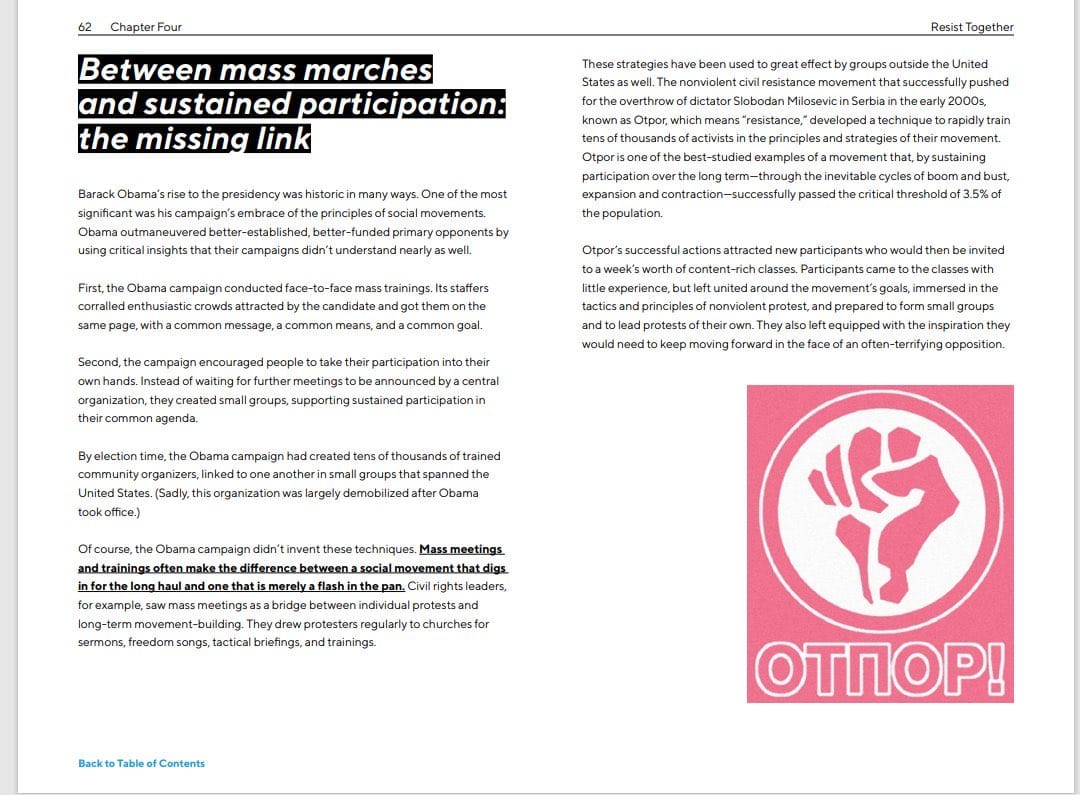
You cannot let this go on at the end of a century that has seen the major holocaust of our time." Otpor's genius lay in its scalability: training tens of thousands in nonviolent tactics like street theater, flash mobs, and symbolic gestures (their clenched-fist logo became iconic). Funded indirectly through U.S. channels like the National Endowment for Democracy, Otpor sustained participation through "boom and bust" cycles, hitting the 3.5% population threshold that researchers like Erica Chenoweth later deemed critical for success.
By 2016, this model had evolved into "color revolutions"—velvet uprisings in Georgia (Rose, 2003), Ukraine (Orange, 2004), and Kyrgyzstan (Tulip, 2005)—often with Soros's Open Society at the helm, training activists in regime-change artistry.
They call the Trump administration a competitive authoritarian regime. Democracy Inc. is currently running a color revolution against Trump 2.0 just like they did in Serbia, Ukraine, the country of Georgia, and against Trump 1.0.
— The Researcher (@listen_2learn) October 22, 2025
The revolution business (Otpor/CANVAS) which was… pic.twitter.com/4jfw764fS4
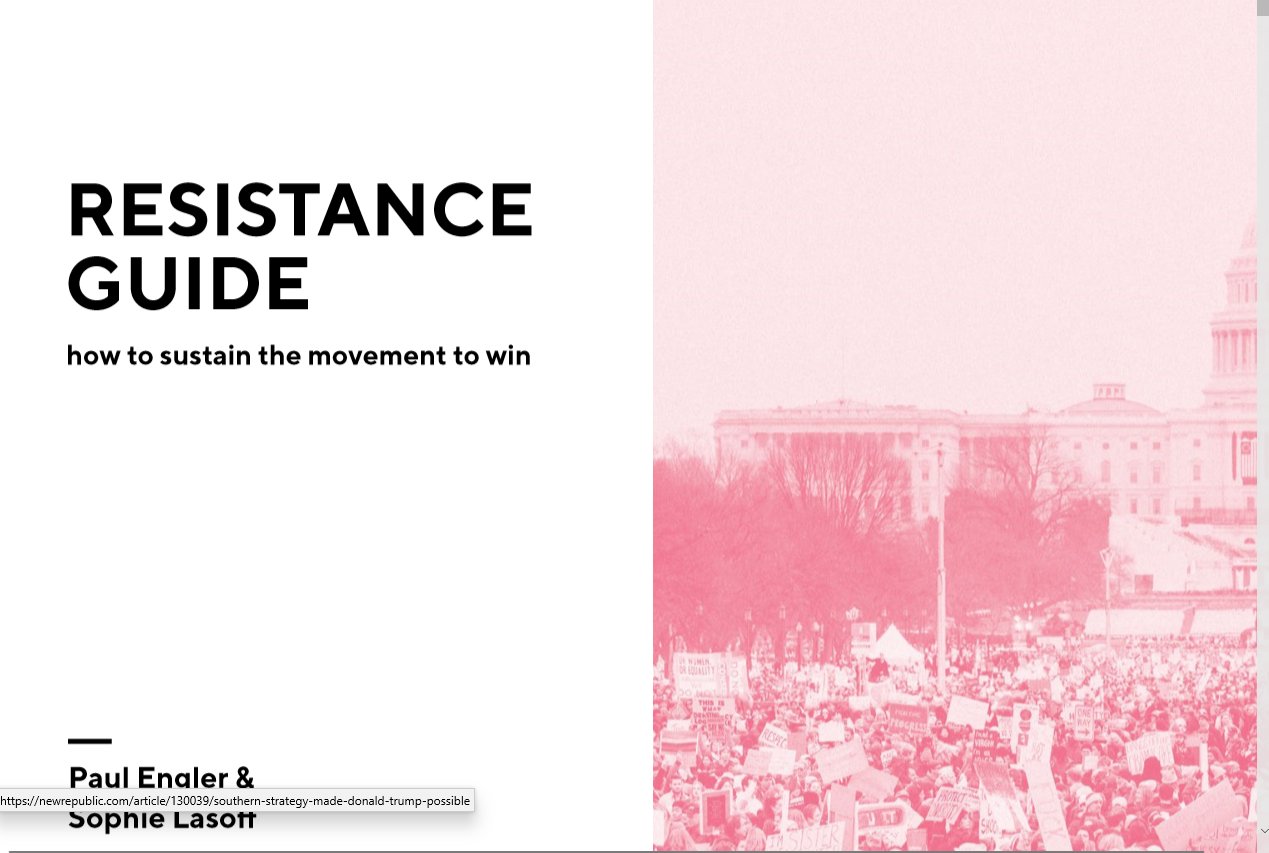
Back in the U.S., the Mandarin conferees didn't reinvent the wheel; they oiled it. The "Trump Resistance Guide," circulated in those early post-election weeks, explicitly invoked Otpor: "The nonviolent civil resistance movement that successfully pushed for the overthrow of dictator Slobodan Milošević... developed a technique to rapidly train tens of thousands of activists... Otpor is one of the best-studied examples of a movement that, by sustaining participation over the long term... successfully passed the critical threshold of 3.5% of the population." This wasn't abstract theory. Groups like Indivisible and MoveOn.org, both DA beneficiaries, sprang into action. Indivisible, born from a viral Google Doc by former Obama aides Ezra Levin and Leah Greenberg, exploded to 3,800 local chapters by February 2017, organizing town halls that forced Republicans like John Kasich to admit the protests derailed Obamacare repeal. MoveOn, with its 46,000-person weekly calls, coordinated the post-inauguration Women's March, drawing millions worldwide. By April 2025, these same outfits rallied over 1,300 "Hands Off" events against Trump's Department of Government Efficiency, blending pocketbook fears with cries of fascism.
They literally have a guy from the color revolution group Otpor on this panel. pic.twitter.com/8o0q348Qg0
— The Researcher (@listen_2learn) June 26, 2025
Barack Obama, the community organizer turned president, provided the ideological scaffolding. Trained in Saul Alinsky's "Rules for Radicals"—a bible of agitation emphasizing "direct action" to polarize haves and have-nots—Obama channeled this into his 2008 campaign's grassroots machine. Alinsky's son, L. David, praised Obama in 2008: "Barack Obama's training in Chicago by the great community organizers is showing its effectiveness. It is an amazingly powerful format, and the method of my late father always works." Post-presidency, Obama's Organizing for Action (OFA) funneled energy into DA-aligned efforts, while his rhetoric—"agitation" as empowerment—echoed in Indivisible's playbook. Clinton's shadow loomed large too; her State Department had greenlit Otpor-style training for Arab Spring activists, and her 2016 loss only sharpened the resolve to "remove him from office" via the Resistance Guide's blueprint.

Enter the academic enablers: university labs churning disinformation to cloak these operations in legitimacy. At Johns Hopkins' SNF Agora Institute, the P3 Lab (Possible, Probable, Powerful)—directed by Hahrie Han, a specialist in "civic engagement"—researches "disinformation and polarization" under the guise of bolstering democracy. Funded by the Stavros Niarchos Foundation (echoing Soros's model), P3 explores interventions against "threats to democratic societies," including workshops on spotting "facts or fakes." Critics see a double standard: while decrying "conspiratorial thinking," these labs train organizers in narrative-framing—Alinsky's "personalize the enemy"—to sustain outrage cycles. Han's work on "collective action" mirrors Otpor's threshold model, producing toolkits that DA groups deploy in protests from Black Lives Matter to anti-Trump rallies. Nearly 100 organizations, from Color of Change to the Tides Foundation, form this web, laundering funds through 501(c) pass-throughs for untraceable impact.
The Revolution Business pic.twitter.com/aBsJLSM0nE
— The Researcher (@listen_2learn) September 30, 2024
Nine years on, the toll is staggering. What began as "resistance" has morphed into a color revolution redux: sustained mobilization eroding institutional trust, with 2025's "No Kings" protests in 2,000 communities protesting Trump's parade as authoritarian. Soros's network, implicated in Ukraine's Euromaidan and Georgia's Rose Revolution, now targets domestic soil—training via CANVAS (Center for Applied Nonviolent Action and Strategies), Otpor's successor. Is this treason? Legally, no—protected speech and dark money flow freely. But ethically? A foreign billionaire engineering chaos against a duly elected leader smacks of the very "assault on democracy" they decry. As Camus warned, resistance unchecked becomes the tyranny it fights.
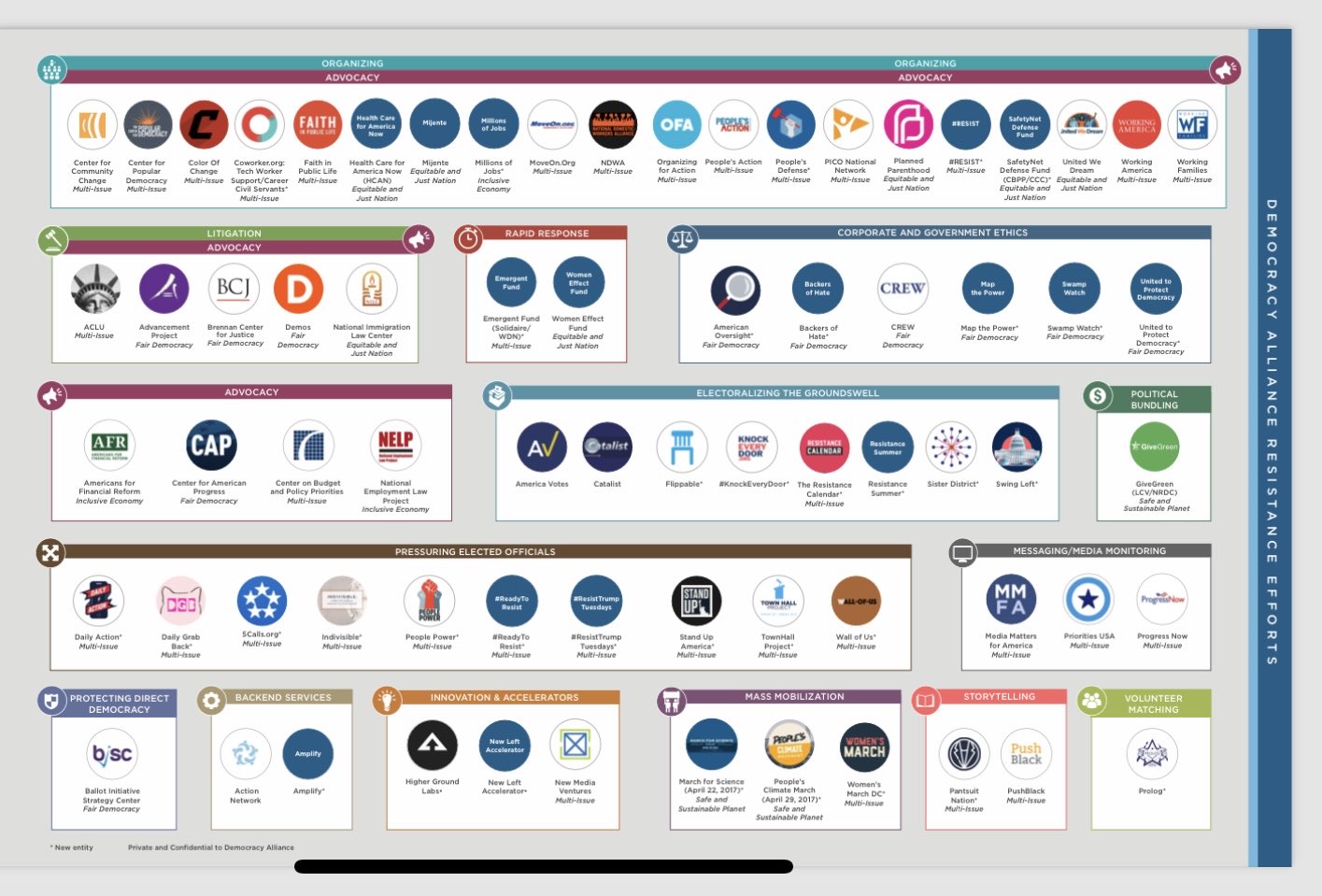
The Mandarin meeting's legacy endures because it weaponized hope against governance. Indivisible's Levin, echoing Alinsky, urges "disruptive tactics" to "quicken the outrage metabolism" in Congress. MoveOn's Victoria Kaplan preaches "persistence, repetition, not taking 'no' for an answer." And the Resistance Guide's clarion call—"We could take back Congress... block Trump's agenda, remove him from office, and ignite a progressive revolution"—has aged into prophecy, fueling everything from January 6 scrutiny reversals to DOGE sabotage. Yet cracks appear: turnout wanes when optics sour, as in 2025's scattered post-election flares. True power lies not in disruption but dialogue—something Otpor's architects forgot when exporting their model.
As Trump settles into his second term, the question looms: Will this network fracture under scrutiny, or evolve into something more insidious? The P3 Lab's "generational opening" for transformation hints at the latter. For patriots weary of scripted rage, the real resistance begins with exposure: follow the money from Mandarin suites to campus labs, from Serbian streets to American squares. Liberty's history demands no less