The Socialist's Gambit: How Zohran Mamdani Learned to Work the Room

“A kingdom is inherited by the sword, but preserved by wisdom.” Zera Yacob
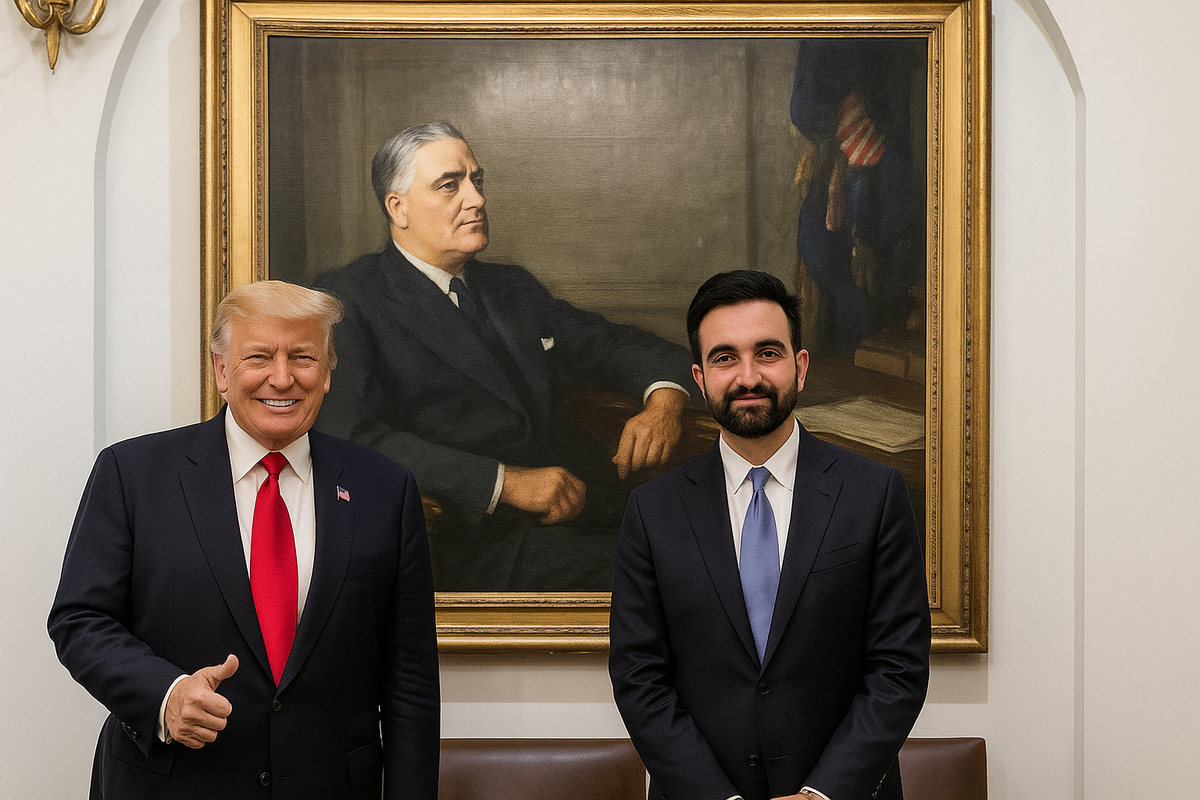
On Friday, New York City's incoming mayor sat across from Donald Trump in the Oval Office and the two men discovered, or at least performed the discovery, that they had far more in common than months of political theater had suggested. Zohran Mamdani, the democratic socialist who called the president a fascist and promised to arrest Benjamin Netanyahu, walked out after 45 minutes of what his chief of staff described as a "very productive" discussion about housing, utility costs, and keeping the city safe.
Trump, for his part, insisted he would "feel very, very comfortable" living under a Mamdani administration. He praised the mayor-elect as "different than your average candidate" and "a very rational person." He said he wants to be "a big help" to the young politician—not to hurt him, but to help make New York great again.
Zohran Mamdani flips his position entirely on the eve of his meeting with President Trump. pic.twitter.com/0GdVPesaC6
— Open Source Intel (@Osint613) November 20, 2025
Something is wrong with this picture. Not because the two men cannot find common ground—any two officials tasked with governing overlapping territories can locate areas of agreement. But because the speed and comprehensiveness of the reversal suggest neither man was simply discovering shared interests in the moment. Rather, the meeting itself appears to have been choreographed, with Trump playing a part he had explicitly rejected just weeks earlier when he was threatening to cut federal funding to the city if Mamdani became mayor.
What changed between those threats and Friday's love fest was not the political environment or Mamdani's positions, which remain as they were. What changed was the calculation. And that calculation reveals something about how power actually works in American politics, and about who really pulled the levers that elevated a democratic socialist from a state legislator representing a small portion of Queens to the office of mayor of America's largest city.
When Mamdani won the Democratic primary in September, observers noted the peculiarity of his coalition. Here was a man who made his name challenging the institutional Democratic Party, demanding that the city defund police and invest instead in what he called care infrastructure. He positioned himself as a voice for working people crushed by the cost of living, for tenants at war with landlords, for immigrants and the poor. His rhetoric was insurgent. His constituency was supposed to be outside the system.
“That’s OK, you can just say yes ... it's easier than explaining it. I don't mind.”
— Fox News (@FoxNews) November 21, 2025
President Trump jokes with NYC Mayor-elect Zohran Mamdani when he was asked to explain his comments on calling the president a “fascist.” pic.twitter.com/J9eWwXXtuc
Yet as his campaign gained traction, it became clear that Mamdani had access to resources, connections, and platforms that don't typically accrue to anti-establishment figures. His campaign benefited from volunteer networks already in place—networks built by organizations with deep pockets and professional infrastructure. The media coverage of his campaign, particularly in outlets catering to urban progressives, treated his ascent as inevitable, even inspirational.
The Forest Hills Stadium event in spring 2025, where he shared the stage with prominent progressive figures and academic voices sympathetic to postcolonial critique, functioned as something like a coronation. The attendees were not randomly assembled. They represented a particular ecosystem of funded activism, academic influence, and media platforms—the kind of infrastructure that requires institutional support to maintain.
But here is what matters: Once Mamdani won the general election, once it became clear that he would actually be mayor of New York, the calculation changed entirely. And that is because being mayor of New York is not primarily about ideology. It is about managing relationships with federal power, particularly with the president of the United States.
Mamdani understood this. Or more precisely, the people advising him understood it. His chief of staff Elle Bisgaard-Church, who sat in the Oval Office meeting, is a professional. She knew exactly what the meeting needed to accomplish: a public signal that the new mayor and the sitting president were not antagonists, that they could work together, that the city would not be cut off from federal resources.
Trump, for his part, understood something else. He understood that Mamdani, for all his socialist rhetoric and his talk of arresting Netanyahu, was fundamentally a politician who wanted to govern a city—which meant he wanted federal cooperation and access to federal power. Trump also understood that making an enemy of New York's new mayor served no tactical purpose. The city had elected whom it elected. The question was not whether to accept that result but how to use it.
So Trump made a choice. He would give Mamdani what he needed: legitimacy, access, and the appearance of partnership. In exchange, he signaled to the new mayor what the implicit terms would be. This is how you stay on my good side. This is what working with the federal government looks like. You talk about housing and public safety, and utility costs. You work on the issues that affect millions of New Yorkers. You do your job.
Notably, Trump did not discuss Mamdani's promise to arrest Netanyahu. He dismissed it. He moved past it. He signaled that it was campaign rhetoric, the kind of thing politicians say during campaigns that need not constrain their actual governance. This is an important signal for a young mayor who has built his political identity around moral clarity and uncompromising positions.
New York City mayor-elect Zohran Mamdani on U.S. President Donald Trump:
— Open Source Intel (@Osint613) November 21, 2025
I appreciated the meeting with the president and as he said, it was a productive meeting focused on a place of shared admiration of love which is New York City and the need to deliver affordability to New… pic.twitter.com/nhW2hG55nv
What is striking about the meeting's public presentation is what remains hidden beneath it. Mamdani did not ask Trump to explain his previous threats to cut federal funding. Trump did not ask Mamdani to walk back his attacks on the president. Neither man addressed the fundamental ideological differences between them. Instead, they performed agreement on issues that are, in reality, far more complicated than the public messaging suggests.
Take housing. Both men said they want to see more housing built and rents come down. This sounds straightforward. But how you build housing—what regulations you eliminate, what environmental reviews you streamline, what zoning changes you make—involves genuine disagreement about power, development, and who benefits from growth. Trump, a real estate developer, has clear views on reducing "onerous burdens" on developers. Mamdani ran on a platform of tenant protection and skepticism of unfettered development. They did not reconcile these positions in 45 minutes. They simply agreed to table the dispute and focus on the optics of partnership.
The larger pattern here is familiar. An insurgent figure wins an unexpected election by mobilizing grassroots energy and channeling public anger. But once in office, the insurgent discovers that governing requires cooperation with existing power structures. The transition from challenger to administrator is typically swift and nearly complete. Ideology becomes negotiable. Moral clarity yields to pragmatism.
Mamdani will govern New York for four years. During that time, he will face pressure from tenants and workers to follow through on his campaign promises. He will also face pressure from developers, business interests, and federal power to moderate those promises, to accept the constraints of governing within the existing system, to prove that he can be trusted with institutional responsibility.
Friday's meeting was the opening ceremony of that negotiation. Trump gave Mamdani permission to be mayor. Mamdani accepted the terms, which are simple: deliver basic competence, maintain order, cooperate with federal authority. In exchange, he gets the resources and respect that come with the office.
U.S. President Donald Trump on New York City mayor-elect Zohran Mamdani:
— Open Source Intel (@Osint613) November 21, 2025
I feel very confident that he can do a very good job. I think he is going to surprise some conservative people actually.
Contributed by @AZ_Intel_. pic.twitter.com/SYD8IQQGji
What the meeting did not address—what neither man will likely address in any public forum—is the question of who actually runs New York, and by extension, who benefits from Mamdani's governance and who does not. That answer will emerge not from rhetoric about shared purpose but from actions: which neighborhoods get investment and which do not, which development projects get approved and which face delays, which constituencies get access to the new mayor and which are left outside the door.
That is the real meeting that took place on Friday. Everything else was theater.
🚨 MAMDANI IS AT THE TOP OF THE POLLS — and if he wins, he’s going to do NOTHING but ENABLE the Hamasniks rioting on our college campuses. WHO IS GOING TO HOLD HIM ACCOUNTABLE?
— Councilwoman Inna Vernikov (@InnaVernikov) June 24, 2025
The Trump administration WILL — I just delivered almost 100 NAMES of VIOLENT RIOTERS who ravaged our… pic.twitter.com/uEpGjCuIeW
We are working on radical element tracking and narrative analysis pieces examining institutional power dynamics in NYC politics. This reflects his ongoing focus on how political movements navigate relationships with federal authority and institutional power structures.