The Socialists in Office Committee: How NYC's DSA Turns Volunteers Into Votes

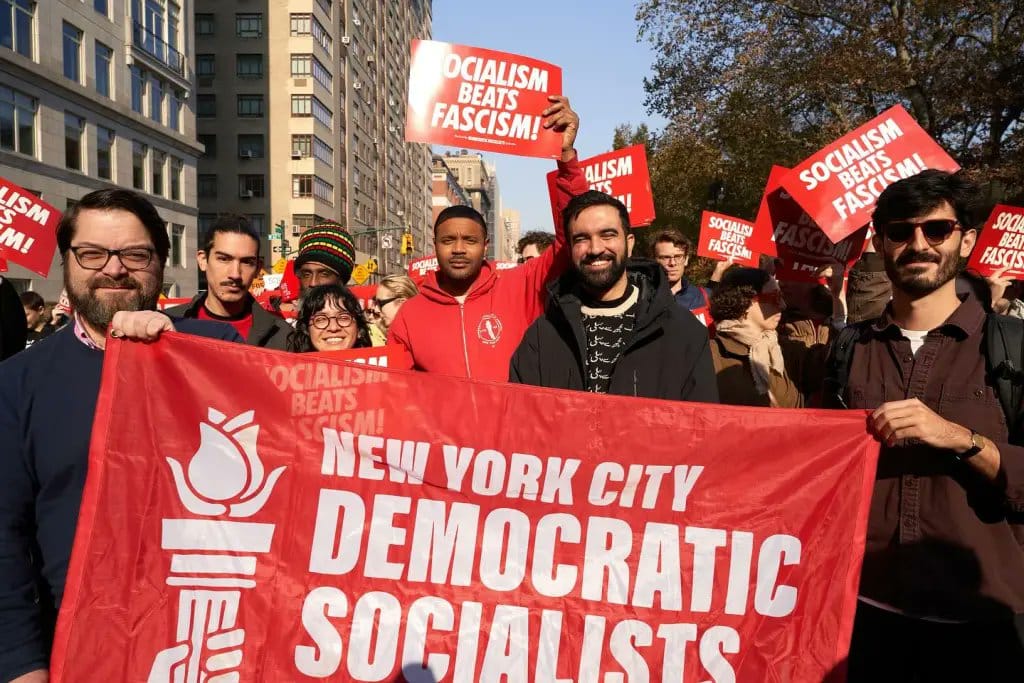
On December 3, weeks before Zohran Mamdani takes office as New York City's mayor, his ally Grace Mausser published a curious manifesto in Jacobin magazine. The NYC-DSA co-chair wasn't calling for rallies or protests. She was urging the organization's nearly 12,000 members to "plug Zohran organizers and supporters into lower-level city institutions en masse."
The target list reads like a civics textbook: community boards, parent-teacher associations, community education councils, library boards, park volunteer positions. These are the "small semigovernmental bodies" that Mausser says have been "typically ceded to less progressive forces." The goal, she writes, is to "create a sense of mass ownership over the city and build support for Zohran's agenda from the bottom of city government to the top."
Mausser sits on Mamdani's transition committee for small businesses and Minority-and Women-Owned Business Enterprise. In that capacity, she describes this infiltration as essential for "mobilizing and preparing lower levels of government to support and enact policy goals from the top"—even when facing "enemies" like Governor Kathy Hochul, who "is certainly not excited to implement the Mamdani agenda."
This isn't revolutionary socialism. It's something more methodical: the systematic colonization of New York City's democratic infrastructure through organizational discipline disguised as civic participation.
🚨On Mamdani’s Committee on Worker Justice Team, Bhairavi Desai Sees Genocide, Chaos, and Capitalism Everywhere
— Stu Smith (@thestustustudio) December 5, 2025
Bhairavi Desai, founding member of the New York Taxi Workers Alliance and now on Zohran Mamdani’s transition team for the Committee on Worker Justice, frames the… pic.twitter.com/wmzasDUyLc
Understanding how the DSA converts individual volunteers into coordinated political force requires examining the organization's internal structures. NYC-DSA maintains what it calls a "Socialists in Office" (SIO) committee. According to the chapter's own descriptions, this body serves two functions: "to coordinate and communicate with its officials" and "to insulate members from legislative pressure."
The coordination mechanism is straightforward. When the SIO committee "comes to a consensus and adopts a position," NYC-DSA assembly members "are expected to vote as a bloc." The language is revealing—not encouraged, not requested, but expected. Multiple NYC-DSA assembly members hold office in Albany. When the committee issues direction, they vote together.
This explains certain otherwise puzzling legislative patterns. Take June 2024, when NYC-DSA city councilors Tiffany Cabán, Alexa Avilés, and Shahana Hanif all voted against the city budget. They cited identical reasoning: the budget was "insufficient for the working class." Three different elected officials, representing different districts, articulating the same position using the same language, casting the same votes—because the SIO committee reached consensus.
Grace Mausser described Mamdani's relationship to this structure in an August 2025 Jacobin interview: "I mean, before he ran for assembly, he was deeply involved in other DSA races and was a well-known entity in the chapter. And then he's also been a leader in our Socialists in Office committee with other state-level legislators. You can't disentangle Zohran from DSA at this point."
The SIO committee's official platform includes universal healthcare, criminal justice reform, public banking, tenant protections, and "transferring to green energy." When members run for office, they must complete a questionnaire and answer questions at citywide and branch forums. Relevant branches vote on endorsements. If candidates pass branch votes, the Citywide Leadership Committee votes. Then, if elected, they're expected to attend weekly SIO committee meetings and vote as directed.
This is how twelve thousand individual memberships become a single voting bloc.
NYC's 59 community boards present a particularly attractive target for this strategy. Each board consists of up to 50 unsalaried members serving staggered two-year terms. Half are appointed by borough presidents. The other half are appointed based on City Council members' nominations.
The procedural detail matters: Council members nominate, but borough presidents appoint. A September 2025 City & State article noted that some borough presidents "have rejected or even ignored" council nominations. Staten Island Borough President Vito Fossella, for instance, simply ignored three nominees submitted by Council Member Frank Morano in June 2025.
This creates an opening. Council members nominate but cannot guarantee appointment. Yet Mausser's Jacobin piece suggests DSA members should pursue these positions—while DSA-endorsed council members already hold significant representation. NYC-DSA has four council members in Los Angeles, four in Minneapolis, four of 12 in Portland, and seven of 50 in Chicago, where they formed an official Democratic Socialist Caucus.
When DSA members apply to community boards in districts represented by DSA-endorsed council members, what happens? The council member nominates someone from their organizational network. If the borough president rejects the nomination, it becomes evidence of anti-democratic behavior requiring procedural reform—the kind of reform proposed in September 2025 legislation to give council members direct appointment authority.
If the borough president accepts the nomination, DSA gains another position on a body that votes on land use, liquor licenses, budget priorities, and development projects. Over time, enough appointments create voting blocs within the boards themselves.
Community boards meet monthly except in summer, and decisions require only a majority of members present. Average attendance runs lower than full membership. A coordinated bloc of even ten committed members on a 50-person board exercises significant influence when 30 members typically attend.
DSA describes itself as "entirely member-funded" and "primarily funded through membership dues." The national organization reported $6.16 million in revenue and $7.09 million in expenses on its 2023 tax return, with net assets of $3.69 million. National dues allocate 20 percent back to local chapters. Local dues fund chapter operations separately.
Yet this membership-funded model obscures something. The national DSA peaked at 95,000 members in 2021, then declined to 51,000 by October 2024. Membership dropped 46 percent while the organization maintained $3.69 million in net assets and $6.16 million in annual revenue. After Mamdani's November 2025 victory, membership surged to "over 80,000" according to DSA's own website.
Membership fluctuates dramatically based on electoral outcomes. The day after Alexandria Ocasio-Cortez won her 2018 primary, 1,152 people joined DSA—35 times the normal daily rate. When Bernie Sanders ran in 2020, membership jumped from 5,000 to 50,000 nationally. After Trump's 2024 election, DSA saw another membership spike.
What sustains the organization between these surges? National DSA reports "contributions and grants" as a revenue line separate from membership dues, though amounts are modest compared to dues. The DSA Fund, a 501(c)(3) sister organization, received $410,830 in contributions and grants in 2023 and ended the year with $661,631 in net assets. It granted $25,000 to the national DSA "for youth and student education."
Jacobin magazine, which published Mausser's manifesto, provides additional context. Founded in 2010 by Bhaskar Sunkara—who recruited colleagues from DSA to write and edit the magazine—Jacobin reported $1.52 million in revenue in 2018, mostly from subscriptions. The Jacobin Foundation, its 501(c)(3) arm, received a $100,000 grant from the Annenberg Foundation in 2017.
Sunkara has been explicit about his goals: "The broader political project of rebuilding the socialist movement in the US." Jacobin serves as both organizing tool and revenue generator, with subscription money supporting "organizing and events" that Sunkara describes as "loss-generating" but essential for movement building.
This creates an ecosystem: Membership dues fund operations, grants fund expansion, and media platforms provide both revenue and ideological infrastructure. When Grace Mausser outlines strategy in Jacobin, she's speaking through a publication founded specifically to rebuild the socialist movement and funded partly by foundation grants.
The Democratic Socialists of America sent top brass and International Committee reps to Honduras as election observers.
— Stu Smith (@thestustustudio) November 30, 2025
If I were in Congress, I’d have three simple questions.
Who invited them? Who paid for the flights and hotels? Did any Honduran party pick up the tab? pic.twitter.com/NADySgPGf9
National DSA existed since the 1980s but hovered around 5,000 members for decades. Then 2016 changed everything. Bernie Sanders' campaign and Trump's election created a "one-two punch" that drove exponential growth. By 2017, membership hit 32,000. In 2018, after Ocasio-Cortez's victory, it reached 55,000. It peaked at 95,000 in 2021.
NYC-DSA followed a similar pattern but more dramatic. In 2020, the chapter had 7,000 members. By July 2026, after Mamdani's primary victory, it had gained its 10,000th member. By August, membership reached 10,500. After his general election victory in November, the chapter topped 12,000 members.
A December 2024 internal analysis noted that 97 percent of current national DSA membership joined after 2016. A majority joined after 2019. This means nearly the entire organization consists of members who joined during periods of "intense growth" following electoral victories.
The 2020 membership explosion "was even more concentrated in large chapters with half of 2020's new members joining a chapter with over 1000 members—the first and only time this has occurred from 2016 to August 2024." NYC-DSA, the country's largest chapter, drove this concentration.
As of August 2025, over 250 DSA members held public office nationwide, with 90 percent elected after 2019. That includes 96 city councilors and county commissioners, eight mayors or county executives, and members of Congress. The organization evolved "from a system of annual mailed membership checks to monthly recurring payments tied to income."
Zohran Mamdani’s “Community Safety” team is full of activists who call cops “violence workers,” want prisons “obsolete,” and vow to shrink the NYPD.
— Stu Smith (@thestustustudio) December 8, 2025
New Yorkers are test subjects in what may become the largest anti-policing experiment in the world.
My latest for @CityJournal pic.twitter.com/p5Z6L1veia
When Mamdani announced his 17 transition committees on November 24, 2025, he tapped more than 400 people. The list included NYC-DSA co-chairs Gustavo Gordillo and Grace Mausser. Gordillo joined the economic development and workforce development committee. Mausser joined the small businesses and Minority-and Women-Owned Business Enterprise committee.
Several other DSA members received committee positions, alongside former NYC officials like Fire Commissioner Laura Kavanagh, Police Commissioner Rodney Harrison, Health Commissioner Oxiris Barbot, Council Speaker Christine Quinn, and Manhattan Borough President Ruth Messinger. The mix suggested calculated balancing: experienced administrators for credibility, DSA organizers for ideological alignment.
But Mamdani created two committees that no previous mayor had established: worker justice and community organizing. As he explained at the East Harlem press conference: "There has too often been a distance between the intent of what City Hall does and the impact of what it actually has in any given neighborhood across the five boroughs."
The community organizing committee addresses exactly what Mausser described in her Jacobin piece: mobilizing "lower levels of government to support and enact policy goals from the top." It institutionalizes within city government the same coordinating function that the SIO committee provides within the legislature.
By the time Mamdani announced his transition committees, more than 70,000 people had submitted resumes through an online portal. Their average age was 28. This represents a generation politicized during Sanders' campaigns, Trump's presidency, and the George Floyd protests—the same events that drove DSA membership from 5,000 to 95,000.
Mausser's Jacobin piece named Governor Kathy Hochul as an explicit "enemy" who "is certainly not excited to implement the Mamdani agenda." This despite Hochul endorsing Mamdani and helping "calm the nerves of the Democratic establishment."
The antagonism isn't personal—it's structural. Mamdani ran promising universal childcare, free bus service, frozen rents, and higher minimum wages. Hochul controls state budget allocations that would fund these programs. She initially opposed "taxing the rich" to pay for them, though she said she wanted to work with Mamdani on childcare.
In 2021, NYC-DSA waged a campaign that secured increased taxes on millionaires and billions for public schools, rent relief, and undocumented workers not covered by federal stimulus. The mechanism was mobilization: rallies, phone banking, legislative pressure. As Nathan Gusdorf, executive director of the Fiscal Policy Institute, noted in a November 2025 interview, New York State runs high budget surpluses that could theoretically fund Mamdani's agenda without new taxes.
But funding programs from existing surpluses doesn't advance the redistributive agenda. "Taxing the rich is the piece that makes the whole platform a realistic one and moves it out of a struggle for scant resources," Gusdorf explained. The goal isn't just funding programs—it's wealth redistribution itself.
This is where "mobilizing lower levels of government" becomes essential. If community boards across the city pass resolutions supporting Mamdani's agenda, if library boards do the same, if parent-teacher associations align with his priorities, it creates political pressure that transcends normal legislative processes. Each resolution becomes evidence of grassroots support. Each board vote demonstrates that ordinary New Yorkers want these policies.
Except the boards won't be filled with ordinary New Yorkers making independent decisions. They'll be filled with DSA members who attended weekly SIO committee meetings, who filled out questionnaires about their political commitments, who passed through branch votes and Citywide Leadership Committee approval before running for office—or who simply applied for volunteer positions after reading Mausser's Jacobin article.
None of this is illegal. Filling community board positions, joining PTAs, volunteering at libraries—these are forms of civic participation that democracy depends on. The question is whether organized capture of these positions still constitutes civic participation.
Consider the mechanics: An individual applies to join a community board out of genuine interest in neighborhood issues. A DSA member applies to join a community board after reading an organizational directive to "plug Zohran organizers and supporters into lower-level city institutions en masse."
Both technically do the same thing. But one makes independent decisions based on community input and personal judgment. The other attends weekly SIO committee meetings where consensus positions are reached and bloc voting is expected.
The City Charter requires that community board members "reside, work, or have some other significant interest in the district." It requires that appointments "fairly represent all segments of the community." But it includes no mechanism for evaluating whether board members function as independent representatives or as disciplined agents of external organizations.
Borough presidents already struggle with this. A July 2024 Comptroller audit found that some "stated that their control over appointments is limited since half of Community Board member appointments must come from City Council member nominations and it is difficult to recruit some groups, such as younger residents."
When DSA targets exactly these hard-to-recruit positions—encouraging young members to fill volunteer spots—it solves the recruitment problem while creating a representation problem. The board gains younger members but loses ideological diversity. It gains engaged volunteers but loses independent voices.
That Mausser published her strategy in Jacobin rather than announcing it at a rally or press conference suggests something about how the organization understands itself. Jacobin describes itself as "a leading voice of the American left, offering socialist perspectives on politics, economics, and culture." It has 75,000 print subscribers and over 3 million monthly web visitors.
Founder Bhaskar Sunkara has been explicit: The magazine exists to advance "the broader political project of rebuilding the socialist movement in the US." He initially recruited colleagues from DSA to write and edit the magazine. Noam Chomsky, called "Jacobin Comrade #1" in donation solicitations, praised it as "a bright light in dark times."
Publishing the infiltration strategy in Jacobin serves multiple functions. It coordinates the membership without requiring formal directives. It signals seriousness to political opponents—this isn't just campaign rhetoric but documented strategy. It provides ideological cover by framing the takeover as democratic participation rather than institutional capture.
Most importantly, it creates a record. When DSA members begin flooding community board applications, when they start appearing at PTA meetings in coordinated numbers, when library boards suddenly pass resolutions supporting Mamdani's agenda, observers can look back at the Jacobin article and understand: This was always the plan.
The article appeared December 3, 2025. Mamdani takes office January 1, 2026. Community board appointments typically occur each spring. PTAs hold elections in fall. The timeline aligns: Publish the strategy in December, mobilize members over winter, execute in spring and fall 2026.
By the time critics notice the pattern, dozens of positions will be filled. By the time procedural reforms are proposed, DSA members will be defending "grassroots participation" against "elite gatekeeping." The language will shift from capturing institutions to democratizing them, from infiltration to inclusion, from organized takeover to organic community engagement.
🚨 Mamdani’s Community Safety Team Now Includes NYU Scholar Who Calls Courts a Source of “Perpetual Punishments” and Casts Child Protective Services as Police
— Stu Smith (@thestustustudio) November 29, 2025
Justine Olderman now holds a joint appointment as a Distinguished Scholar in Residence at NYU Law’s Center on Race,… pic.twitter.com/tMuTSWw2Cy
The paradox is that Mausser might be right about one thing: Community boards have often been "ceded to less progressive forces." They're time-intensive volunteer positions that attract retirees, homeowners with stakes in local development, and people with flexible schedules. Younger renters, working parents, and hourly wage workers are underrepresented.
If DSA mobilizes these underrepresented groups, it could make boards more demographically representative. But representation has two meanings. Demographic representation means boards that look like their communities. Ideological representation means board members who exercise independent judgment about community interests.
DSA's model offers the first while undermining the second. A 28-year-old renter serving on a community board adds demographic diversity. But if that member attends weekly SIO committee meetings and votes as directed by organizational consensus, they're not representing their community—they're representing DSA.
The City Charter requires appointees to "have a residence, business, professional or other significant interest in the district." It says nothing about organizational loyalties. A DSA member who lives in the district meets the residency requirement even if their board votes are determined by an organization headquartered elsewhere.
This creates a vulnerability in New York City's democratic infrastructure that Mausser has identified and plans to exploit. Community boards, PTAs, and library volunteer positions operate on an assumption of independent civic participation. They're structured for individuals making autonomous decisions about community needs. They're not designed to resist coordinated infiltration by an organization whose members "are expected to vote as a bloc."
The same vulnerability exists in any system that depends on volunteers. Block associations, tenant organizations, civic groups—all can be captured by small numbers of disciplined members working from common strategy. Once captured, these organizations become force multipliers, each amplifying the others' positions and creating the appearance of broad-based support.
🚨 Mamdani Community Safety Pick Says NYPD “Harass, Abuse, and Kill” Trans People and Pushes to Decriminalize Sex Work
— Stu Smith (@thestustustudio) November 26, 2025
Meet Deborah Lolai, now a clinical instructor at Harvard Law’s LGBTQ+ Advocacy Clinic and a member of Zohran Mamdani’s Transition Committee on Community Safety.… pic.twitter.com/qKbfMVfnEP
Mamdani's administration begins January 1. His Tax the Rich campaign launched November 15 with a Union Square rally. His transition committees include both establishment figures and DSA organizers. His agenda requires state funding that Hochul has been reluctant to provide. His co-chairs published a strategy for mobilizing government from the bottom up.
Over the next year, watch which volunteer positions fill with which applicants. Watch which community boards suddenly start passing resolutions supporting mayoral initiatives. Watch which PTAs adopt platforms aligned with DSA priorities. Watch whether city council members begin proposing reforms to give themselves more direct appointment authority over boards.
Watch whether Grace Mausser's prediction comes true: that "mobilizing and preparing lower levels of government to support and enact policy goals from the top" proves more effective than "pressuring high-level decision-makers."
If it works, if systematic infiltration of civic institutions generates sustained political pressure that forces policy changes despite opposition from elected officials like Hochul, then Mausser will have demonstrated something significant about how democratic systems can be captured without violating democratic norms.
The members will be real residents. The applications will be properly submitted. The appointments will follow established procedures. The votes will be democratically conducted. And the outcomes will be determined by an organization whose 12,000 members meet weekly to reach consensus about how their elected officials should vote.
That's not a conspiracy. It's just organization, which is why it works.