The War on the Jews Has Reached the End of the Earth
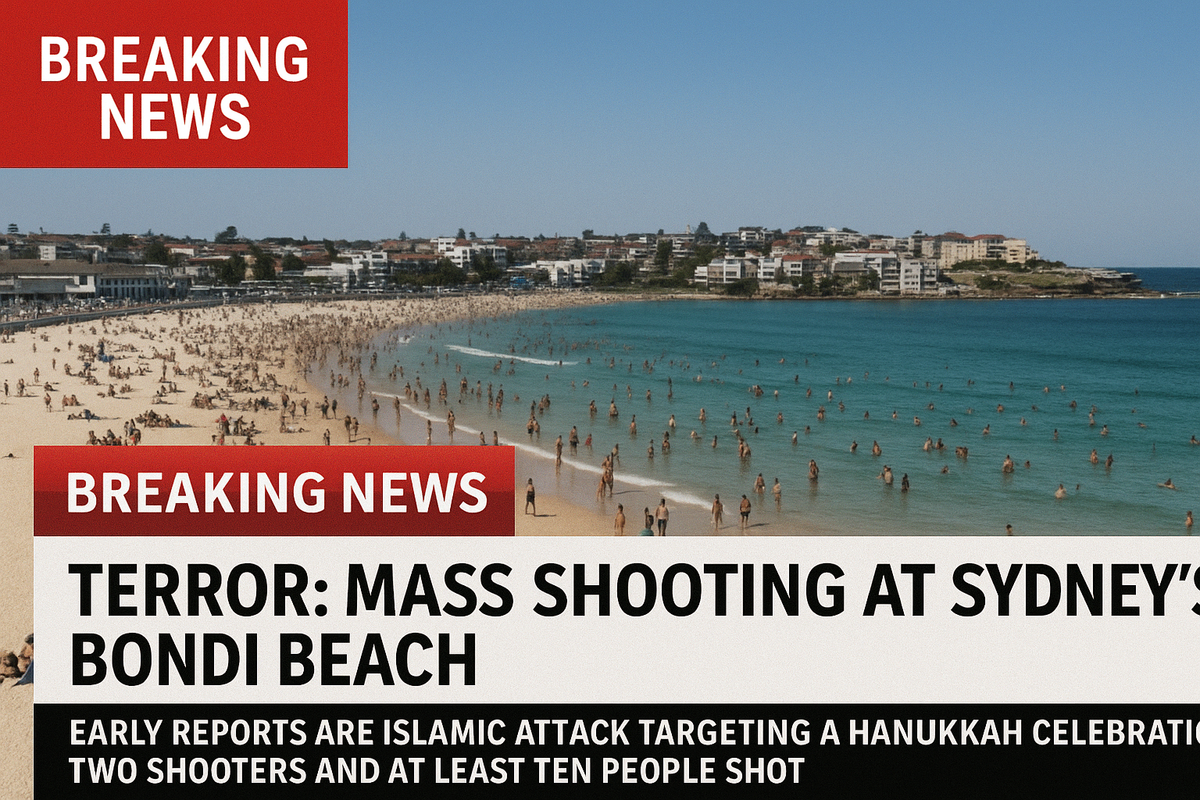
That is what they call Australia—a land defined by its remoteness from the world's troubles, a sun-drenched fortress of leisure and safety. And within that fortress, there is perhaps no place more symbolic of the carefree Western life than Bondi Beach. The golden sand, the turquoise water, the bodies in motion. It is a place where history is supposed to feel very far away.

But history has a way of finding the Jews, no matter how far we travel, no matter how safe we feel, and no matter how brightly we try to shine our light.
On Sunday evening, as the sun dipped low over the Pacific, thousands of Jews and their neighbors gathered for "Chanukah by the Sea." They were there to mark the first night of the Festival of Lights. They were there to eat donuts, to sing songs, and to watch a giant menorah defy the coming darkness.
Instead, the darkness fought back.
At 6:45 p.m., the crack of gunfire shattered the rhythm of the waves. Twelve people lie dead. More are wounded. The blood of innocent celebrants has stained the white sands of Bondi.
We are told by the New South Wales Police that two gunmen, dressed in black, perched themselves on a pedestrian bridge overlooking the park—a vantage point of cowardice—and opened fire on the families below. We are told that one of the gunmen, identified as Narveed Akram, is dead, and another is in custody.
But we do not need a police report to tell us what this was. We know what this was.
This was not a random tragedy. This was not a "senseless act of violence," that favorite, anesthetic phrase of the political class. This was a pogrom. This was a hunt. This was the specific, targeted slaughter of Jews for the crime of being Jews, committed on the very night we celebrate our survival against those who sought to erase us two thousand years ago.
The irony is as bitter as it is devastating. Hanukkah is the story of a small band of Jewish zealots, the Maccabees, who refused to bow to the Seleucid Empire. They refused to extinguish their distinctiveness. They fought for their right to worship, to exist, and to light a candle in the Temple.
Two millennia later, in a flourishing democracy in the Southern Hemisphere, Jews gathered to remember that victory. And for that act of remembrance, they were massacred.
MASS SHOOTING AT BONDI BEACH
— Drew Pavlou 🇦🇺🇺🇸🇺🇦🇹🇼 (@DrewPavlou) December 14, 2025
MULTIPLE GUNMEN
THIS IS HAPPENING LIVE pic.twitter.com/IuF5hKI3L9
For years now, those of us who pay attention have been warning that the "Golden Age" of Diaspora Jewry is coming to a close. We have warned that the safety we enjoyed in the second half of the 20th century was a historical anomaly, not a permanent state of affairs. We watched the rise of antisemitism in Paris, where Jews were murdered in supermarkets and elementary schools. We watched it in Pittsburgh, where a gunman stormed the Tree of Life synagogue. We watched it in Israel, on October 7, when the world saw the face of absolute evil and then, shockingly, told the Jews to exercise restraint.
And now, we see it in Sydney.
For a long time, Australia felt immune. It is an island nation with strict borders and, famously, some of the strictest gun laws in the world. The last time Australia saw a massacre of this scale was in 1996, at Port Arthur. That tragedy changed the nation’s laws.
But you cannot legislate away hatred. You cannot confiscate an ideology of annihilation.
DRONE FOOTAGE SHOWS MOMENT POLICE SHOT TERRORIST IN SYDNEY pic.twitter.com/irRzkXTjHO
— Drew Pavlou 🇦🇺🇺🇸🇺🇦🇹🇼 (@DrewPavlou) December 14, 2025
The identity of the gunman, Narveed Akram, will surely lead to difficult conversations that the Australian political establishment would prefer to avoid. We already see the hesitation in the official statements. Prime Minister Anthony Albanese calls the scenes "shocking and distressing." Opposition leader Sussan Ley speaks of the "loss of life."
They are not wrong, but they are insufficient. To treat this as a crime is to miss the point. This is a battlefront.
UNARMED AUSTRALIAN DISARMED TERRORIST DURING MASS SHOOTING IN SYDNEY
— Drew Pavlou 🇦🇺🇺🇸🇺🇦🇹🇼 (@DrewPavlou) December 14, 2025
BALLS OF STEEL
AUSTRALIAN OF THE YEAR pic.twitter.com/NBRvcGnKKM
The enemies of the Jewish people—whether they are white supremacists in dark corners of the internet or Islamist extremists radicalized by global networks of hate—do not care about geography. They do not care if you are a Zionist in Tel Aviv, an Orthodox Jew in Brooklyn, or a secular family on a beach in Bondi. They see us as one body. And they want that body destroyed.
It is uncomfortable to say this. It is uncomfortable to acknowledge that the West, for all its tolerance and diversity, has failed to inoculate itself against the world’s oldest virus. We want to believe that if we just keep our heads down, if we are just "good" citizens, the wolf will pass over our door.
Sunday night proved, yet again, that the wolf is hungry, and the door is unlocked.
But there is another part of this story, one that we must hold onto just as tightly as we hold onto our grief.
Amidst the chaos, amidst the screaming beachgoers fleeing the bridge, there was a spark of the Maccabean spirit. Reports indicate that a civilian—an unarmed man—did not run. He saw the gunman. He saw the weapon. And he charged.
This man tackled one of the terrorists. He ripped the firearm from his grasp. He pinned the murderer to the ground as he tried to crawl away.
We do not yet know this hero's name. But we know his character. In that split second, facing the ultimate terror, he chose action over paralysis. He chose life. He embodies the lesson of Hanukkah far more than any speech or ceremony could.
The lesson is this: We do not get to choose the times we live in. We do not get to choose whether our enemies rise up against us; history teaches us that they almost always do.
Initial reports from the scene are that more than 50 bullets were fired at the crowd of Jewish Australians who had come to Bondi Beach for a Hanukkah event ahead of the first night of Hanukkah.
— Emily Schrader - אמילי שריידר امیلی شریدر (@emilykschrader) December 14, 2025
This is what “Globalize the Intifada” meanspic.twitter.com/HisHZPawW1
What we get to choose is how we respond.
We can respond with fear. We can stop wearing our stars of David. We can take down our mezuzahs. We can cancel our "Chanukah by the Sea" events next year, retreating behind high fences and armed guards, quieting our joy to avoid offending those who wish us dead. We can accept the darkness.
Or, we can be like the man who charged the gunman. We can be like the families who, I guarantee you, will light their menorahs tonight in Sydney, even with shaking hands.
The terrifying reality of 2025 is that there is no "safe place" left on the map. The distance from the Middle East to Bondi Beach is zero. The ideological war against the West and against the Jews has collapsed all distance.
This realization is painful. It shatters the illusion of the Lucky Country. It forces Australian Jews, and Jews everywhere, to accept a burden we did not ask for: the burden of being the sentinel on the wall.
Israeli President Isaac Herzog called this a "cruel attack on Jews who went to light the first candle." He is right. But the purpose of the attack was not just to kill Jews; it was to kill the spirit that the candle represents. They want to turn a festival of light into a memorial of death.
They will fail.
Breaking: shooting attack at a Hanukkah event in Bondi beach in Sydney Australia. Multiple injuries. The terrorists have been apprehended. Shocking videos from the scene show attendees running for their lives as the terrorists opened fire pic.twitter.com/Myl1edjWcp
— Brooke Goldstein (@GoldsteinBrooke) December 14, 2025
They will fail because we have seen this before. We have seen it in every century and on every continent. We have stood at the graves of our martyrs, recited the Kaddish, and then, invariably, we have gone home and lit the fire.
The sand at Bondi Beach will be washed clean by the tide. The police tape will come down. The politicians will issue their condemnations and move on to the next news cycle.

But we will remember. We will remember the twelve souls who went to the beach to celebrate a miracle and became martyrs. We will remember that civilization is fragile, that barbarism is always at the gate, and that the only thing holding it back is the willingness of free people to fight for the light.
Tonight is the second night of Hanukkah. The tradition requires us to add a candle. We increase the light, specifically when the night is darkest.
So, light the second candle. Light it for Sydney. Light it for the twelve. Light it to show them that we are still here, that we are not afraid, and that we are not going anywhere.
Light a candle tonight. Wherever you are, light the second candle of Hanukkah. Post it on social media to show the Jewish community in Australia that they are not alone. Do not let the darkness win.