A Brazilian beauty queen built a very public life on very dirty money.
Operation Luxury.” Monteiro, who owned a women's fashion store that cops said inspired the operation's codename, boasted about her vacations

Then she wrote the sentence that will follow her into every courtroom.
Sara Monteiro wanted everyone to know she was winning.
The 36-year-old former Miss Uberlandia posted yachts. She posted Tomorrowland. She posted vacations that her women's fashion boutique in Sao Paulo had no business funding. And on January 1, 2026, she posted a message to enemies real and imagined: "This year is the year of karma. Good luck to everyone who tried to destroy me for nothing, I'm looking forward to the harvest."
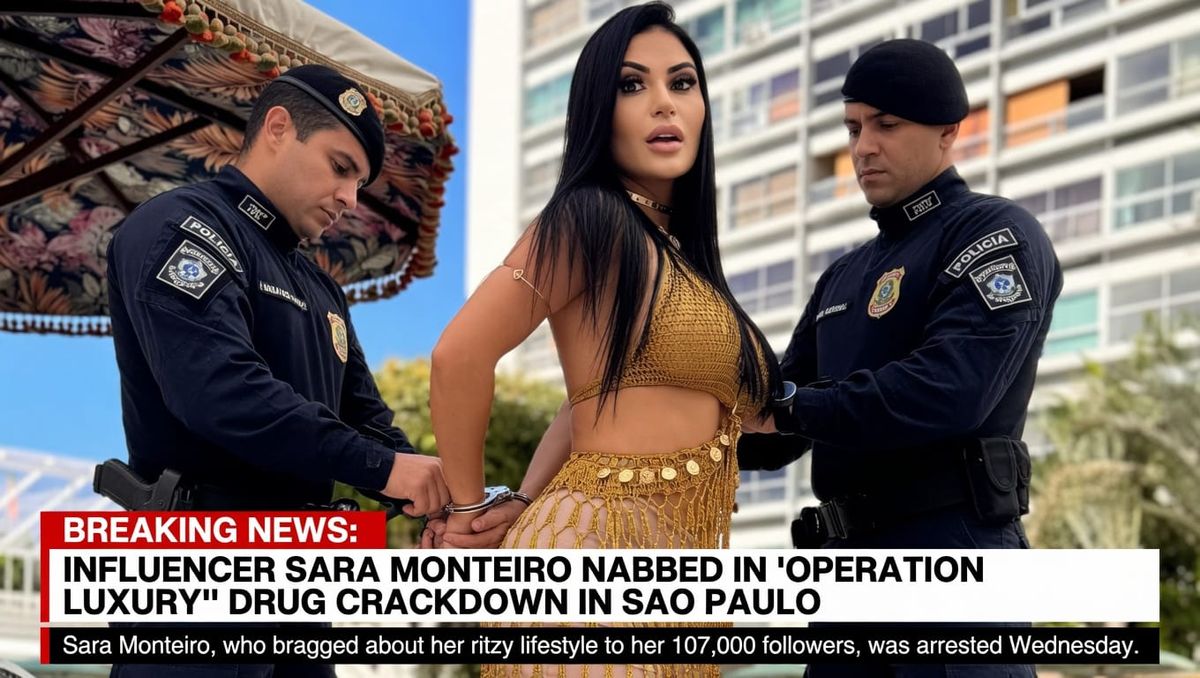
On Wednesday, Brazilian federal police harvested her.

Monteiro was arrested in Sao Paulo as part of what investigators branded Operation Luxury, a wide-scale drug trafficking probe that police say followed the money from marijuana shipments moving across Brazil directly into the lifestyle she broadcast to 107,000 followers. The operation's name was reportedly inspired by her own fashion store, a detail investigators seemed to enjoy.
The charges pending against her include money laundering, drug trafficking, and participation in an organized criminal enterprise. Police say she was spotted walking her dog near a rural property being used as a drug transport base, a detail that sounds mundane until you understand what it implies about how comfortable she had become operating in proximity to the operation.
Her husband remains at large. Investigators say he moved more than $2.1 million in transactions that cannot be explained by any legitimate income. He was living well too.
Operation Luxury has so far netted 24 arrests, 20 seized vehicles including Porsches and BMWs, and 5.9 tons of marijuana. The lead investigator, Rafael Herrera, described Monteiro's lifestyle in the precise bureaucratic language that lands hardest in court: "economically incompatible" with her reported income.
That phrase carries legal weight in Brazilian criminal procedure. It is the foundation of a money laundering case, and it is difficult to defend against when the defendant has spent years publishing documentary evidence of the incompatibility on Instagram.
This is the part that should interest anyone who studies how criminal organizations fail. Operational security breaks down in a hundred ways, but few are as consistent as status signaling. The money comes in and the first instinct is to prove to someone, anyone, that it arrived. The yacht photo. The festival wristband. The fashion boutique that does not quite add up. The karma post.
Law enforcement did not need to build a complicated theory of the case. Monteiro built it for them, one post at a time, in front of 107,000 witnesses.
The Brazilian press has noted the irony of the January 1 post with some enthusiasm, and understandably so. But the irony is almost too clean. What the karma post actually reflects is the mindset that made the rest of it possible: the belief that visibility is protection, that a public persona is an alibi, that anyone who questions the source of the money is simply a hater to be dismissed.
That belief is not unique to Sao Paulo. It runs through every influencer-adjacent financial fraud story of the past decade, from crypto pump schemes to the more prosaic money laundering operations where Instagram becomes an inadvertent ledger. The platform rewards performance of wealth. It does not ask where the wealth came from. It turns out prosecutors do.
Monteiro's case is still unfolding. She has not been convicted. Her husband has not been found. Operation Luxury may yet expand. But the core of the case has already been made public, in her own words and her own images, archived and indexed and available to anyone with a warrant or a search bar.
She said she was looking forward to the harvest.
She was not wrong about that.
The Unredacted covers money, power, and the people who think the rules don't apply to them.