I Read the DSA's "Day Without Capitalism" So You Don't Have To, and Comrade, You Are Going to Love Your One Day Off
The DSA platform wants to abolish the Senate. Problem: Article V of the Constitution says equal Senate representation is the one thing you can't amend away. Their own plan requires demolishing the system, not reforming it. It was never hidden. They posted it with cartoons.


The DSA's new platform opens by asking you to imagine a day off without capitalism. It has cartoons. I read all of it, including the part where they accidentally quote Marx and the part where their own plan runs into a clause the Constitution says can't be repealed.
"The most important thing we can do is take that (American) empire down from within"
— Canary Mission (@canarymission) July 5, 2026
DSA members make it clear what their goal is: destroying America. pic.twitter.com/Txy5Na21UG
I want you to understand that I came to the Democratic Socialists of America's new platform in good faith, the way you'd come to any document that a sitting Speaker of the House called amazing that anyone would put it on paper.
Here's the thing about the paper, though. It was never hidden. There was no leak, no whistleblower, no source hurrying through a parking garage. The DSA adopted this platform in June, with a title, a ratifying body, and recorded votes, and then posted it on a website with a fist on it. Our own Stu Smith read the whole thing and reported it weeks before the national press noticed. He didn't get it from a source. He got it from the tape. The only scandal here is how long everyone else took to click the link.
So I clicked the link. And I need you to sit down for this, because the first thing on it is a cartoon of a person waking up.
The platform is called "Workers Deserve More." It opens not with a policy, not with a number, not with anything you could cost out, but with a guided meditation. The first words are: "Imagine taking a day off from work in a future without capitalism." And then, so you don't strain yourself imagining, they drew it for you.
Let me walk you through it. Slowly. Because the whole thing collapses if you go slowly, and going slowly is the most hostile thing I can do to it.
🚨 DSA declares a socialist mandate over 3 million New Yorkers: “We control these areas”
— Stu Smith (@thestustustudio) June 25, 2026
On tonight’s DSA call, the message was clear. DSA is staking its claim to New York City and warning challengers it is not worth trying.
“Don’t even try it. We control these areas.”
As DSA… pic.twitter.com/t1zl1eXshS
First, you will love your job
Here is the platform's opening promise about your work, verbatim: "You enjoy your work; it's interesting to you, and you're well trained for it. You work as much as you are able and no more than needed."
You work as much as you are able and no more than needed.
I want to be fair to the DSA here, because this sentence is not original to them. They did not invent the idea that under socialism you'll simply want to work. That was Marx. It's the actual load-bearing assumption of the entire project: that the worker, correctly re-socialized, comes to see laboring for the commune as his favorite hobby. It is not a throwaway line. It is the thing the other 4,000 words are standing on. And they opened with it, in the friendly voice you'd use to describe a spa day.
The obvious question, the one a curious ten-year-old asks, is: what happens to the guy who is able but does not want to? The platform is silent. The cartoon does not depict him. He is the most important character in the history of every socialist state and he does not appear in the brochure.
Second, and I cannot stress this enough, no bills
The next section is titled, functionally, "no bills." I'm paraphrasing the vibe. The actual text: "Speaking of bills: you don't really have them anymore. You have no debt. You don't need health insurance. You don't pay a mortgage or have a landlord, because comfortable housing is a human right."
Notice the trick, and it is a good one. Everything you currently pay for is reclassified as a human right, and a human right is free. Housing: free. Retirement: "publicly funded." Food, medicine, energy, transportation: "they are common goods and utilities."
Now. Somebody builds the housing. Somebody grows the food. Somebody keeps the lights on. In the previous paragraph these people were doing it because they enjoy their work. So the entire economy runs on the honor system of a workforce that has been emotionally reprogrammed to find joy in provisioning strangers, forever, for free, and the word for the organizing force that guarantees all of this is left blank.
We both know what fills the blank. It's the state. It's always the state. But you can't say "the state" in a socialist utopia, because the whole grand promise is that eventually the state withers away, so instead you say "common goods and utilities" and you draw a nice picture of a kitchen.
🚨 DSA now says support for its radical Workers Deserve More platform will be incorporated into the endorsement process for candidates.
— Stu Smith (@thestustustudio) July 15, 2026
“Having our endorsed candidates supporting the program, it’s a requirement now.” https://t.co/fP8n413h4f pic.twitter.com/vn3g1RT48C
Third: what you actually don't have
Here's the part the cartoon skips. What you lose in this arrangement isn't your bills. It's your recourse. In a world where your housing, your food, your medicine, and your retirement are all administered by the community's organizing force, the community's organizing force now has an opinion about you. And if that opinion sours, there is no landlord to sue, no other grocery store, no second doctor, no exit. There's just the one provider, and it has noticed you're a problem.
And here's the part that should worry you, if you're the kind of person who takes a group at its word about how it treats the people inside it. The DSA wrote a platform about expanding democracy to everyone. Then it spent an entire Sunday fighting over who gets to vote inside its own organization. A group's internal rules are the beta test for its external ones. If the movement promising you a "real democracy" can't settle who's entitled to a ballot at its own meeting, you might want to read the fine print on the one they're drafting for the rest of us.
The platform does not mention any of this. It mentions the movies.
Fourth: your day off, which is one day
This is my favorite part, so I'm going to quote it in full and then we're going to talk about Karl Marx again.
"What do you do on your day off? Maybe in the morning, you walk your kids to school, run errands, or go to a doctor's appointment. In the afternoon, you might play a sport, practice a new skill, read, plan a trip. In the evening, you could meet up with friends or family and eat together, maybe go to the movies or down to the park."
Morning: errands. Afternoon: a hobby. Evening: recreation.
If that structure sounds familiar, it's because you've read it before, in a book the DSA is very careful not to cite here. From Marx and Engels, The German Ideology, describing daily life once labor is no longer forced on you: society makes it possible "to do one thing today and another tomorrow, to hunt in the morning, fish in the afternoon, rear cattle in the evening, criticise after dinner, just as I have a mind, without ever becoming hunter, fisherman, herdsman or critic."
Hunt in the morning. Fish in the afternoon. Criticise after dinner. Walk your kids to school in the morning. Play a sport in the afternoon. Go to the movies in the evening. The DSA didn't paraphrase Marx. They redrew his 1846 daydream in a modern art style and put a fist on it.
🚨 DSA National Leader David Jenkins Says the Quiet Part Out Loud: “Our Goal Is Communism”
— Stu Smith (@thestustustudio) April 13, 2026
You may have seen the recent New York Post piece on David Jenkins, the DSA mime leader who also holds national leadership. Since mimes are usually silent, it seemed worth letting people… pic.twitter.com/SxqyferacS
And here's the tell buried in that beautiful sentence, the one Marx wrote and the DSA inherited without reading closely: "without ever becoming" a hunter, a fisherman, a critic. The whole promise is that you get to do everything and become good at nothing. It sounds like freedom. It's a description of a society staffed entirely by amateurs. Every actual attempt to run a country this way, rotating people through jobs they never mastered because mastery was bourgeois, produced the same result, and the result was not "the movies." It was the food not showing up.
Fifth: the small print, which is a new constitution the current one won't allow
Now, you'd think a document this focused on your leisure would keep the governance stuff to a footnote. It does not. Buried past the cartoons, in the plainest possible language, is the actual ask. The DSA writes that its goal is to "win the battle for democracy, draft a new constitution, and create a democratic socialist republic."
A new constitution. That's not me characterizing them. That's the sentence.
And the specifics are all there, stated flatly, no cartoon: "Abolish the Electoral College. Replace the President and Supreme Court with an executive and judiciary chosen by and subordinate to Congress." Plus, in the next section, "abolish the Senate."
Read that "subordinate to Congress" part twice, because it's doing an enormous amount of quiet work. The courts become subordinate to the legislature. Which is another way of saying the thing that currently tells the majority "no, you can't do that" is redesigned to say "yes." A judiciary that answers to the people who write the laws is not a check on power. It's a rubber stamp with a robe on.
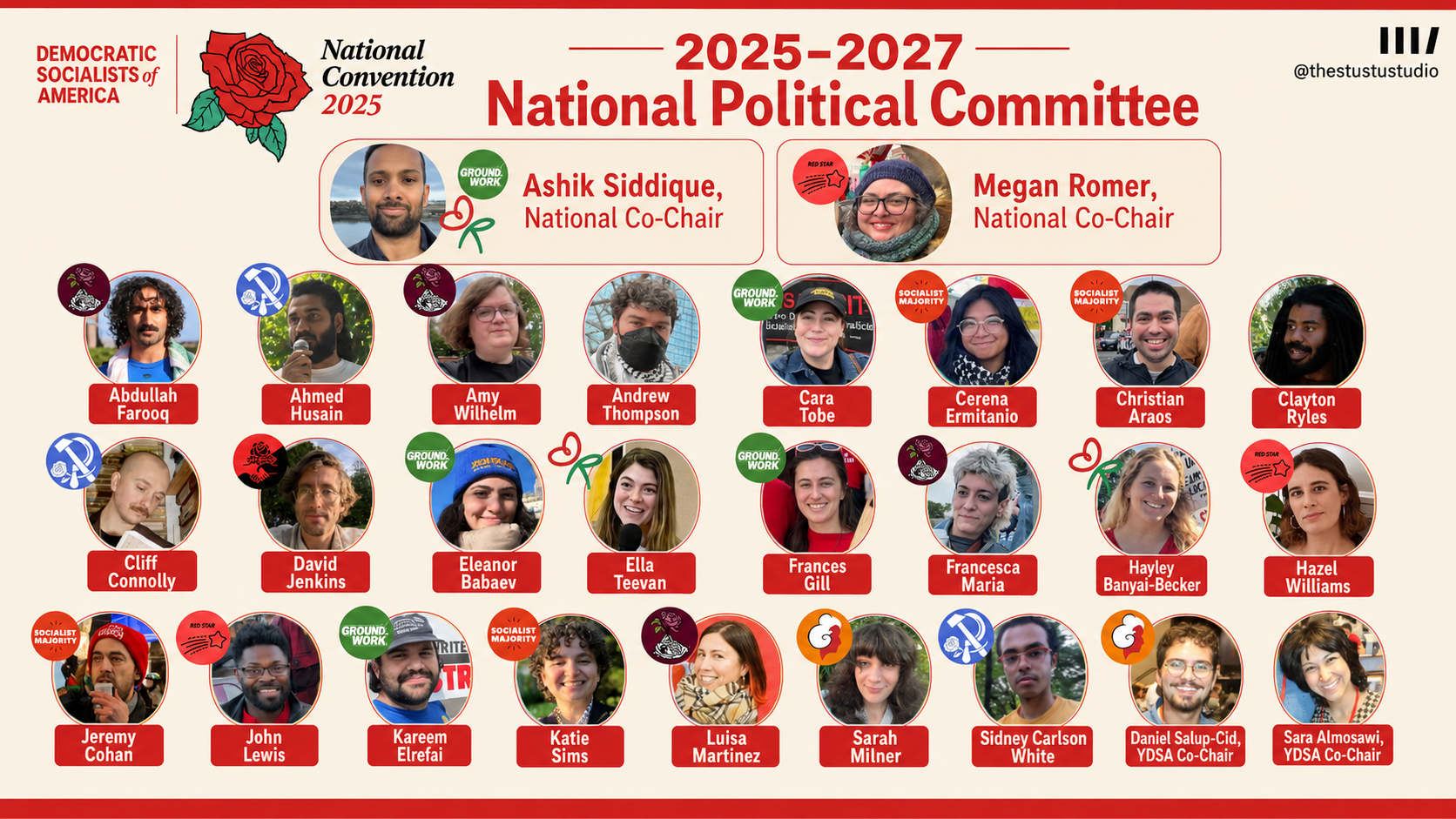
But here is where it gets genuinely funny, and I mean funny in the way that only a committee that met "most weeks" for three months can manage. They want to abolish the Senate. And as Rich Lowry pointed out in the Post this morning, the Constitution has a specific opinion about that. Article V, the part that explains how you amend the thing, contains one clause it puts entirely off limits: no state, without its consent, may be stripped of its equal vote in the Senate. Equal Senate representation is the single provision the Founders declared un-amendable. They did not include a self-destruct button.
So sit with the geometry of it. The one institution the DSA most wants gone is the one institution the Constitution specifically says you cannot amend away. Which means their own plan, the "draft a new constitution" plan, runs headfirst into the fact that you can't dismantle the constitutional system through the constitutional system. There's no legal door. There's only the other kind. This is a program that quietly requires the thing to be true that its cover story insists it isn't: not a reform, a demolition.
And if the destination sounds familiar, it should. Strip out the presidency, strip out the federal courts, leave a single all-powerful legislature: that is very close to the Articles of Confederation, the unicameral, president-less, court-less arrangement the country tried first and scrapped in 1789 precisely because it produced a central government too weak to function. The DSA has workshopped, over three months, with original artwork, the system America speedran and rejected before the Bill of Rights existed. They reinvented the rough draft and drew a rose on it.
“America is the bane of humanity's existence.”
— Canary Mission (@canarymission) July 21, 2026
That's what DSA Co-Chair Megan Romer believes.
She also led one of DSA's delegations to Cuba on their anti-American mission. pic.twitter.com/xX1v1KEZgq
Sixth: the vibe on crime and enemies
For the day-off enjoyer wondering who keeps the peace, the platform is refreshingly direct. It calls for "fully abolishing the police and prison system" and eliminating, in its foreign-policy voice, the machinery it dislikes abroad. It also, in its Palestine plank, endorses "the right to resist military occupation," which is a phrase that does a lot of gentle laundering.
And on the world stage, the countries it wants freed from American pressure are named: "such as Cuba, Venezuela, and Iran." If you were building a slideshow titled "governments that ran the you-enjoy-your-work experiment and where it ended up," you would use those exact three logos. The DSA put them in the sympathy section.
The metaphor, as promised
So here's the whole document, honestly summarized. A cartoon of a rested worker who loves his job and has no bills, drawn on top of a 180-year-old philosophy text, stapled to a plan to rewrite a Constitution that specifically forbids the rewrite they most want, landing on a system the country already tried and threw out, endorsed by the people who just swept New York and published in plain sight while everyone looked away.
They gave you the morning, the afternoon, and the evening. They gave you the errands and the sport and the movies. They gave you one whole day.
They just never got around to describing the other six. And they never got around to the part where the only door out of the current system is one the Founders nailed shut on purpose.
Because that's the paragraph they can't illustrate. There's no friendly cartoon for it. And it only works out this way every single time it's been tried, which is the one historical fact "Workers Deserve More" managed to leave out of a document about how much workers deserve.
They did the paperwork. They just didn't read it all the way to the end. Workers deserve more. Starting with more than one day off, a footnote, and a plan that survives contact with Article V.