Two Democratic Socialists of America-backed House candidates have hatched a scheme with congressional Squad members to vote down the Department of Homeland Security budget next year. The plan, once executed by Darializa Avila-Chevalier and Claire Valdez as freshman members, would strip New York City of more than $215 million in counter-terrorism grants. The cost to the city. The political cover for the radicals. Both acceptable, sources say, in the name of ideology.
The evidence is documented. The contradiction is stark. The damage, if the plan advances, will be measured in city agencies stripped of resources meant to prevent catastrophic attack.
Avila-Chevalier, who unseated longtime Rep. Adriano Espaillat in NY-13's Democratic primary this year, is expected to sail to victory in November. Valdez, a state assemblywoman representing parts of Brooklyn and Queens, won her primary and heads for Congress. Both are freshmen on track to take office in January 2027 with instructions from Squad Reps. Ilhan Omar (D-Minn.) and Rashida Tlaib (D-Mich.) to vote against the DHS budget.
The Funding That Matters
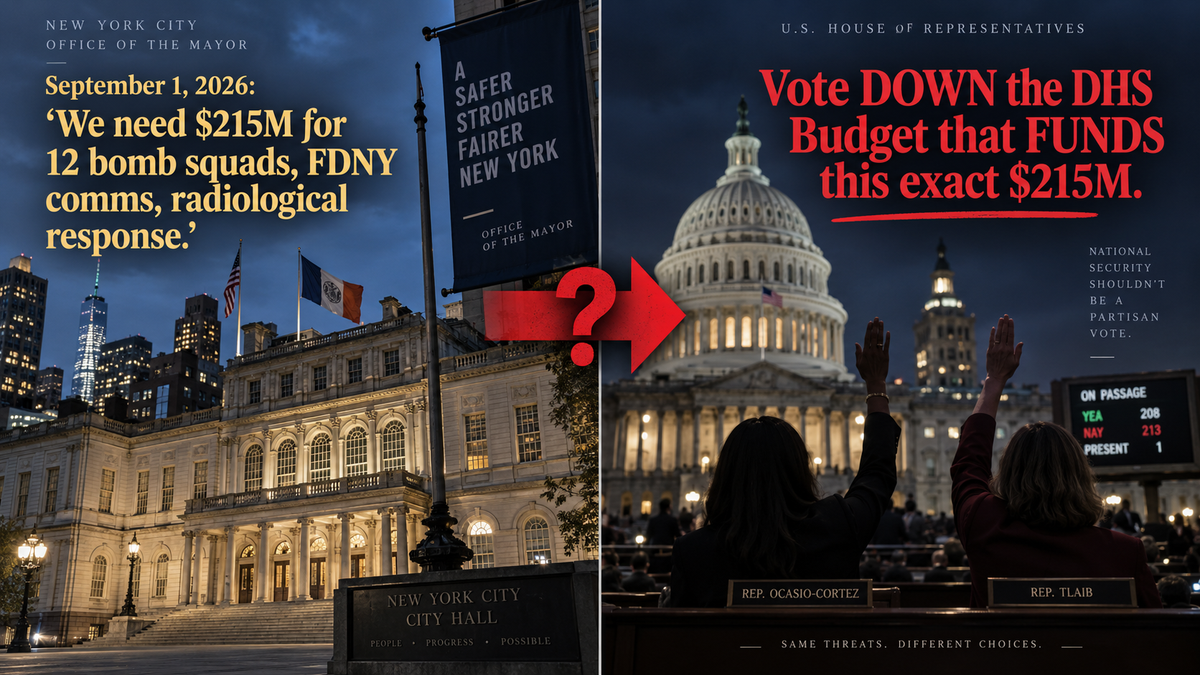
The Urban Areas Security Initiative, created in 2003 as a direct response to 9/11, distributed nearly $600 million to high-profile urban areas for terror-attack prevention. NYC received the largest share. That money funds bomb squads. It funds emergency communication systems for the FDNY. It funds radiological threat response for first responders. The grant total that would be at risk: $215 million.
Mayor Zohran Mamdani—the DSA-aligned politician who sits at the center of this network—has railed publicly against any cut. On September 1, he issued a statement that read like a deposition:
He continued: "There is no excuse for the federal government to leave the nation's largest city to shoulder this burden alone."
Mamdani meant what he said. His administration has joined Gov. Kathy Hochul and state Attorney General Letitia James in pushing back against the Trump administration for withholding portions of the funds as recently as this month. The political effort is coordinated, documented, and urgent.
Then came the turn. Sources within the federal legislative branch report that Avila-Chevalier and Valdez have been developing a plan with Squad leadership to vote against the DHS budget—the very mechanism that funds UASI and delivers that $215 million to NYC. The coordination is deliberate. The timing is set for next Congress. The consequence is a calculation the candidates and their DSA shepherds have apparently made and accepted.
One federal legislative source described the dynamic plainly: "They are trying to figure out how to hurt DHS even if it costs NYC millions of dollars. They don't care what it costs NYC. They are there to make a point."
The political bind for Mamdani is transparent. He has positioned himself as the de facto leader of the city's DSA faction—a role he has filled through his office of mass engagement and through close collaboration with figures like Tascha Van Auken, who heads Mamdani's office and maintains DSA ties. But his incoming House members, both card-carrying DSA candidates, are preparing to execute a plan that would financially gut the city whose security he claims to champion. The contradiction is total.
What's at Stake
- 12 bomb squads across New York
- FDNY inter-team emergency communication systems
- Radiological threat response and training
- First-responder capability infrastructure
- Funding mechanism: DHS budget vote
Sources said Avila-Chevalier and Valdez have worked to keep the plan quiet because they understand the optics would cause "drama" with Mamdani and his administration. They know, in other words, that cutting $215 million in counter-terrorism funding from NYC while their de facto political patron sits in the mayor's office raises a set of questions they cannot answer.
The infrastructure point here is structural. The DSA has positioned itself as the voice of the radical left within American electoral politics. Its candidates run on platforms of accountability, of protecting working people, of standing against federal overreach. Mamdani himself has built his political brand in NYC on a posture of fierce local defense—defending the city against federal neglect, federal budget games, federal indifference to the needs of New York.
Avila-Chevalier and Valdez are now preparing to vote in direct contradiction to that posture. They are preparing to gut funding for city services their own network's leader has identified as essential to public safety. They are preparing to do this not because the funding mechanism is unjust, but because their Squad mentors have instructed them to vote against the entire DHS budget as a gesture of ideological purity.
A federal legislative source who works on these issues summed up the dynamic with those words. The statement carries weight. The 9/11 attacks transformed how American cities approach counter-terrorism funding. The UASI was not created as an accident of bureaucracy. It was created because New York needed capacity it did not have. Twelve bomb squads. FDNY inter-team communication systems. Radiological threat response. These are not luxuries. They are the institutional infrastructure that allows a city to survive and respond to the kind of attack that killed nearly 3,000 people in lower Manhattan.
Mamdani and his allies have positioned themselves as defenders against federal underfunding. That position becomes untenable the moment his own political movement—through his own Party's House freshmen—votes to strip that same funding from his own city. The damage, when it comes, will be personal and will be documented.