Mamdani Signal Propaganda Ops
The clearest measure of the machine's power is a single video. On July 27, Mamdani posted content calling for the arrest of Israeli Prime Minister Benjamin Netanyahu. It did not spread the way organic content spreads. It was launched. The bot network drove it past 200 million views.

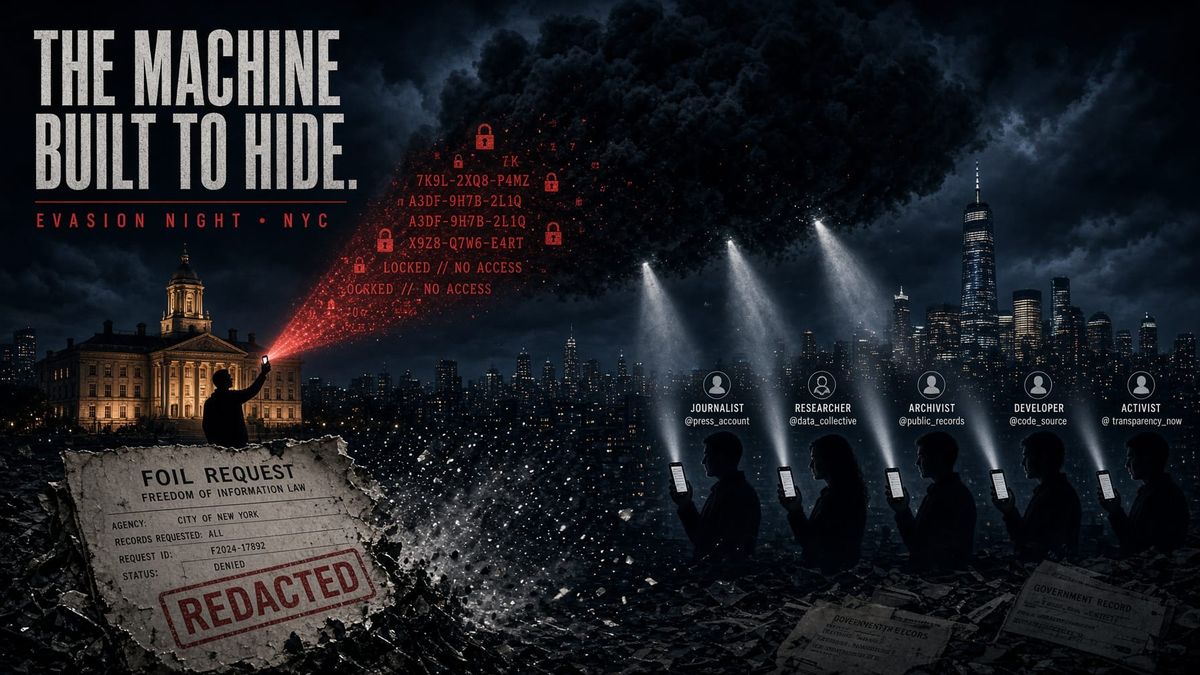
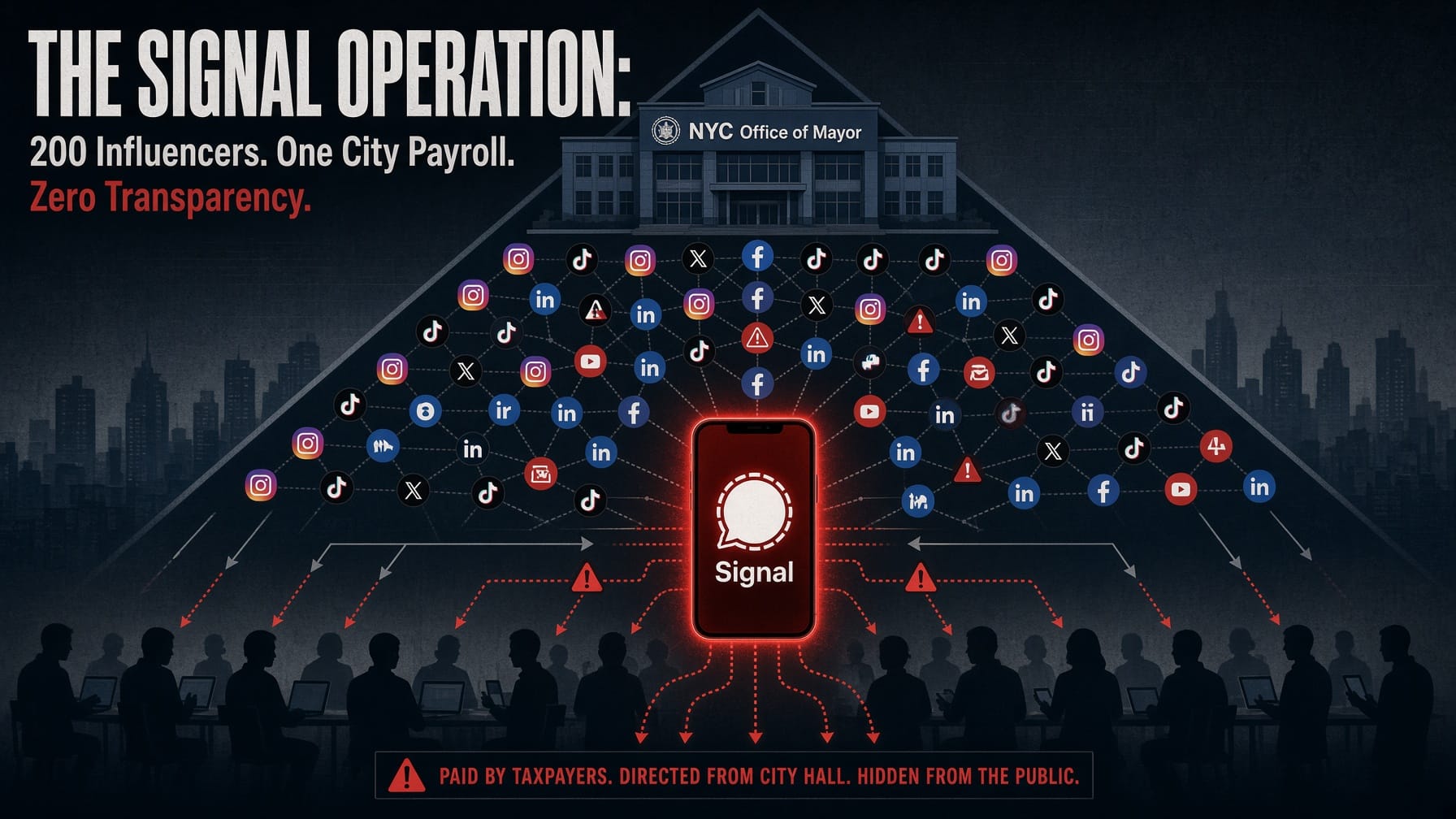
The Machine That Made One Man Unquestionable City Hall pays a staffer to run an encrypted group of 200 influencers. Dissent gets swarmed. The reach is global. The bill comes later.
A city employee distributes daily talking points to more than 200 creators through an encrypted Signal group. None of them tell their followers where the message came from. The record shows it was built that way.
Try to question Zohran Mamdani in public and watch what happens.
Say the rent freeze will strangle housing supply. Say free buses and free childcare and free rent have to be paid by someone, eventually. Say it politely, with numbers. Within an hour the replies arrive. Dozens of them, then hundreds. They are confident. They are coordinated. They are wrong in ways that sound right, the kind of wrong that takes a paragraph to correct and a sentence to spread. You will be ratioed. You will be called a landlord, a Zionist, a plant. The correction will never catch the smear. By morning the thread is a monument to your bad faith, and the policy question you raised has vanished under it.
This is not spontaneous. It is staffed.
The coordination runs through an encrypted Signal group called "NYC Creators Announcements." It is run by Emilia Rowland, director of new media and cultural communications at the New York City Office of the Mayor. She is on the city payroll. Her salary is public money. The group she manages distributes daily talking points, video clips, and messaging instructions to more than 200 influencers who then push the mayor's line to a combined audience in the tens of millions. None of them are required to tell their followers the message came from City Hall.
The reporting is not disputed. Columbia Journalism Review's Tow Center published a peer-reviewed study on August 31, 2026, mapping the ecosystem. Dr. Anya Schiffrin found the group, named the operator, and documented the mechanics. The mayor's office refused to provide the member list. Members interviewed for the study estimated the group at more than 200 influencers, ranging from micro-creators with five thousand followers to some with millions.
That is the machine. Here is how it was built, what it costs, and what it is for.
How one message reaches millions
The pipeline
The Signal group did not appear in office. It moved there.
During the 2025 campaign, digital strategist Gabriella Zutrau built an Instagram chatbot pipeline using a tool called Manychat. The chatbot sorted contacts by follower count. Users under 20,000 followers were routed to a volunteer funnel. Creators with larger followings, up to tens of millions, went to a VIP track. The system logged 45,000 direct-message interactions and moved more than 10,000 creators onto "owned lists," contact databases the campaign controlled outside of any social platform. Zutrau described the architecture in interviews with Campaigns and Elections and FWIW. It was, by her own account, an operation designed to turn online contact into offline control.
When Mamdani won, the operation did not disband. Rowland, who ran the Creators4Zohran network on the campaign, moved to the city payroll. The owned lists moved with her, now encrypted on Signal. Zutrau continued consulting. The title changed from campaign staff to city employee. The job did not change at all.
Influencers selected for the group fill out an intake form. It asks where they live and what topics they care about. Based on the answers, they receive targeted invitations. Some are invited to film a canvassing event. Some get interviews with city officials. Some get access to the mayor. In return, they receive Rowland's daily messages. Talking points. Clips. Instructions on what to post and when.
New York Penal Law section 240.20 prohibits city employees from using public resources for political activity. Rowland's salary is a public resource. Coordinating influencer messaging to defend and promote the mayor is political activity. The prohibition is not ambiguous. The operation is not hidden from its participants. It is only hidden from the public, and it was built that way.
Why Signal
The app is the tell.
Signal encrypts messages and deletes them on a timer. It leaves no searchable record. A public official conducting public business on Signal is conducting that business where no Freedom of Information request can reach it. This is not a novel concern. In 2019, Mayor Bill de Blasio faced FOIL scrutiny and legal challenges for using Signal to coordinate government scheduling. The city fought disclosure. The controversy was public. Everyone at City Hall understood what Signal meant and why its use on government business draws legal fire.
Rowland and the Mamdani administration chose it anyway. They understood the evasion. They chose it anyway.
The money
Some influencers are paid. City agencies route contracts through marketing firms, and the going rate runs five thousand to twenty thousand dollars per campaign, according to CJR's reporting. The contracts do not name the creators. The procurement notices are generic. The mayor's office did not respond to CJR's repeated requests for details.
Others are not paid in cash. They are paid in access. Interviews with officials. Invitations to events. Proximity to the mayor. The traffic that comes from being amplified by City Hall's own accounts. Under federal law, a thing of value provided to a political operation is an in-kind contribution, and in-kind contributions are reportable to the Federal Election Commission. The Mamdani administration has filed no such disclosures.
Free childcare. Free buses. Frozen rent. The slogans are excellent, especially for people who do not read the fine print or do not read English. The problem is arithmetic. Someone pays for free. The clearest proof is already on the ground: the housing vouchers Mamdani promised as a candidate went into appeal once he was in office, because the city said it could not carry the version it had sold. A rent freeze works the same way. It does not eliminate the cost of housing. It transfers it, defers it, and suppresses the supply that would have eased it. The bill arrives later, and it arrives for the people the slogans were aimed at. The machine that sells the slogan is funded well enough to bury anyone who does the math in public.
Who is a Hamasachurian Mayor Mamdani? pic.twitter.com/S6aSl9tqX7
— The Unredacted (@theunredacted) August 22, 2026
The suppression
The talking points are only half the operation. The other half is what happens to dissent.
When someone questions a Mamdani policy, the Signal network does not persuade. It swarms. The same talking points arrive in dozens of accounts within the same hour. The replies are near-identical in substance, varied just enough in wording to look organic. They do not need to be correct. They need to be numerous and fast, because the goal is not to win the argument. The goal is to make the argument look settled and the questioner look isolated. Manufactured consensus does not require truth. It requires volume and coordination, and the operation supplies both on a schedule.
CJR found the disclosure labeling is inconsistent by design. Health + Hospitals uses a #paidpartnership tag. The Campaign Finance Board uses #NYCVotesPartner. Influencers pushing Mamdani's line use nothing, or a generic tag that hides the coordination. The content is engineered to read as the spontaneous opinion of a trusted voice. A communications staffer told CJR the point plainly: boosted influencer content works because people stop and watch without realizing it is an ad. The word the staffer used was sneaky. The word for it in law is undisclosed.
The bot layer
Above the human network sits an automated one.
On August 6, 2026, the World Zionist Organization's Department for Combating Antisemitism published a cyber analysis of bot accounts amplifying Mamdani content on X. The accounts shared a fingerprint. Hundreds of posts per day. Repeated-sharing rates between 96 and 100 percent. Accounts created within days of each other. No original content. Identical behavior across dozens of profiles. One account, @SnoopyLima13, posted 955 times in a single day, every post a repeat share of Mamdani material. The analysts said they were 100 percent certain the IP addresses traced to City Hall infrastructure. They could not establish who directed the accounts.
The human network manufactures the appearance of grassroots support. The bot network manufactures the appearance of scale. Both point to the same building.
The reach
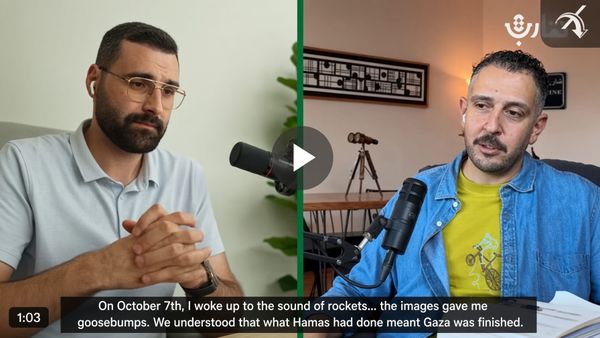
The clearest measure of the machine's power is a single video. On July 27, Mamdani posted content calling for the arrest of Israeli Prime Minister Benjamin Netanyahu. It did not spread the way organic content spreads. It was launched. The bot network drove it past 200 million views. It was shared with approval across Turkey and Pakistan, in media ecosystems where a New York mayor calling for the arrest of the Israeli prime minister is a gift to the local narrative. The campaign was aimed. It found its audience because the audience was targeted, and the numbers it produced were not a measure of persuasion. They were a measure of infrastructure.
This is where the local story becomes a bigger one. The tactics did not originate at City Hall. They are the standard operating method of the same apparatus that ran the same play across four states this summer, a machine that manufactures turnout in specific districts and swarms everyone outside them. The Signal group is the municipal instance of that older playbook. Manufacture consensus. Swarm dissent. Control the terms of the conversation until the radical position is the only one that sounds normal.
The record
Rowland was the director of new media on the campaign. She is the director of new media at City Hall. The infrastructure she ran to elect Mamdani is the infrastructure she now runs on public money to defend him. The mayor's office will not name the members. It will not release the messages. It will not explain the arrangement. The refusal is not a gap in the story. The refusal is the story.
The people running this machine are not shy about who pays for it. Their most visible chairs and fixers live in homes their own parents bought while telling everyone else that free is a policy and not a bill. Now the record shows the same instinct wired into City Hall. Everywhere you look, all you can hear is one man's name, praised in a thousand voices and amplified by ten thousand more. It was built to sound that way. It was built to bury the question. It was built to hide.
The Signal group is one node. The full architecture, the forty-year incubation of this network and how it finally went operational, is the subject of the DRGD field briefing. This is what it looks like at street level, in one city, on one encrypted app.
The Signal operation, by the numbers
Share, Comment, and Support Our Work
Share this. Restack it. Forward the email. That's the whole ask.
Support the work. The reporting above took a sourcing check against a peer-reviewed study and two outside investigations before a word got published. If you want more of it, paid subscribers are what gets it there. Become one and help fund the next one.
Disclaimer: This website may contain images, videos, and other media that have been generated or modified using artificial intelligence (AI) tools. Such content is created for illustrative purposes and is not intended to represent real events, people, or objects.