Iran's American Bench: The Four US Nationals Tehran Keeps Putting on Camera
Jackson Hinkle, Calla Walsh, Max Blumenthal, and Chris Helali have each become repeat guests of Iranian state broadcasters, doing on camera what no Iranian official's own statement could do.

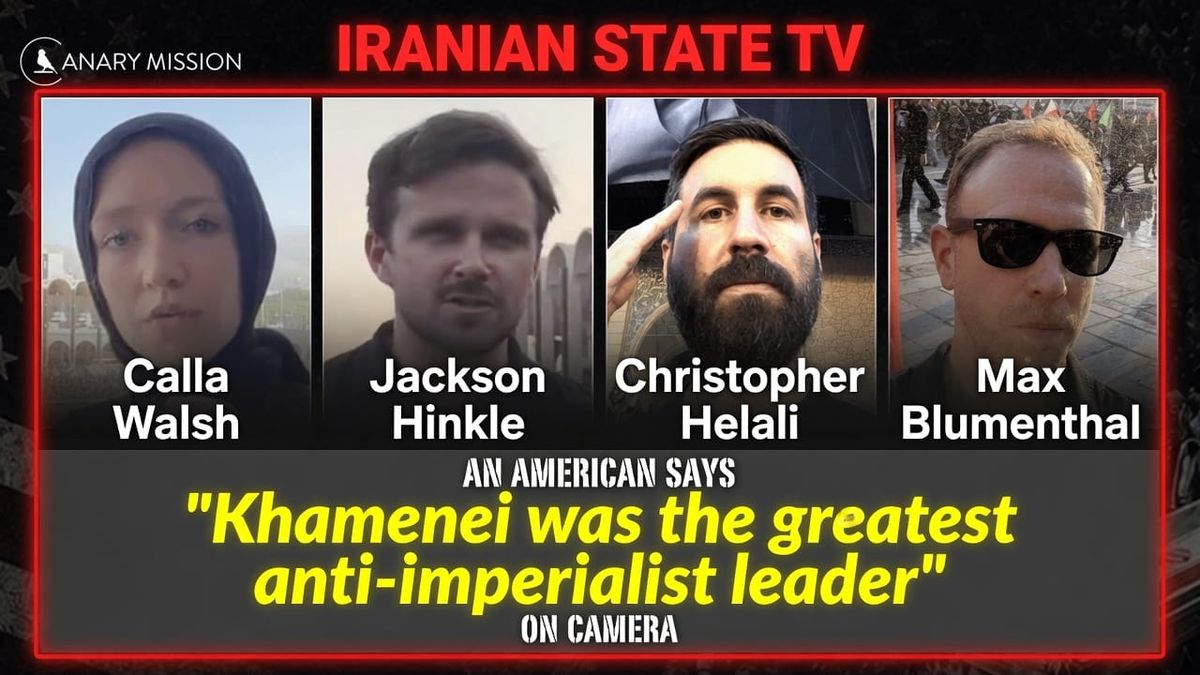
How a communist expat, a self-styled anti-imperialist journalist, a Grayzone founder, and a Boston debutante-turned-Tehran regular became the friendliest foreign faces in the Islamic Republic's press pool
There is a particular kind of American who goes looking for authenticity abroad and finds, instead, a camera crew waiting for him. Jackson Hinkle found his in Beirut, at a funeral for a man the U.S. government has spent two decades trying to kill. Calla Walsh found hers in Tehran, standing in a hijab in front of a wall of Shahed drones, telling PressTV that watching Iran's missile program up close was "incredible." Max Blumenthal found his in a media apparatus that no longer needs to explain itself, because he explains it for them.
And Chris Helali found his in a strategy meeting, the kind with an agenda and a seating chart, held the night before a Hezbollah funeral procession, under the banner "Global Awakening and Palestine."
None of this happened by accident. Iran's state broadcasters have spent the better part of three years cultivating a small, durable roster of English-speaking Americans willing to say, on camera, in Tehran, what an Iranian official saying it would not have the same effect. This is a story about that roster, and about how each of these four accumulated more access than most credentialed foreign correspondents ever get, precisely because they arrived asking for none.
🚨🚨🇺🇸🇮🇷 Jackson Hinkle spotted leading the "Down With The USA" chant at a pro regime terrorist rally in Tehran, Iran. pic.twitter.com/UIzQx8aton
— C14 News | EN (@c14english) July 6, 2026
The Communist and the Court
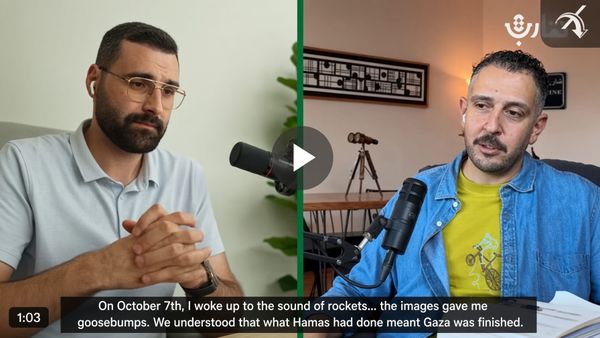
Jackson Hinkle's biography is, by now, well documented on this site. We wrote about his transformation from beach-town lifeguard to communist agitator to Kremlin fixture two years ago, and little has changed except the passport stamps. What is worth revisiting is the specific mechanics of his access. In February 2025, Hinkle traveled to Beirut for the joint funeral of Hassan Nasrallah and Hashem Safieddine, an event the Anti-Defamation League called a "brazen" display of support for a designated terrorist organization. He did not slip in quietly. He was interviewed by Lebanon's Al-Mayadeen, by Hezbollah's own Al-Manar, and by Iranian Channel 3, and in each conversation he described himself as a brother in struggle to Hezbollah, Hamas, the IRGC, the Russian Army, and China's People's Liberation Army. He told one interviewer he feared arrest if he came home. He told another he hoped Nasrallah's spirit would protect him from what he called "Zionist terrorists."
This was not spontaneous. Reporting from that week describes a curated, "birthright-style" delegation of Western influencers flown in specifically to generate this kind of footage, with Hinkle as its most bankable name. He has since resurfaced closer to home, or at least closer to a stadium: he has been photographed visiting Iran's national soccer team at its training camp in Mexico ahead of the 2026 World Cup, the first tournament in the event's history where a host nation is in active tension with a competing federation's government. No formal action against his passport or his reentry has been reported by the State Department, and no charge alleging material support for a designated terrorist organization has been filed as of this writing. Condemnation is not indictment, and it is worth being precise about the difference even when the underlying conduct is, as one outlet put it, "criminally stupid."
🎥 @CallaWalsh narration of the poetry reading by 250 Iranian poets addressed to the martyred leader of Iran pic.twitter.com/Fn5m5Kbxve
— IRIB (Islamic Republic of Iran Broadcasting) (@iribnews_irib) July 5, 2026
The Boston Girl Who Found the Revolution
Calla Walsh's arc is the more legible tragedy of the four, mostly because her before-picture is so ordinary. She was, per the Boston Globe's own coverage in an earlier life, a promising young operative in Ed Markey's reelection campaign, the kind of activist Massachusetts Democrats point to when they want to talk about the party's future. Her present life is spent largely in Tehran and Beirut. In July 2025 she stood before a memorial ceremony for Iran's "Media Martyrs of the Struggle against the Zionist Regime" and led a chant of "Death to America, Death to Israel," a moment captured in full by NH Journal, which had tracked her since her 2023 conviction for vandalizing an Elbit Systems facility in Merrimack.
By February 2026 she had returned as a guest of the Sobh International Media Festival, filming herself among Iran's missile and drone displays and calling the country's indigenous weapons program "incredible," while separately telling PressTV that Iranian police defending "the Revolution" were fundamentally different from American police cracking down on protest. And on July 4, 2026, in the days after Khamenei's death in the opening strikes of that year's war, she was back in Tehran again, this time at the funeral itself, telling PressTV that the late Supreme Leader was "the greatest anti-imperialist leader" of her generation. Newsweek's Josh Hammer did not mince words about the timing or the substance, calling the footage "literal Iranian propaganda" and arguing Walsh should, "at a bare minimum," be barred from returning home.
A common sentiment at the funeral for Khamenei was incandescent rage at the American leadership that authorized his assassination, but a refusal to hold average Americans collectively responsible for the crime pic.twitter.com/WqcPHh4Ysp
— Max Blumenthal (@MaxBlumenthal) July 5, 2026
The Editor Who Doesn't Need to Attend
Max Blumenthal operates with more distance than Hinkle or Walsh, which is precisely what makes his role harder to dismiss as fringe theater. The Grayzone, which he founded and edits, has spent years building relationships with Hezbollah's political wing directly, including a December 2024 sit-down with Hezbollah MP Ibrahim Moussawi in which the Grayzone's own framing described the group's "resistance" against Israel without much interrogation of the term. Around the Khamenei funeral in July 2026, Blumenthal's outlet posted content characterizing the event as a demonstration of Iran's "enduring anti-U.S. rhetoric" shaping the country's "regional posture," language indistinguishable in register from the state messaging it was ostensibly describing.
Reporting live from outside the Grand Mosalla Mosque in Tehran (watch until the end) pic.twitter.com/wEdUKYXO2T
— DD Geopolitics (@DD_Geopolitics) July 4, 2026
The Organizer in the Room Before the Cameras Arrived
Chris Helali gets the least mainstream attention of the four, which is a mistake, because his role at the Nasrallah funeral was structural rather than performative. A former lecturer at Wuhan University and a self-described Marxist-Leninist organizer, Helali was part of the same delegation as Hinkle, alongside Houthi media official Mazin Hebah and Yemeni blogger Osama Alfarran. Before the funeral itself, that delegation convened for a planning session titled "Global Awakening and Palestine," aligning messaging among the Western creators before a single camera rolled at the procession. If Hinkle was the face Iranian state media wanted on air, Helali was part of the machinery that made sure the face said the right things.
If you want to know how the regime brought attendees to Khamenei’s not-so-impressive funeral, this explains how. The majority of Iranians live below the poverty line, and the regime distributes free bananas and potatoes to bring people in.pic.twitter.com/XasJHyouNX
— Navid Mohebbi نوید محبی (@navidmohebbi) July 7, 2026
Why the Access Keeps Getting Renewed
The through-line across all four cases is not ideology alone. Genuine sympathy for Tehran, Moscow, or the "Axis of Resistance" is easy enough to find without ever leaving a laptop. What distinguishes Walsh, Blumenthal, Hinkle, and Helali is that each has been treated as a repeat guest by a state media apparatus that does not extend that privilege casually. An American citizen calling Khamenei the "greatest anti-imperialist leader," on Iranian television, in Farsi-subtitled footage meant for domestic consumption, does work that an Iranian official's own statement cannot do.