Midterms Massacre and the Last Election
Since the left won overwhelmingly in the midterms, they will wait until January 3rd, or after, to accelerate the mobilization on the streets. That is unless an event "provokes their ire."

MAGA Got Smoked. Here Are the Seven Reasons, Graded.
Six of the seven hold up. One needs reporting nobody has done. And inside them sit three specific claims our own side keeps repeating that the evidence does not support, including the one you most want to be true. The thread nobody has pulled runs from a taxpayer-funded NGO in Los Angeles to a rose-covered map in a DSA conference room, and the same names appear on both ends of it.
How to read this report
Two layers, kept visibly apart. Source data blocks carry outside reporting, polling and filings. Diamond blocks are The Unredacted's own read on top of it. Every claim is graded Observed Assessed Not established. Each of the seven arguments carries a plain verdict at the top: REAL, REAL WITH A LIMIT, or NEEDS THE WORK. Separately, three specific claims circulating inside those arguments are graded Not established, and the Grader in § 09 names each one. We grade our own side's arguments by the same standard we grade theirs, which is the only reason anyone should believe either.
Grok Bot · Meet your AI teammates
You are invited to try Grok Bot, free for two weeks. Hand off real work and everyday tasks, and come back to them done.
Start the free 2 weeksReferral link. The Unredacted earns credit if you sign up, at no cost to you. Sponsorships never touch editorial. Nothing in this report was reviewed by an advertiser.
Riot Inc. has an org chart. The RNC has a quarter.
The infrastructure the right calls dark money is neither dark nor, mostly, money in PACs. It is nonprofit revenue, much of it public, attached to organizations that exist on the first Tuesday in November and on every other day of the year.
Source data · the structure, named by the people tracing it
Seamus Bruner of the Government Accountability Institute described the apparatus to a White House roundtable as a corporate operation he calls Riot Inc., with divisions for boots on the ground, marketing, public relations and legal support. He named Open Society Foundations, the Tides Foundation and Hansjörg Wyss among its funders, and said more than $100 million in taxpayer funds had moved through networks tied to protest activity. Observed
The three nonprofits that organized the protest outside Elon Musk's Austin compound reported $56.1 million in combined 2024 revenue, by Asra Nomani's tally from their filings. The same organizations helped lead the 2025 Tesla Takedown protests, which Fox tied to 258 organizations with combined revenues estimated at $2.6 billion. They are separate entities; the totals are not shared budgets. Observed · ProPublica 990s
The Progressive Change Institute commissioned the "I Am Stealing From You" poster and sells it through ActBlue at $135 for five. The same poster appeared at a Washington May Day march carried by the Party for Socialism and Liberation, and again in Austin among the Freedom Road Socialist Organization. Observed
The Unredacted · one poster, three storefronts
The proof of structure is not a revenue total. It is a piece of cardboard. One Democratic nonprofit's product, two separate communist formations' marches, a single supply chain with a published price list. That is Bruner's marketing division operating in daylight.
Set the balance sheets side by side. MAGA Inc. raises in cycle, buys media, goes quiet. The Center for Popular Democracy has executives on six-figure salaries and a 990 due whether or not anyone is voting. One rents an electorate for ninety days. The other employs organizers permanently. Assessed
They sold a product that does not exist, and the pitch was better
Hakeem Jeffries told his caucus the affordability message was cutting through. It was. Sherrill closed in New Jersey on utility costs, Spanberger in Virginia on cost of living, and front groups named things like Affordable New Jersey spent $15 million in a single primary. Talarico raised $27 million in one quarter in Texas and ran against Ken Paxton rather than against Trump. Observed
What the victory laps omit: the AP Voter Poll found that on the economy, foreign policy, healthcare, taxes and immigration, roughly two in ten voters said neither party was better equipped. Observed
Source data · the correction to our own thesis
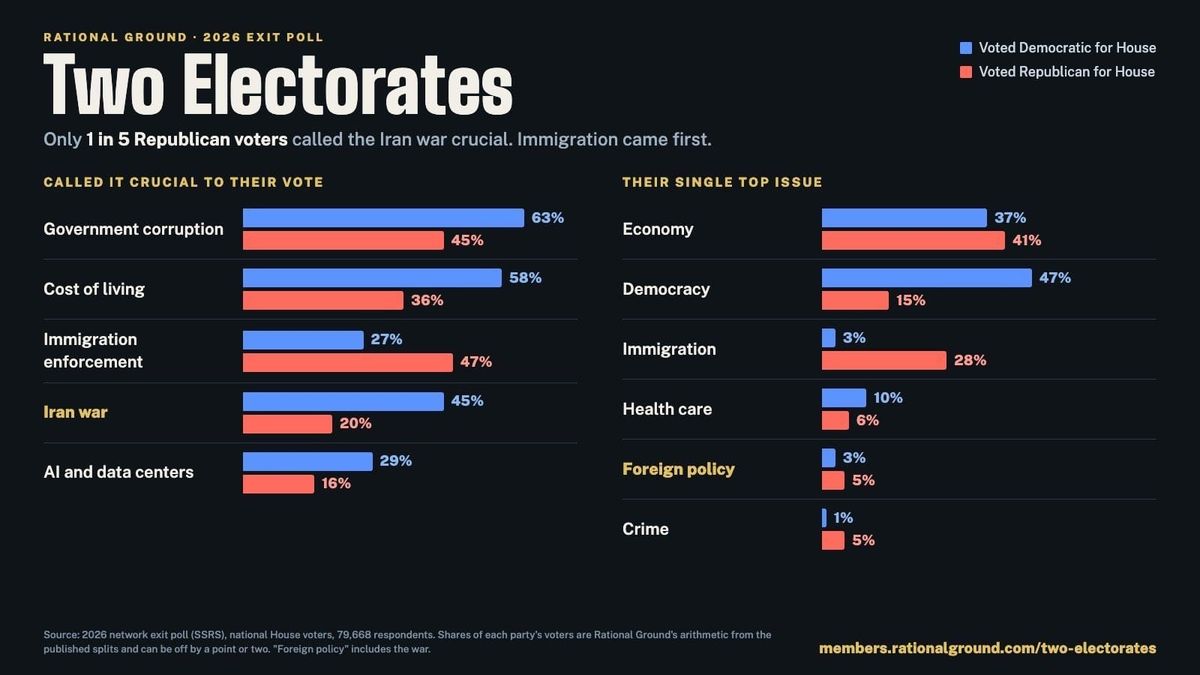
The network exit poll's single-top-issue question does not return a pure affordability verdict. Economy led at 39 percent overall, but the state of democracy came second at 32 percent, ahead of immigration at 14 percent. Broken out by how people voted, democracy was the top single issue for 47 percent of Democratic House voters, against 37 percent naming the economy. Observed · network exit poll
Third Way's post-election memo reads it the same way: a repudiation of those blamed for inflation, wars, tariffs and health care cuts, not a wholesale embrace of Democrats. Its battleground survey had the generic ballot tied at 50, an eight-point shift toward Democrats since 2024. Observed · Third Way, Nov 6
The Unredacted · where the affordability story is too simple
We have to mark our own thesis down here. The affordability message was the delivery system, and it worked. It was not the whole motive. Nearly half of the people who voted Democratic named democracy, not groceries, as their single top issue, and that is a larger share than named the economy.
Anyone on our side telling themselves this was purely a kitchen-table election is reading one number and skipping the one next to it. A coalition that turns out over institutional alarm is harder to peel off with a tax cut than one that turns out over the price of eggs. Assessed
The Unredacted · the product never changed
Nothing in the Democratic offer improved between 2024 and 2026. Premiums rise in January because the Senate declined to extend ACA subsidies, and the party promising relief has no mechanism to deliver it either. Voters did not buy a plan. They bought an account of who was responsible for the price of groceries, repeated without deviation by one side and answered by the other with the word hoax.
This is the oldest finding in propaganda research and the right keeps rediscovering it late. A simple false story told with discipline beats a complicated true one told with contempt. Assessed
Seven weeks that erased everything else
Source data · the war and the pump
Republican officials privately conceded to Reuters that the war with Iran had negated nearly all the economic progress the party planned to run on. Only 25 percent said the strikes were worth the consequences. Inflation reached 3.8 percent, gasoline passed $4.50 nationally and $5.00 in seven states after the Strait of Hormuz closure. Gallup has the Iran situation as the fourth most urgent issue for Democratic voters and the eighth for Republicans. Observed
Vance conceded before the election that young voters opposed the war. Afterward he blamed the war for the losses. Two Republican Senate nominees, Hinson in Iowa and Rogers in Michigan, reversed and called for ending it weeks before the vote. Observed
The exit poll put the war among the top factors: 74 percent called it crucial or major to their vote, and roughly 62 percent of those voters backed Democrats. Third Way measured a 14-point Democratic trust advantage on it, the party's largest on any issue, and found voters preferring an end to the war over a $5,000 payment by 70 to 11. Among Trump voters who had turned unfavorable, that margin was 80 to 10. Observed
The Unredacted · the coverage is not the variable
The reflex is to blame the press, and on most stories we would join you. Not this one. Trump never mounted a sustained public case for the war. When your own nominees in two must-hold states break with the policy three weeks out, hostile framing is not what moved the numbers. A press corps cannot manufacture a diesel price.
Where portrayal did matter is narrower and worth stating precisely: the war was covered as foreign policy while voters experienced it as a price, and the administration never contested that framing because it had no answer inside it. Assessed
One qualifier we owe the reader, because it cuts against us. Among people who actually voted Republican, the war was close to a non-issue. Rational Ground's arithmetic off the exit poll puts it at 20 percent calling it crucial, against 45 percent of Democratic voters. The war did not make Republicans defect. It raised a price every household pays, handed the opposition its strongest trust advantage, and gave a demoralized Republican under thirty one more reason not to bother. Those are different mechanisms and only the last two show up in the result. Assessed
A ballroom, a gilded tractor, and the word hoax
Trump called affordability concerns a Democratic hoax and said he had won affordability. The Washington Post–ABC–Ipsos poll found voters opposed the ballroom 56 to 28. The $1 billion security request included $220 million tied to it. Senate Democrats started calling their colleagues Ballroom Republicans. Add the 24-karat Oval Office, the staged $100 tip, the gold-painted tractor, and a Health Secretary telling Americans to buy liver instead of beef. Senator Andy Kim relayed what his constituents kept asking: "What about us?" Observed
The firewall was transactional, and the transaction failed
Kansas had not elected a Democratic senator since 1932. The explanation is not that Kansas turned progressive in twenty-four months. Tariffs took the export market, the war took the fuel price, and the relief on offer was imported beef. Gallup puts gas prices above abortion, above the Middle East and above immigration in urgency for independents. Assessed
Stop here for a second
Every one of these five sections describes something that can be fixed by people who decide to fix it.
Diesel prices, candidate selection, a message about groceries, a leader who says hoax when people say rent. None of that is destiny and none of it required a conspiracy. It required a party that stopped doing the work and assumed a coalition would wait for it. Coalitions do not wait. They get built or they get borrowed, and ours was borrowed.
Good news is buried in that sentence. A problem you caused is a problem you control.
The Congressional Progressive Caucus is holding a press conference with its new members:
— Andrew Solender (@AndrewSolender) November 8, 2026
“This will be the largest Congressional Progressive Caucus in our history,” says CPC chair Greg Casar pic.twitter.com/Iei2zwgvlO
The highest number on the board was corruption, and nobody on our side ran on it
Seven arguments were circulating on the right after this election. Not one of them was the issue that more voters called decisive than any other.
Source data · the number nobody led with
Ninety percent of voters called government corruption crucial or major to their vote, the highest figure recorded for any issue in the exit poll, and 56 percent of them backed Democrats. Cost of living was second at 89 percent, with 58 percent of those voters going Democratic. Observed · network exit poll
Third Way found corruption among the most-recalled negative ad topics at 28 percent, behind only the Iran war at 32 and costs at 29. Investigating congressional stock trading drew 90 percent support. Investigating the Epstein files drew 68 percent. Observed
The same survey measured a 7-point Democratic trust advantage on corruption, and found that impeaching Trump was unpopular, with only 18 percent preferring it to investigating costly administration actions. Observed
The Unredacted · the issue we handed them
Drain the swamp is our line. It has been our line for a decade. In this election the other side ran on it and won the voters who cared, by 56 to 44, on the single issue more Americans called decisive than any other on the ballot.
That did not happen because the public changed its mind about who the swamp is. It happened because for twelve months the visible corruption story belonged to a gold ballroom, a $1 billion security request, an Epstein file fight the leadership lost in public, and a $445 million donor whose candidates kept losing. Ninety percent of the electorate was listening for a corruption argument. Ours was busy being the subject of one.
This is the eighth argument, and it should have been the first. Assessed
The red-green alliance is real. It is not why you lost.
Asra Nomani's mapping of the red-green alliance is documented and we have built on it before. Her France roster broke 54 organizations into categories: 16 student and youth groups against 11 communist, Marxist and Trotskyist formations, 12 labor and teachers' federations, 11 NGOs and 2 Islamist organizations. Observed
Source data · the ceiling, in numbers
Gallup's October survey of registered voters puts the Israeli-Palestinian question near the bottom of eleven issues for every party: roughly 46 percent of Democrats, 33 percent of independents and 25 percent of Republicans called it extremely important. Healthcare, income distribution, the economy, Iran and gas prices all rank above it for Democrats. Observed · Gallup, Oct 1–19
In June 2026 Nomani appeared on a Middle East Forum podcast titled "The Limits of the Red-Green Alliance," which asked why only a handful of Islamist-run groups are actively involved and what explains the absence of grassroots street power. Observed
Jewish voters barely moved: 67 percent planned to vote Democratic against 26 percent Republican, with Israel ranking fifth behind cost of living, democracy and antisemitism. Observed · JVRC
Reuters documented the generational split at CPAC in March, where the Generation Zion booth distributed stickers reading "Tucker Carlson Hates Me." A Young Republicans chapter in Tennessee mailed material reading "No wars for Jews" and "Stop the Great Replacement." Observed
The Unredacted · right diagnosis, wrong patient
We are not retreating from this network and we will keep mapping it. But Gallup settles the electoral question. An issue that 25 percent of your own voters call extremely important, ranking dead last among Republicans on an eleven-issue list, did not decide a national election.
The honest version: the red-green alliance did not cost Republicans Kansas. The war about the red-green alliance cost Republicans a coalition. That is why this one is graded needs the work rather than real. The network is documented. The causal claim is not. What would settle it is a district-level test, and nobody has run one. Assessed
Bezmenov named the first stage, and it was never persuasion
The KGB defector Yuri Bezmenov described four stages of ideological subversion and gave the first, demoralization, fifteen to twenty years, because that is how long it takes to educate one generation.
The misreading attached to his model ever since is that demoralization means converting an adversary's population to your ideology. It does not. Demoralization severs a population's attachment to its own institutions. The target does not become a communist. He becomes a man who no longer believes his own side is worth defending, and withdraws. It works on the young because they have the least invested, and through native voices because imported ones are discounted. It is measured not in converts but in participation that does not occur.
Source data · the live demonstration
In November 2025 Tucker Carlson recorded a friendly two-hour interview with Nick Fuentes, the white nationalist streamer who has praised Hitler. More than five million watched. Heritage president Kevin Roberts defended Carlson; Heritage then faced staff turmoil and multiple resignations. Ben Shapiro called Carlson "the most virulent superspreader of vile ideas in America" and ended the friendship. Trump declined to condemn either man. Fuentes thanked Roberts for "defending Tucker against the Israel First Woke Right." Observed
Rod Dreher estimated that 30 to 40 percent of young conservative staffers follow Fuentes, pressed the matter on the Vice President, and published a checklist stating the movement is real and has infiltrated young conservative networks. Laura Loomer warned before the election that "Hitler Larping and obsessively talking about Israel doesn't appeal to everyday Americans," and predicted the party would lose over it. Carlson then declared he no longer supports the Republican Party. Marjorie Taylor Greene resigned from Congress. Observed
The Unredacted · portability, not command
Warner and Himes, briefed on the classified intelligence, said Russia ran an influence campaign this cycle targeting Democratic candidates and Ukraine supporters, and found no operation against voting machinery. Clemson's Darren Linvill describes the mechanism: persuading anyone of anything is hard, reinforcing an existing belief is not.
So the temptation to draw a line from Doha or Moscow to a groyper group chat fails on the record. The honest finding is worse than the conspiracy. A technique built by a state intelligence service to hollow out an adversary's rising generation no longer requires a state intelligence service. It is being reproduced by Americans, on American platforms, monetized by American advertising, with no handler and no budget line. Bezmenov's bitterest observation was that the useful idiots are always native. He was describing the left of his era. The sentence does not care who is holding it. Assessed
Where the evidence stops, we stop
| Claim | Basis | Grade |
|---|---|---|
| GOP held a 5-to-1 cash edge, Musk spent $445M, Republicans flipped zero seats | FEC filings, NPR, AP and CNN results | Observed |
| Inflation, fuel and the Iran war were the dominant vote drivers | AP Voter Poll (~80,000 voters, 50 states); Gallup | Observed |
| CHIRLA hosted a county voting center and relayed endorsements inside it | City Journal undercover, County Registrar records | Observed |
| Youth turnout intention fell, concentrated among young Republicans | Harvard IOP, Third Way, WaPo–ABC–Ipsos | Observed |
| The Israeli-Palestinian issue ranked near last for every party | Gallup, Oct 1–19 2026 | Observed |
| Corruption was the single most-cited decisive issue, at 90% crucial or major | network exit poll; Third Way ad-recall | Observed |
| Democracy, not the economy, was the top single issue for Democratic voters | exit poll toplines: economy 39, democracy 32 overall | Observed |
| Among Republican voters specifically, the Iran war was a minor factor | Rational Ground's derivation, not independently reconcilable | Assessed |
| Permanent nonprofit infrastructure outperformed cycle-timed PAC money | our read of the spending-to-outcome gap | Assessed |
| Young Republicans abstained rather than defected | turnout-intention gap set against the exit-poll split | Assessed |
| The protest industry and the electoral machine are the same infrastructure | overlapping entities; no document links the two ledgers | Assessed |
| A coordinated national NGO scheme delivered the election | one documented Los Angeles office; no national pattern on the record | Not established |
| Foreign propaganda moved the youth vote, or directed the fracture on the right | the Russian operation this cycle targeted Democrats; no tasking evidence | Not established |
| Voter fraud altered the outcome | no evidence in any source reviewed; Republicans flipped nothing anywhere | Not established |
The Unredacted · the three that do not hold, and why we say so
The national NGO scheme. What CHIRLA establishes is a nonprofit-law and election-administration violation, documented by one undercover visit to one office, prosecutable under California law and actionable by the IRS. It is not a national operation and we will not call it one until a second office is documented.
Foreign direction. An operation capable of producing the fracture on the American right would leave a tasking document, a payment, or a handler. None exists in any record available to open sources.
Fraud. A scheme capable of flipping seven Senate seats, two dozen House districts and five governorships would leave anomalies. This election produced a uniform national swing in which Republicans flipped nothing anywhere. Judge Glock of the Manhattan Institute, writing in City Journal on Hinojosa's seven-point Texas win, attributes it to "a nationwide blue wave that caught Texas in its wake" and alleges no irregularity. That is the conservative institutional read of the most surprising result on the board.
We hold all three open rather than excluded. If a document surfaces we publish it. Asserting it first is how the real part of this story gets discarded with the speculation. Assessed
From a taxpayer-funded ballot box in Los Angeles to a rose-covered map in a convention hall
Here is where the seven arguments stop being separate arguments.
Source data · the three layers, each self-published
Layer one, the base. California has granted CHIRLA more than $100 million since 2019. Its Immigrant Political Power Project names its own target in its own materials: new citizens, Latinos and English learners, with the stated aim of building a voter base from scratch with enough power to sway state politics. Days before the election, City Journal reporters found an official Los Angeles County Flex Voting Center inside CHIRLA headquarters, with Smartmatic tablets and a drop box, where a CHIRLA employee walked their ballot line by line relaying endorsements. Asked who he was with, he said: "I'm with CHIRLA." Observed
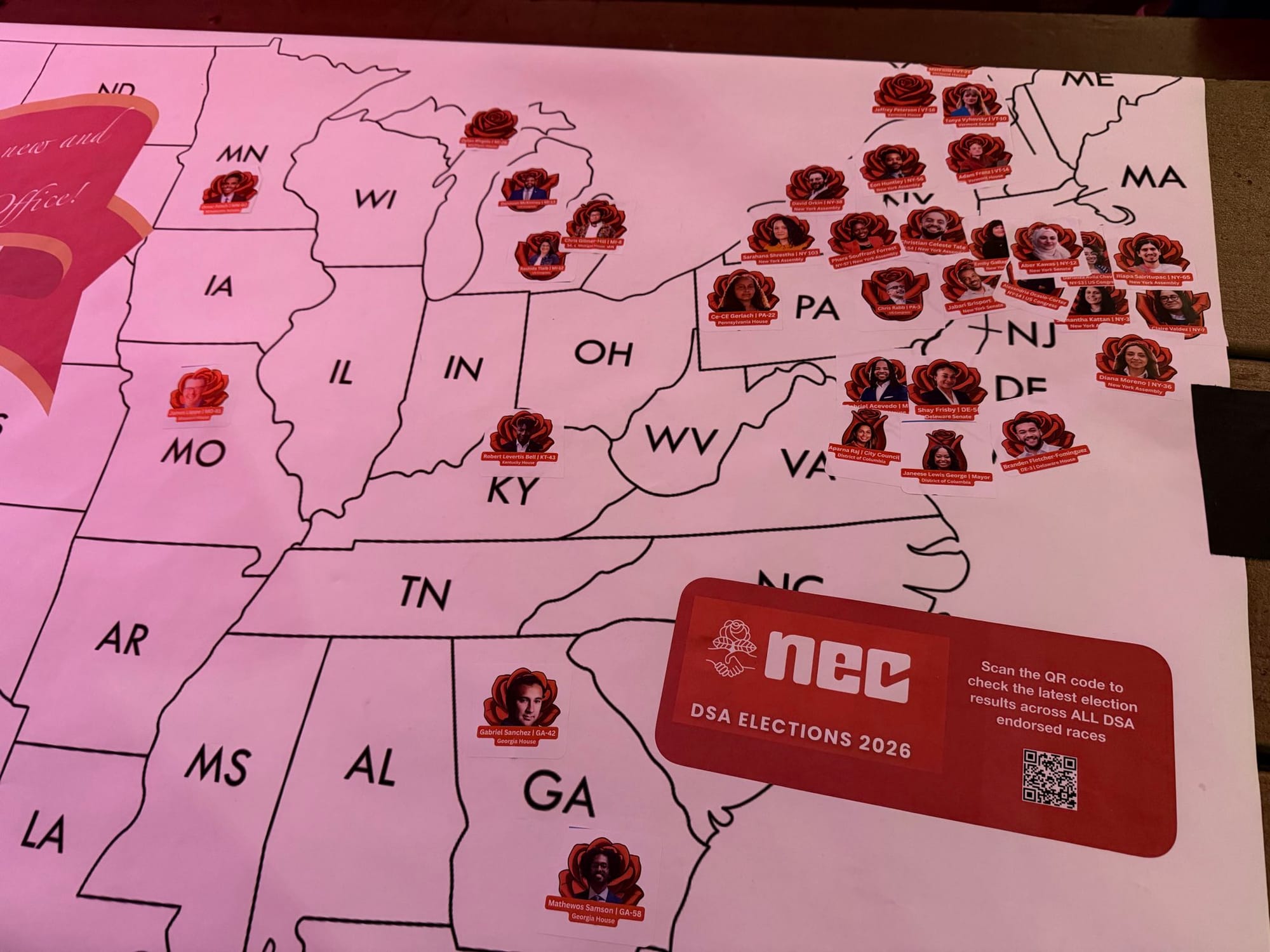
Layer two, the apparatus. The Democratic Socialists of America seated a 2025–2027 National Political Committee drawn from thirteen chapters including New York, Los Angeles, Seattle, Portland, Detroit, Houston, Denver, New Orleans, Orlando, Ithaca, Long Island, Connecticut and Wilmington, co-chaired by Ashik Siddique and Megan Romer. Its National Electoral Committee tracked 2026 endorsements on a national map, chapter by chapter, state House seat by state House seat. Observed · DSA's own convention and NEC materials
Layer three, the slate. US Campaign for Palestinian Rights Action published its elected 2026 congressional endorsements: Abdul El-Sayed, Rashida Tlaib, Donavan McKinney, Delia Ramirez, Danielle Avila Chevalier, Claire Valdez, Chris Rabb and Adam Hamawy. Observed · USCPR Action's own graphic


On both slates
- Rashida Tlaib · MI-12
- Donavan McKinney · MI-13
- Chris Rabb · PA-03
- Claire Valdez · NY-07
- Danielle Avila Chevalier · NY-13
The Unredacted · this is what the circle looks like closed
Read the three layers in sequence, because sequence is the whole argument.
A taxpayer-funded nonprofit states in writing that it is constructing a voter base from scratch with enough power to sway state politics, and is then found hosting county voting equipment while an employee reads endorsements off a ballot. A membership organization with a national committee and a chapter in every significant metro maintains a map of endorsed candidates down to the state House district. A single-issue advocacy group publishes a congressional slate. And when you lay the second and third against each other, the same five names are on both.
Nobody hid any of this. CHIRLA publishes its mission. DSA photographs its own map and posts it. USCPR Action sells the slate as a win. The machine is not concealed; it is marketed. What has never been assembled in one place is the sequence, which is the only form in which it reads as a system rather than three unrelated press releases.
And this is precisely where we stop, because the next claim is the one everyone wants and nobody has earned. An overlap between two published endorsement lists is an overlap between two published endorsement lists. It is not evidence that CHIRLA's taxpayer grants funded anyone's campaign, and we have seen no document showing that they did. Assessed
Two years. That is the entire runway.
The other side spent the last decade building. We spent ninety days buying airtime. The gap is real and it is closeable, but not by anyone waiting for a savior candidate to arrive in late 2027.
Here is the part that should make you hopeful rather than bitter: nothing in this report describes a force of nature. It describes a choice the other side made about where to put its money, and a choice ours made not to.
They built organizations that file a 990 in a year when nobody votes. We built a war chest that sat on $400 million and went quiet. Those are both decisions. Decisions can be made differently starting the week you read this, and the people who make them are not in Washington. They are reading this.
- Build the thing that exists in odd years. The Center for Popular Democracy has a payroll in February. Your county party has a Facebook page. Permanent beats seasonal every single time, and permanence is cheap at the local level. One paid organizer in a county, hired in 2027 and still there in 2028, outperforms six figures of November television.
- Fix the primary, because that is where November was lost. Two-thirds of Texas Senate voters said Paxton lacked the character for the office, and he was the nominee anyway after allies burned $90 million trying to stop him. Candidate quality is not an establishment word. It is the difference between a held seat and a eulogy. Show up to the primary. Most people do not.
- Go get the young men back with something other than contempt. Fifty-one percent of Trump's own 18-to-39 voters were certain to vote, against 77 percent of Harris's. They did not defect. They stayed home because the offer was a war, a ballroom and the word hoax. The offer that wins them is the one they voted for in 2024 and never received: rent, wages, a house, a job that an algorithm cannot take. Make that offer again and mean it.
- Refuse the demoralization, by name, out loud. A movement that tells young men their own institutions are the enemy is not recruiting them for you. Loomer called it before the votes were counted. The people running that operation do not need a handler in Moscow and they are not on your side, whatever flag they post. Name it in your own chapter, your own group chat, your own comment section.
- Use the law that already exists. California Elections Code 18370 and IRS rules on 501(c)(3) electioneering are not aspirations. They are statutes with enforcement bodies attached. A referral costs a stamp. One documented office in Los Angeles is a complaint. Ten documented offices is a reform.
- Do the reporting nobody has done. Which of those 258 organizations hold public contracts, and in which states? Nobody knows, because nobody has sat down with the 990s and the state grant databases and matched them. That is not glamorous work and it does not require a press pass. It requires an afternoon and a spreadsheet.
- Hold your own side to this standard. Six of the seven arguments in this report survived the evidence. Three specific claims circulating inside them did not. Repeating those three anyway is not loyalty, it is a gift to the other side, because the day one of them collapses in public every true thing next to it collapses too. The six that held are enough. They were always enough.
Matching 990s to grant databases is exactly this kind of job
Section 11 asks you to pull filings and cross-reference them against state contracts. That is spreadsheet work a teammate can run while you sleep. Grok Bot is free for two weeks on our invite.
Put a bot on itReferral link. The Unredacted earns credit if you sign up, at no cost to you. Sponsorships never touch editorial. Nothing in this report was reviewed by an advertiser.
If you take one thing from this report
They did not beat us with a secret. They beat us with a payroll.
That is the most encouraging sentence in this entire document, and it is why we closed with a build order instead of a grievance. A secret cannot be matched. A payroll can. Institutions are not magic and they are not foreign, they are just somebody showing up on a Tuesday in a year with no election, over and over, until the thing they built is load-bearing.
Twenty-four months is not a lot of runway. It is enough to hire the organizer, win the primary, make the offer and file the complaint. It is not enough to spend arguing about ballots that were counted correctly.
Start this week. Send us what you find. If you pull a 990, match a grant, or document a second CHIRLA, bring it here and we will publish it with your name on it or without, however you want it.
Republicans had the money. They had $677 million, the largest individual donor in the history of American politics, and a primary endorsement operation running at a 96 percent success rate. They used it to nominate a man two-thirds of Texas Senate voters said lacked the character for the office.
The other side had the Center for Popular Democracy's payroll, 258 organizations with $2.6 billion in combined revenue, a marketing division selling protest posters at $135 for five, a national committee seated from thirteen chapters, a map with rose stickers on it, and a taxpayer-funded NGO in Los Angeles with a county ballot box on the floor.
One of those is a war chest. The other is a government in waiting. Money is rented every two years. Institutions are owned.
Six of the seven arguments our side is making survived contact with the record. One needs reporting nobody has done. Three specific claims living inside them did not survive at all, and repeating those is how we lose the six that did.
They told us what they are. They put it on a map and photographed it. Nobody hid the machine, which means nobody has to discover it. It only has to be matched, and matching it is ordinary work: a payroll, a primary, an offer worth voting for, a complaint filed with an agency that already has the authority to act on it.
The presidential is twenty-four months out. That is short, and it is survivable, and the people who will decide it are not waiting on a candidate. They are the ones who start in the week nobody is watching.
The closing argument
We are in a new era of communication, and only one side seems to be living in it. The old guard consultant class is about to be relegated to the dustbin of history.
Everything above this line is graded. This part is not, so we are flagging the change in register rather than smuggling it past you.
A caution about the version of this argument now going around our side, which runs: it is not the product, it is the brand, and voters do not care about results. Half right. The messaging gap is real and § 02 grades it real. But 89 percent of this electorate called the cost of living decisive and 90 percent said the same of corruption. Those are not people responding to vibes. Those are people responding to a diesel pump, a premium notice and a gold ballroom, and the story that beat us was effective partly because it was pointing at something that was actually there. Tell yourself they only bought a brand and you will spend two years fixing the ad campaign instead of the product.
One more line from that argument should not be printed anywhere: that the economy is the strongest in generations. Inflation ran 3.8 percent, the President's net economic approval was minus 18, and 58 percent disapproved. Lead with that number and a hostile reader throws out everything after it.
When you have surrendered your institutions for generations and abandoned the culture, doing the right thing is always going to be extremely unpopular. That is the actual position. It is also not an excuse, because unpopular and impossible are different words, and the people who built the machine on the other side started when they were unpopular too.
So: hire the organizer. Win the primary. Make young men an offer worth showing up for. File the complaint. Match the 990s to the grant databases and send us what you find, with your name on it or without.
They did not beat us with a secret. They beat us with a payroll. Start this week.
Sourcing & method
Primary sources: Gallup, Oct 1–19 2026, registered voters; AP Voter Poll (approx. 80,000 voters in 50 states); NBC News exit polls; FEC filings via NPR and published compilations; ProPublica 990 records for the Center for Popular Democracy, People's Action Institute and VOCAL-NY as compiled by Asra Q. Nomani for Fox News Digital; "Riot Inc.: The Funding Behind the Protests," Fox Nation, Oct 27 2026; Seamus Bruner, Government Accountability Institute; Christopher F. Rufo, Kenneth Schrupp and Austen Hufford, "Inside CHIRLA's Secret Voter Campaign," City Journal, Nov 4 2026; Judge Glock, "The Red-State Model Will Endure in Texas," City Journal, Nov 5 2026; Brookings on rural economic conditions; Reuters/Ipsos; Washington Post–ABC News–Ipsos; Harvard IOP 53rd Youth Poll; Third Way; Rod Dreher's Diary; NPR, Semafor and The Daily Beast on the Carlson–Fuentes fallout; DSA 2025 National Convention and National Electoral Committee published materials; USCPR Action published endorsements.
Diamond-marked blocks are the author's own assessment. Findings are graded Observed (on the published record), Assessed (our inference from it), or Not established (held open, neither asserted nor excluded). Section verdicts of Real, Real with a limit and Needs the work are summary judgments on each of the seven arguments as a whole. Later sections carry descriptive labels rather than verdicts.
Caveats stated rather than buried: the $56.1 million protest-group total sums three separate entities and is not a shared budget. The $2.6 billion figure is an estimate of combined annual revenues across 258 separate organizations, not a campaign expenditure or a pooled fund. The CHIRLA finding rests on a single undercover visit to a single office. Rod Dreher's 30 to 40 percent is his own estimate. Bezmenov's four-stage model is drawn from his public 1984 lectures and is used as a described doctrine, not as a sourced claim about any present operation. "Riot Inc." is Bruner's coinage and carries no legal status. Fig. 2 is redrawn from Gallup's published chart and read to the nearest point. Fig. 6 is compiled from each organization's own promotional endorsement materials and records an overlap between published lists, nothing further.
Grok Bot · Free for two weeks
Hand off the research, the sorting and the follow-ups. Come back to them done. Our readers get the first two weeks free.
Claim the inviteReferral link. The Unredacted earns credit if you sign up, at no cost to you. Sponsorships never touch editorial. Nothing in this report was reviewed by an advertiser.