MAMDANI THE FAMILY BUSINESS

PART 2
Let's talk about the Mamdanis. Not as villains in a thriller — they're not secretly twirling mustaches in a Doha villa — but as something far more interesting: a genuinely ideologically coherent family whose convictions happened to align perfectly with the financial interests of a foreign state that was willing to spend $62.4 billion to see those convictions institutionalized in American life.
That alignment isn't a conspiracy. It's something potentially more dangerous: a convergence of interests so total that nobody involved ever had to make a compromising choice. Mira Nair didn't take Qatari money despite her politics. She took it because of them — because the Doha Film Institute wanted exactly the kind of films she wanted to make, and because Sheikha Al-Mayassa, the Emir's sister who controls the entire Qatari cultural apparatus, understood that the most effective propaganda is the propaganda that doesn't feel like propaganda. It feels like cinema.
Here's the timeline. Follow it closely.
In 2004, Mira Nair founds Maisha Film Lab in Kampala — a nonprofit that trains East African filmmakers. Noble. Apolitical. Annual operating budget: roughly $420,000. Donors include the OSI Development Fund (George Soros's Open Society Institute), the Agnes Gund Foundation, and the Pannonia Foundation. The Ford Foundation eventually makes her an Art of Change Fellow.
In 2009, the Doha Film Institute is founded. Sheikha Al-Mayassa, then 23 years old, is put in charge. One of her first major investments: Mira Nair's Amelia opens the inaugural Doha Tribeca Film Festival. The relationship between the Qatari royal family and the Mamdani-Nair household has begun.
🚨 Jihadi Zohran Mamdani is a Fraud 🚨
— Amy Mek (@AmyMek) June 19, 2025
He calls himself a “socialist for the people” — but he’s really the privileged son of Hollywood royalty, raised in luxury and handed his career by his famous mother, Queen of Katwe director Mira Nair.
Mamdani even faked a South African… pic.twitter.com/xIuoW5fWQ4
Between 2010 and 2014, DFI funds Maisha Film Lab to train Qatari students in screenwriting — in East Africa and in Doha. Qatar's money is now flowing through Nair's nonprofit, shaping the next generation of storytellers in two continents simultaneously.
In 2011, DFI commits to fully funding Nair's next feature — a $15 million production called The Reluctant Fundamentalist, based on Mohsin Hamid's novel about a Pakistani man who turns away from Wall Street toward Islamic identity. Think about what you are watching when you watch that film: a sympathetic portrait of radicalization, funded entirely by a state that the U.S. government now acknowledges has a "spiritual commitment" to the Muslim Brotherhood, directed by a woman whose son will one day be the mayor of New York City. The film opens the 2012 Doha Tribeca Film Festival.
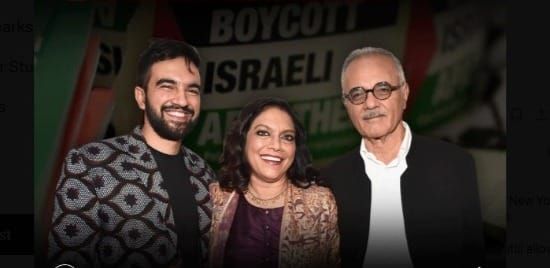
That same year — 2013 — Nair is invited to Haifa to screen the film. She refuses. Publicly. Dramatically. "I will go to Israel when apartheid is over," she tweets. The U.S. Campaign for the Academic and Cultural Boycott of Israel celebrates her. Her endorsement of BDS is now a matter of public record.
How much has Qatar paid Nair at this point? Fifteen million dollars, plus the Maisha Lab collaboration, plus the Doha Tribeca partnership. How much has the BDS movement paid her? Zero.

Meanwhile, at Columbia,
Mahmood Mamdani is doing what Mahmood Mamdani does — writing and teaching and building the ideological architecture that will give his son's political career its intellectual scaffolding. His book Good Muslim, Bad Muslim — the argument that the West's entire framework for evaluating Islam is a colonial construction — is required reading in graduate programs across the country. He has been President of CODESRIA, Africa's most prestigious social science body. He has taught at Cape Town, Michigan, Princeton. He is, by any measure, one of the most influential academic voices on colonialism and political Islam of the past three decades.
He is also, by documented record, someone who has defended suicide bombers in his academic work. This was reported. It made news briefly during the 2025 mayoral campaign. Then it didn't.
Zohran Mamdani’s mom mentioned in Epstein files email about film she directed, DOJ’s newly released documents show https://t.co/f8BaEA6Enx pic.twitter.com/RRDBI98loQ
— New York Post (@nypost) January 30, 2026
Zohran Mamdani announced his mayoral campaign in early 2025, polling at 1 percent. He was 33 years old. He was a socialist. He was a Muslim. He was, in the establishment's view, a novelty candidate. The Democratic Party leadership either ignored him or actively worked against him.
Al Jazeera did not ignore him.
Qatar's state media network ran multiple full-length features on Mamdani throughout the campaign. In October 2025, they sent reporters into New York's Muslim communities to document Zohran's "historic" run. On November 4, 2025 — election night — Al Jazeera's Start Here series ran a feature titled "New York City just elected Zohran Mamdani. What now?". Their documentary series Bigger Than Zohran framed his candidacy as a generational political rupture.
Sheikha Al-Mayassa — his mother's patron, Qatar's cultural power broker — promoted Zohran's candidacy on her personal Instagram to her millions of followers.
The Qatari Prime Minister, confronted about Qatar's ties to Mamdani at the Council on Foreign Relations, denied any connection. The denial was noted. The receipts were already public.
Zohran's campaign accepted nearly $13,000 in potentially illegal foreign contributions. The story lasted one news cycle.
On January 1, 2026, Mayor Mamdani took office and revoked every pro-Israel executive order issued by his predecessor. Palestine advocates cheered. Al Jazeera ran the headline approvingly.
In April 2026, Mamdani gave his first sit-down interview since taking office — not to the New York Times, not to the Post, not to CNN. To Al Jazeera. He discussed childcare, housing, taxing the wealthy, and his opposition to the war on Iran.
Al Jazeera also asked him, apparently without irony, about "rising anti-Muslim bigotry."

So here is the question nobody seems to want to press:
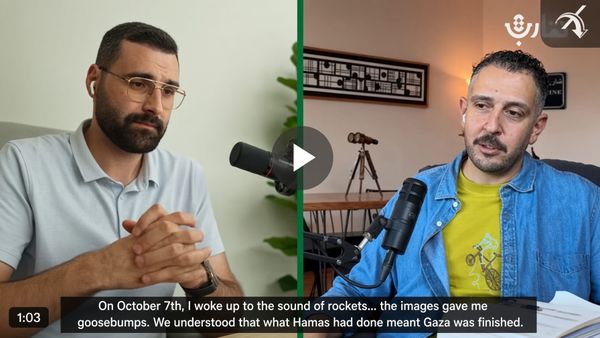
When Qatar pays your mother $15 million to make films. When Qatar Foundation International funds programs at your father's university. When Qatari royal social media amplifies your campaign. When Al Jazeera covers your every move with the devotion usually reserved for a head of state. When your father goes on Al Jazeera and says Palestine was the "near and dear" motivating force behind your candidacy — what, exactly, is the appropriate term for that relationship?
Not corruption. That's too crude, and probably unprovable. Not conspiracy. That implies secrecy, and most of this happened in plain sight.
The word is alignment. A generational, ideological, financial alignment between a Qatari state that spent $62.4 billion buying influence in American institutions and a family whose politics, whose art, whose academic work, and whose governance all point in exactly the direction Qatar's money wanted them to point.

The Doha Film Institute didn't build a Manchurian Candidate. It funded something far more elegant: a Manchurian Ecosystem — films, scholarships, academic frameworks, curriculum, social media amplification — that produced the conditions in which a particular kind of mayor could become not just possible but, in the eyes of many New Yorkers, inevitable.
Congratulations, Doha. The investment paid off.
Research sources: ISGAP Qatar University Funding Reports (2023–2024); Foundation for Defense of Democracies; U.S. Department of Education Foreign Funding Disclosures (2025); New York Post; Jerusalem Post; Jewish Insider; Times of Israel; Al Jazeera; InfluenceWatch; The Guardian; USACBI.