New York Built a Tax Base That Cannot Survive Its Own Politics
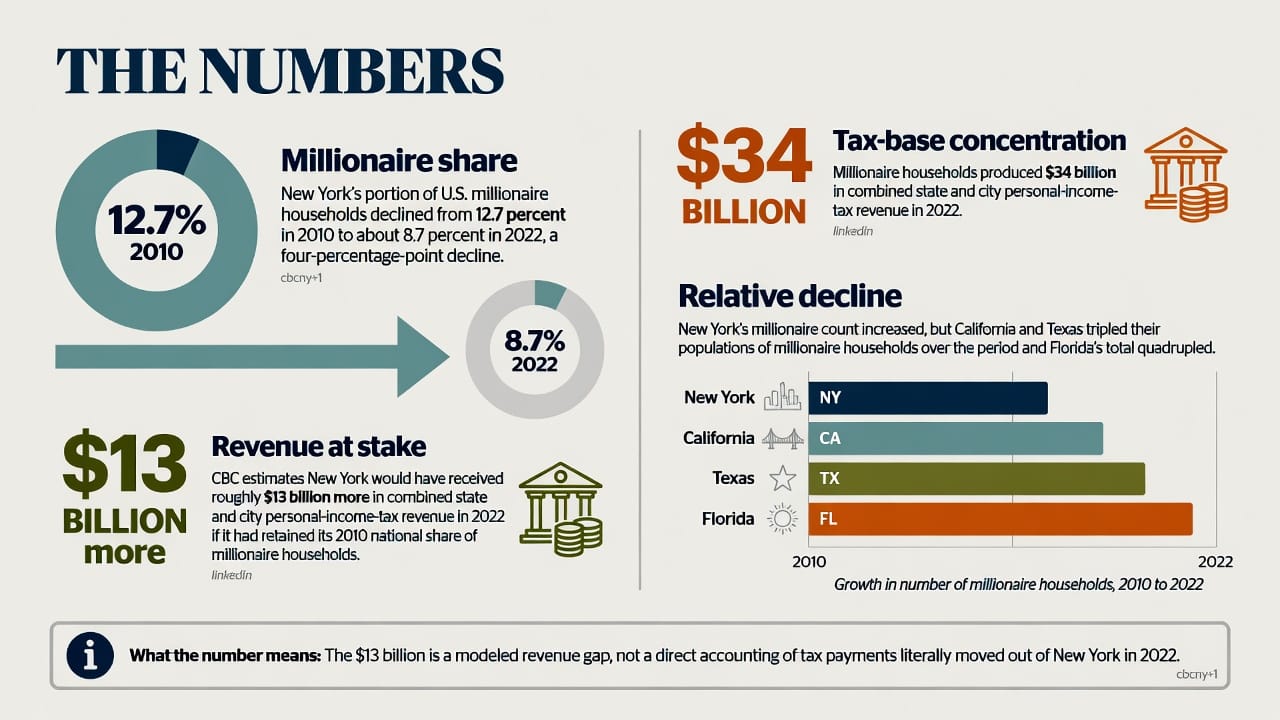
New York’s share of America’s millionaire households fell from 12.7% to 8.7% between 2010 and 2022. CBC estimates that holding its 2010 share would have generated roughly $13B more in combined city and state income-tax revenue in 2022. This is the tax-base trap.


New York built a government on a narrow tax base. Now that base is shrinking relative to the rest of the country, and the people who run the state are proposing to make it still more expensive to remain.
The record is not complicated. Between 2010 and 2022, New York’s share of the nation’s millionaire households fell from 12.7 percent to 8.7 percent. That was the largest percentage-point decline among the states. If New York had merely held its 2010 share, the Citizens Budget Commission calculates that state and city governments would have collected roughly $13 billion more in personal-income-tax revenue in 2022.cbcny+1
That $13 billion is not a literal invoice mailed from Florida or Texas. It is a counterfactual estimate. It measures the revenue New York might have collected if its slice of the nation’s millionaire population had not declined. But the model exposes the real problem: Albany and City Hall have constructed budgets dependent on taxpayers who have more choices than the political class wants to admit.
Millionaire households generated $34 billion in New York State and New York City personal-income-tax revenue in 2022, according to the CBC’s analysis. The state’s own finances are therefore tied to a small group of mobile earners, concentrated in finance, technology, law, real estate, and closely held businesses.
This is the tax-base trap.
New York wants the revenue generated by high-income taxpayers. It wants to finance a vast public apparatus. It wants to expand commitments that recur every year. It also increasingly treats the taxpayers funding that apparatus as a political enemy.
Those goals do not fit together.
The issue is not whether every millionaire packs for Palm Beach after a tax increase. Serious people can disagree about the precise effect of any one levy. The CBC itself points to a broader competitive picture: taxes, housing costs, public services, quality of life, amenities, employment, and economic conditions all shape where people and companies choose to locate.
But the larger pattern is not in dispute. New York’s millionaire population grew in raw numbers from 2010 to 2022. Other states grew much faster. California and Texas tripled their millionaire populations over the period. Florida quadrupled its total. New York moved from second place in 2010 to fourth.
That is not a one-year fluctuation. It is a loss of relative position in the national market for the people whose earnings generate an outsized share of New York’s revenue.
Albany’s answer has been to treat the problem as a messaging failure.
Gov. Kathy Hochul has rejected some direct proposals to increase taxes on high earners, while accepting other measures aimed at high-value property. Mayor Zohran Mamdani has made taxing the wealthy a central political argument. The political theory is simple: New York is rich, therefore New York can charge more.
The fiscal reality is more serious. New York is not taxing an immovable asset. It is taxing people, businesses, investment income, capital gains, and professional activity that can be reorganized, relocated, deferred, or shifted.
Millionaire EXODUS In NYC
— Mr Producer (@RichSementa) July 14, 2026
Down from 12.7% to 8.7% millionaires. COVID + Mandani taxing 300K+ earners driving them out! pic.twitter.com/GxZfU2ZTON
The state can tell itself that a Manhattan apartment is permanent. The taxpayer is not.
A financier can change domicile. A firm can move payroll. A founder can establish a headquarters elsewhere. A family can buy in Miami or Dallas, spend more than half the year there, and take future investment gains with it. The departure does not need to be total to hurt New York. It only needs to alter tax residency, business decisions, or the location of the next job.
That is why the tax-base trap is so dangerous. It is not driven by a single spectacular exit. It is driven by accumulated decisions. A second office opens in Austin. A new fund is organized in Florida. A family office moves to Palm Beach. A young founder starts elsewhere. A high earner stays, but reports less New York-source income.
The budget still arrives. The tax base does not.
New York’s political class has made a habit of confusing stock with flow. It sees the existing wealth concentrated in Manhattan and assumes the flow will continue. It sees luxury towers and concludes that affluent taxpayers have nowhere else to go. It sees one billionaire retain an address and declares the competition over.
That is not analysis. It is complacency.
The CBC’s metric is especially important because it does not rely on anecdotes about individual departures. It measures New York’s place in a national distribution of millionaire households. New York had more millionaire households in 2022 than it did in 2010. But it captured a smaller share of the country’s growth.cbcny+1
The state lost ground.
And the state’s finances make that loss more consequential than it would be elsewhere. Millionaire households were less than 1 percent of New York State and New York City resident tax filers in 2012, but they accounted for 44 percent of state income-tax payments and 40 percent of city income-tax payments, according to the CBC.
That is fiscal concentration. It is a structural weakness.
It means a budget can look stable right until it does not. It means lawmakers can promise new spending based on temporary capital-gains receipts, then confront deficits when markets fall or taxpayers reorganize their affairs. It means every demand for a new program carries an unspoken condition: the highest earners must keep producing, keep realizing gains, keep filing in New York, and keep accepting the state’s terms.
Albany calls this progressive taxation. The balance sheet calls it dependence.
The answer is not to turn New York into a low-tax replica of Florida. New York has assets Florida cannot duplicate. It has global finance, universities, cultural institutions, dense labor markets, specialized professional services, and a city that still draws talent from around the world.
But those advantages are not a license for fiscal malpractice.
A state that collects more per person in state and local taxes than any other state has a duty to show taxpayers what they are buying. The CBC tracker is designed around that exact question: whether New York’s combination of taxes, public services, affordability, and economic opportunity delivers enough value to compete.
That test should govern every major fiscal decision.
Before Albany raises another tax, it should identify the spending it will fund, the measurable public benefit it expects, and the taxpayer behavior it assumes will remain unchanged. Before City Hall adds another burden to employers, it should disclose the effect on job creation, commercial occupancy, small-business formation, and tax residency. Before either government builds a recurring program on volatile income-tax receipts, it should explain how the program will survive the next downturn.
The burden of proof belongs to the people spending the money.
New York does not have a millionaire problem. It has a governing problem.
The state relies on a narrow group of taxpayers for an extraordinary portion of its revenue. It has watched its share of those taxpayers decline for more than a decade. It has known that other states are competing for the same people and businesses. And it continues to behave as if the next tax increase is costless because the last one did not trigger an immediate collapse.
That is how governments walk into a fiscal crisis. One budget at a time. One assumption at a time. One departed taxpayer at a time.
The $13 billion estimate is not proof that New York has already lost everything. It is worse. It is evidence that the state has spent a decade losing ground while preserving the policies that make it harder to recover.
The question is not whether New York can tax the rich.
The question is whether New York can afford to keep governing as if they cannot leave.
📬 Share, Comment, and Support Our Work
Share this. Restack it. Forward the email. That's the whole ask.
Support the work. The reporting linked above took weeks of tracing records, filings, and on-the-record statements. It doesn't happen on faith. If you find it useful, become a paid subscriber and help fund the next one.
Source attribution: Citizens Budget Commission, “Competitive NYS: Value Proposition Tracker,” and related CBC analysis. Reporting premise supplied from the New York Post’s July 13, 2026 coverage.