New York's New Map Erased Little Italy. That Was the Point.
Mamdani's team as savvy political operators running a real strategy.

"The safest road to Hell is the gradual one — the gentle slope, soft underfoot, without sudden turnings, without milestones, without signposts." C.S Lewis
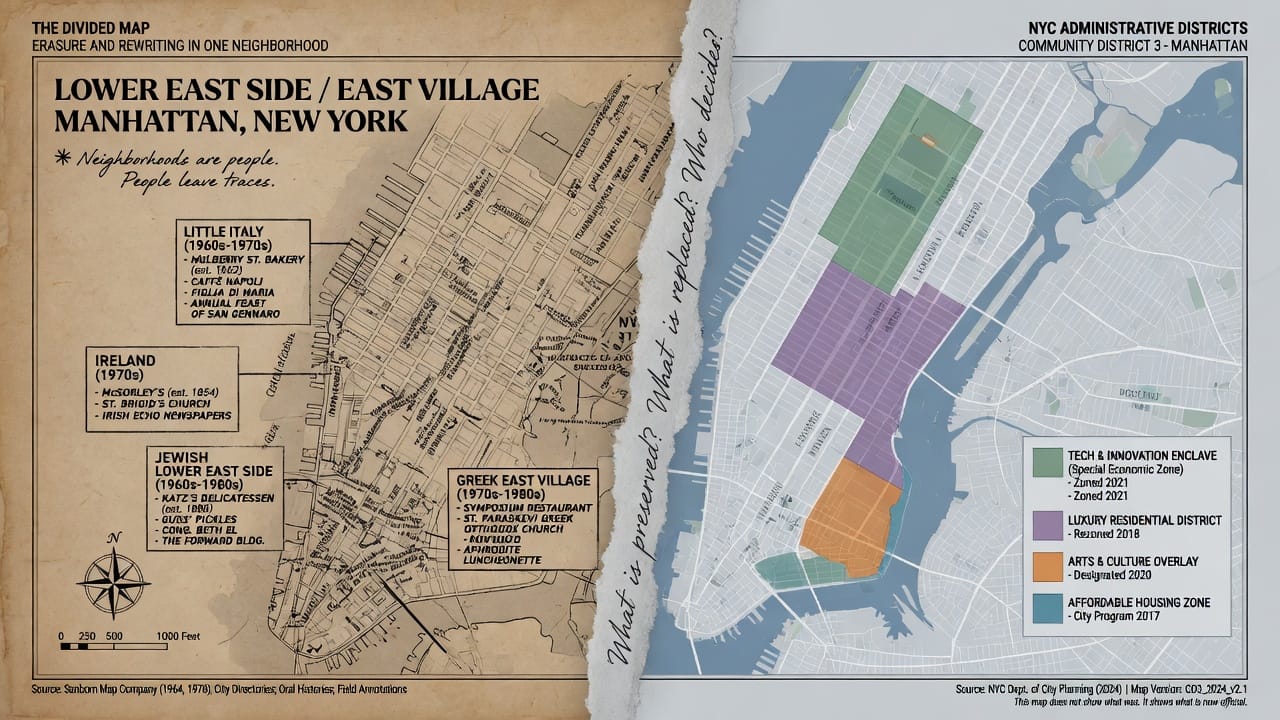
The act of mapping has always been an exercise in memory, a way of anchoring the ephemeral history of a city onto something solid. For generations of New Yorkers, the geography of the boroughs was understood not through municipal decrees but through the organic patterns of migration. You knew where the tenements ended, and the parishes began, where the pushcarts gave way to the bakeries, and where families spent decades laying down the foundational bricks of the metropolis.
Leaving out the Italian, Jewish, and Irish enclaves in NYC is like leaving out Mexican and Persian enclaves in LA.
— Spencer Pratt (@spencerpratt) July 9, 2026
It’s not an “oopsie!” This is deliberate subversion. The communist must erase your history so he can demolish your home and make it his own. https://t.co/JnxMJWQCo9
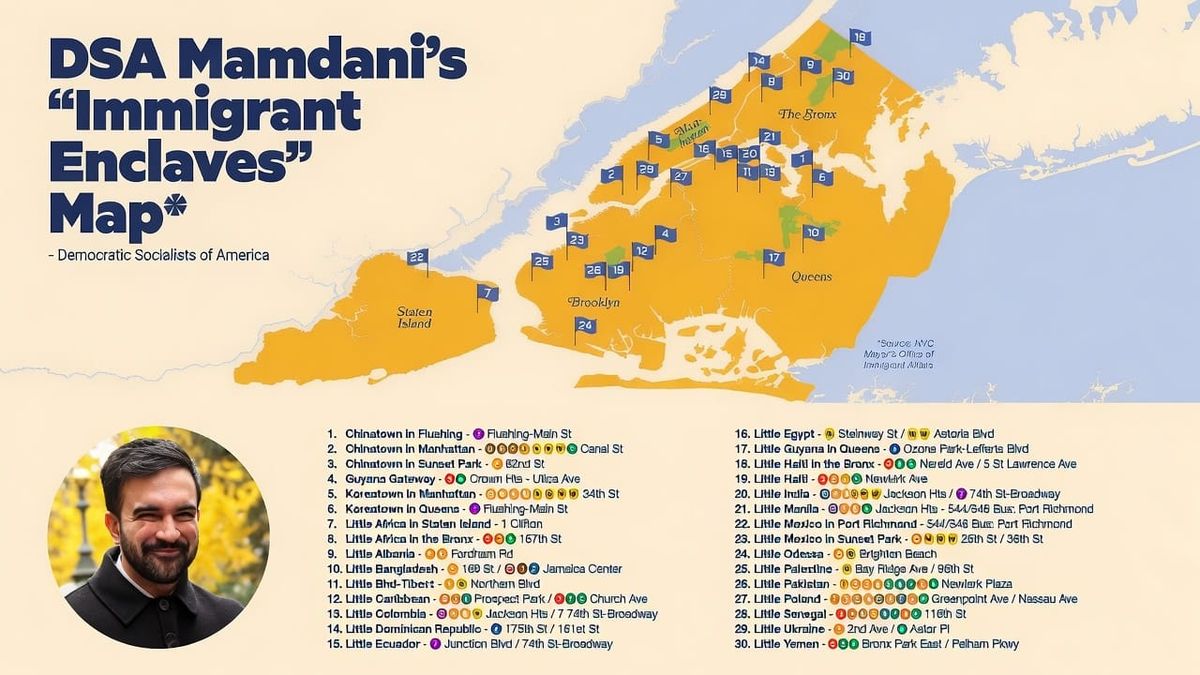
When the Mayor Office of Immigrant Affairs recently published its new guide, titled New York City Immigrant Enclaves, it became clear that the administration of Mayor Zohran Mamdani views geography through a very different lens. The document claims to celebrate thirty distinct cultural zones across the five boroughs, officially sanctifying spaces like Little Palestine, Little Pakistan, and Little Yemen. Yet the true meaning of this new cartography lies in its silence. By a deliberate stroke of the bureaucratic pen, the historic footprint of Little Italy has been entirely scrubbed from the official map. The generational Irish neighborhoods of the Bronx, the foundational Jewish quarters of Brooklyn, and the deep rooted Greek communities of Astoria have met the exact same fate.
"This is not a casual oversight by a distracted administrative clerk. It is an act of ideological erasure, a systematic rewriting of urban history designed to sunset the legacy of the working class European migrations that built the actual infrastructure of New York."
Any map of New York City’s ethnic neighborhoods that doesn’t acknowledge Little Italy is a complete joke.
— Anthony Pompliano 🌪 (@APompliano) July 9, 2026
This is not a casual oversight by a distracted administrative clerk. It is an act of ideological erasure, a systematic rewriting of urban history designed to sunset the legacy of the working-class European migrations that built the actual infrastructure of New York. In the worldview of the Democratic Socialists of America coalition that now occupies City Hall, history is not a continuous line of human strivings but a curated narrative of state-approved grievances. If a community does not fit the specific, contemporary definition of state-recognized marginalization, it is simply unmapped, treated as if its contributions to the city never existed.
The Newsjacking Strategy
Predictably, the publication of the map triggered an immediate explosion of public anger. Everyone from local civic groups to the Young Republicans Club rushed to the microphones to denounce the administration for historical illiteracy. But to respond with standard-issue indignation is to fall directly into the trap that the architects of this policy have set.
For the strategists running the modern progressive apparatus, public outrage is not a sign of resistance; it is the vital fuel that drives their entire media operation. This is a classic instance of newsjacking, an intentional provocation designed to drag the opposition into a localized culture war that the government can then exploit for its own political ends, a tactical maneuver reminiscent of the high-profile stage management used by political radicals in the mid-twentieth century.
The mechanism is elegant in its cynicism. By staging a confrontation over symbolic borders, the administration forces a crowded news cycle to organize itself into a neat binary moral play. The casual observer scrolling through a digital feed is presented with a carefully framed choice between a progressive executive defending vulnerable new populations and a legacy establishment clinging to the past. While the public square remains consumed by this emotional noise, the administration successfully obscures its own material failures, leaving ordinary New Yorkers to navigate deteriorating public services, crumbling infrastructure, and a fracturing middle class.
Ro Khanna: “Raise your hand if you are a pro-terror radical!”
— Stu Smith (@thestustustudio) September 28, 2025
Here’s a supercut of the worst moments from ArabCon this weekend. I’ve already dropped nearly 40 clips since Friday — and there are still more jaw-dropping ones to come. pic.twitter.com/UCQlXNZxeg
The True Seat of Power
To understand how this machine functions, one must look beyond the figurehead standing at the podium. The mayor, whose own journey from Kampala to the heights of Western politics exemplifies the complex ironies of the modern elite, operates less as an independent statesman and more as a theatrical performer, delivering lines scripted by a highly coordinated inner circle of institutional handlers.
Who is bankrolling DSA and other fringe candidates across America? Linda Sarsour shares how "max donations" from Muslim and Arab-American donors whose main agenda is Palestine are behind campaigns in NYC and Texas. pic.twitter.com/z2zeomk1my
— Canary Mission (@canarymission) June 26, 2026
Behind the scenes, the actual levers of municipal authority are held by a specific class of activist managers, housing organizers, and ideological consultants. Operatives like Cea Weaver, Tascha Van Auken, Megan Romer, and Linda Sarsour, working within a shared cultural orbit influenced by figures like filmmaker Mira Nair, form the true governing committee of the city.
This managerial elite has successfully decoupled political power from the realities of everyday governance, transforming the administration into an engine for structural realignment and ideological sorting. It is an environment that easily accommodates the most surreal cultural products, such as luxury yoga retreats linked to the mayoral family circle that charge affluent practitioners five thousand dollars a session to engage in radical posturing, combining spiritualized politics with the absurd historical claim that Jesus was a Palestinian.
🚨 Mamdani’s Mass Engagement Office Pick Called for “Defeating the Republican Right and the Neoliberal Center”
— Stu Smith (@thestustustudio) January 2, 2026
Today, Mayor Zohran Mamdani signed an executive order creating a new Office of Mass Engagement. He tapped Tascha Van Auken, the architect of his campaign’s field… pic.twitter.com/2N5wYzf2Ul
While the children of the elite indulge in these high priced exercises in fashionable activism, insulating themselves from the material realities of the city, their political organizations deploy the sophisticated playbooks of Saul Alinsky and Gene Sharp to quietly expand their institutional footprint, as demonstrated by their recent sweep in the primary elections.
The Path Forward
For those who view this institutional capture as a fundamental threat to the survival of our civic culture, continuing to trade in the currency of reactive outrage is a recipe for permanent defeat. Loud denunciations and symbolic media skirmishes do not disrupt a political machine of this scale; they validate it, reinforcing the tribal divisions that the ideologues rely on to maintain control.
The path forward requires a complete rejection of the bait. Instead of screaming at the map, critics must commit to a cold, forensic exposure of the administrative networks that produce these policies. The focus must shift away from the symbolic proxy wars and toward the specific web of foreign-funded non-profit organizations, activist bureaucrats, and private advocacy groups that are quietly restructuring municipal life behind closed doors.
The radical vanguard wins when it successfully balkanizes New York into a collection of state-managed client states.
The only way to preserve the city is to expose the machinery of the grievance infrastructure and reassert a single, uniform civic standard rooted in our shared reality as New Yorkers.
📬 Share, Comment, and Support Our Work
Share this. Restack it. Forward the email. That's the whole ask.
Support the work. The reporting linked above took weeks of tracing records, filings, and on-the-record statements. It doesn't happen on faith. If you find it useful, become a paid subscriber and help fund the next one.
 Gene Goodwin