OPERATION EPIC FURY: America Chose Force Because Iran Left No Other Choice. Now Watch Who Defends the Mullahs.

The bombs started falling on February 28, 2026, before sunrise in Tehran. By the time President Trump addressed the nation at 2:30 a.m., the United States had already launched what the Pentagon is calling Operation Epic Fury. Strikes hit Tehran, Isfahan, Qom, Karaj, and Kermanshah. The targets were nuclear infrastructure, ballistic missile systems, and military command facilities. The operation, co-executed with Israel under the codename Roaring Lion, was built for days of sustained attacks, not hours.
Trump's message was direct: "Our objective is to defend the American people by eliminating imminent threats from the Iranian regime. For 47 years, the Iranian regime has chanted 'Death to America' and waged an unending campaign of bloodshed and mass murder targeting the United States, our troops and the innocent people in many, many countries."
He is right. And the record proves it.
What America Tried Before the Strikes
The lie already spreading across social media is that Trump launched an unprovoked war while diplomacy was working. The ANSWER Coalition's protest statement, published the morning of the strikes, claimed that "Iran has not attacked the United States" and that "the government has been engaged in diplomatic negotiations up to the very last moment."
This is regime messaging, not fact.
Here is what the diplomatic record actually shows. On February 6, Iran and the US held indirect nuclear negotiations in Oman's capital, Muscat. Iran emphasized that progress depends on consultations back in capitals. A second round of nuclear talks was scheduled in Geneva. The US sent Special Envoy Steve Witkoff and Jared Kushner. Oman mediated. The engagement was serious and structured.
Washington presented three core demands: a permanent end to uranium enrichment, strict limits on ballistic missiles, and a complete halt to support for proxy groups, including Hamas, Hezbollah, and the Houthis. Iran stalled. Just hours before the strikes began, Oman's foreign minister, who had been mediating the talks between US and Iranian officials, said the two sides had made "significant progress." But Iran had not agreed to end enrichment, the only term the United States required. Talks without that commitment were not a deal. They were delay.
Trump had been explicit. On February 19 he issued a 10 to 15-day deadline. On February 24, during his State of the Union address, Trump accused Iran of reviving efforts to build nuclear weapons, condemning these alleged ambitions as "sinister" and claiming that Iran had also developed increasingly advanced missile capabilities that could threaten the US, Europe, and US bases overseas. The warning was public. The consequence was stated. Iran chose defiance.
That is not a surprise attack. That is a deadline kept.
BREAKING:
— Visegrád 24 (@visegrad24) February 28, 2026
U.S. airstrikes hit Tabriz, Iran pic.twitter.com/biavlxSjpi
What the Iranian Regime Is
To understand why this was necessary, you have to understand what the Islamic Republic actually does, not what its American apologists claim.
Support for regional nonstate actors has been a pillar of the Iranian government's foreign policy since the 1979 founding of the Islamic Republic. Iran supports these groups to advance its foreign policy aims, including to position itself as the defender of Shia Muslim communities and other groups that the Iranian government characterizes as oppressed. Perhaps preeminent among these aims is reducing threats that Iran may face stemming from the regional influence of the United States and its regional allies, with which the Iranian government sees itself as locked in an existential struggle.
BREAKING: Iranian high school students cheer on strikes against the Islamic Republic.
— Eyal Yakoby (@EYakoby) February 28, 2026
Students say “I love Trump!” pic.twitter.com/1U4hVrR4fH
The State Department puts it in numbers. Iran provides "up to $100 million annually in combined support to Palestinian terrorist groups, including Hamas." Per the State Department, Iran "continues to provide Hezbollah with most of its funding, training, weapons, and explosives, as well as political, diplomatic, monetary, and organizational aid."
The Houthis, who spent months attacking US Navy vessels in the Red Sea and disrupting global shipping, are an Iranian project. Kata'ib Hezbollah in Iraq, which conducted attacks against American forces, is an Iranian project. The regime does not merely dislike the United States. It funds and directs organizations whose purpose is to kill Americans and destabilize American allies.
Inside Iran itself, the record since December 2025 is catastrophic. Beginning in late December 2025, massive nationwide anti-government protests erupted in Iran, driven largely by economic crisis, the collapse of the rial, and rising prices. The protests became the largest in scale since the 1979 revolution, spreading to over 100 cities across the country. The Iranian government responded with violent repression, including massacres of protesters, with the deadliest incidents occurring on January 8 and 10, 2026. Death toll estimates range from 3,117 (the regime's own figure, which it has every incentive to minimize) to over 32,000.
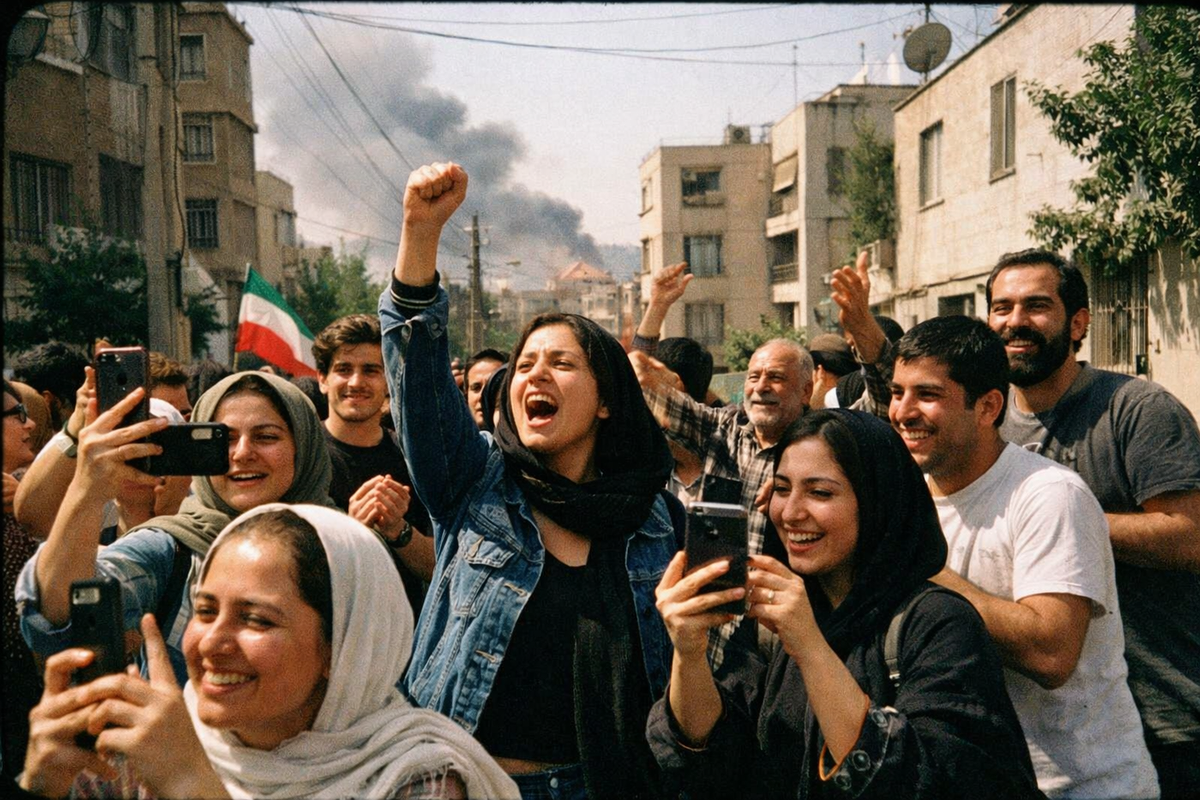
The Iranian people know what this regime is. Many Iranians inside Iran celebrated and rejoiced in the joint American-Israeli strikes. An initial video showed some Iranian citizens laughing and celebrating after witnessing an airstrike on what they called the "leader's house." Another video showed a woman in Iran celebrating the strikes while shouting "Death to Khamenei." Female students at a school in Iran rejoiced after the joint Israeli-American attack.
Trump spoke directly to them: "The hour of your freedom is at hand."
Operation Epic Fury: What Is Happening Right Now
Trump announced "major combat operations" and vowed to decimate Tehran's military and fuel a change in government. Israeli Prime Minister Benjamin Netanyahu said the joint attack would last "as long as needed."
Unlike the strikes in June, these began in daylight early Saturday morning, the first day of the work week in Iran, as millions went to work or school. Whereas the US strikes in June were over within a few hours, sources told CNN that the US military is this time planning for several days of attacks.
Iranian here with a message for every single American who voted for President Trump:
— Goldie Ghamari | گلسا قمری 🇮🇷 (@gghamari) February 28, 2026
Thank you.
God bless President Trump.
God bless the US Military.
God bless America. 🇺🇸 pic.twitter.com/MLxP9p25eI
Israel targeted Iranian political and military leaders, while the US aimed to take out Iran's ballistic missile and nuclear programs. Khamenei's residential compound in downtown Tehran was among the first targets. He was evacuated before the strikes. His survival does not change the message.
Iran has responded. Iran responded by firing missiles at Israel as well as at US bases across the region, including in the United Arab Emirates, Qatar, Kuwait, Bahrain, Jordan, and Syria. Video confirmed a missile struck a US Navy service center in Bahrain. As of this writing, there are no confirmed American casualties.
Iran is now in a near-total internet blackout, with national connectivity at 4% of ordinary levels, according to internet monitoring experts at NetBlocks. The blackout matches measures used during last year's war with Israel. The regime is cutting its own people off from the world as bombs fall. That is not a government protecting its citizens. That is a government protecting itself.
Who Is Running Propaganda Cover in American Streets
Within hours of the first strikes, protest groups mobilized across the United States. A coalition of organizations, including the National Iranian American Council, the ANSWER Coalition, and 50501, held an "emergency day of action" nationwide to protest the attacks. Demonstrations were called in Los Angeles, Washington DC, San Francisco, and dozens of other cities.
Americans have a constitutional right to protest. That right does not exempt these organizations from scrutiny about what they actually represent.
The ANSWER Coalition, which stands for Act Now to Stop War and End Racism, frames itself as a peace organization. The record tells a different story. ANSWER is closely associated with the Party for Socialism and Liberation. ANSWER's National Coordinator is Brian Becker, a PSL co-founder. A writer for The New Republic described ANSWER as a PSL "front group," and the two have significant financial overlap.
🚨 Coalition Check: Progressive Darling 50501 Joins “Stop the War on Iran” Protest Alongside Groups Flagged in State Department Influence Warnings
— Stu Smith (@thestustustudio) February 28, 2026
The sponsor list is the story. You’ve got the usual “anti-war” and anti-imperialist ecosystem: ANSWER Coalition, CODEPINK, The… pic.twitter.com/8kyaRoTR0G
Brian Becker defended the September 11 terrorist attacks against the United States. He characterized America's military retaliation against the Taliban as "one of the great crimes and acts of terrorism" in modern history. This is the man leading today's "anti-war" protests.
The PSL's documented position on Iran is not neutrality. The PSL has claimed that Iran's clerical regime's "interests are aligned with the interests of organic anti-imperialist and anti-Zionist movements across the region." When Iranian citizens rose up by the millions, PSL and its predecessor, Workers World Party, did not stand with them. Neo-Stalinist groups like the Party for Socialism and Liberation and the Workers World Party have predictably denounced the protesters as stooges of Western governments, and accused them of being secretly funded by US government organizations like the National Endowment for Democracy. They did this in 2009 during the Green Movement. They did it again in 2018. They are doing it now.
Workers World Party speakers told protest crowds that "since the Iranian revolution in 1979, Iran has never succumbed to regime change or imperialist threats and intimidations," framing the Islamic Republic's survival as a victory worth defending. Reporters from Iran's state-run Press TV covered those protests and interviewed their speakers. That tells you everything.
If you’re trying to understand how these coalitions actually function, this article breaks down the mechanics and who’s really driving the agenda.
— Stu Smith (@thestustustudio) February 28, 2026
Often, the most radical actors are setting the direction behind a progressive-sounding front. https://t.co/FzETdbYbwO
This is not an anti-war movement. A genuine anti-war movement would stand with the Iranian workers and women who have been dying in the streets since December 2025. These groups stood against them. They defended the regime that massacred those protesters. Now they are marching against the operation that targeted that regime's nuclear and military infrastructure.
They are not for peace. They are for the mullahs.
What America Is Fighting For
Trump said it plainly: "All I want is freedom for the people. I want a safe nation, and that's what we're going to have."
This operation has three documented objectives. Destroy Iran's nuclear program before it produces a weapon. Eliminate the ballistic missile systems that threaten US bases, US allies, and potentially the US homeland. And remove the regime that has spent 47 years building those threats while murdering its own people.
That is not imperialism. That is accountability. It is the kind of accountability that 30-plus years of diplomacy, sanctions, negotiated agreements, and strategic patience failed to produce.
The Iranian diaspora understands what is happening. Across the Iranian diaspora as well as among Iranians inside Iran, calls grew for American military strikes on Iran. Iranian Canadian and Iranian Australian communities submitted petitions to their respective governments seeking support for democratic transition and recognition that a large majority of Iranians reject the Islamic Republic as their lawful representative.
Masih Alinejad, the Iranian-American journalist who has spent years documenting the regime's brutality against women, said Trump is "on the right side of history."
The Iranian people in the streets of Tehran celebrating the strikes agree.
What Accountability Looks Like Going Forward
This operation is not a blank check. America fights best when it fights with clear objectives and honest metrics.
The objectives here are stated and defensible: nuclear dismantlement, missile elimination, regime change through Iranian popular will. Trump told the IRGC they can lay down arms and receive immunity, or face "certain death." He told the Iranian people their freedom is at hand.
Congress has a constitutional role to play. House Minority Leader Hakeem Jeffries called on Congress to vote on a War Powers resolution immediately. Senate Minority Leader Chuck Schumer called for the Senate to reassert its constitutional duty. Those calls are appropriate. Authorization matters even when the underlying action is justified. The two things are not in conflict.
The UAE called the conflict a "historic moment" in the Middle East, saying world leaders had failed to ensure the region's stability. They are correct. That failure belonged to every administration that managed Iran's nuclear program without ending it. Trump ended the management era.
The next phase will be hard. Iran is firing missiles across the region. The Strait of Hormuz is under threat. Oil markets will move. American troops are in harm's way.
Checking in on Marco’s first day at his new job.
— Autism Capital 🧩 (@AutismCapital) February 28, 2026
pic.twitter.com/Qhr44tIJYk
But the alternative, a nuclear-armed Islamic Republic that massacres its own citizens, funds proxy armies across four countries, and fires missiles at US bases while chanting "Death to America," was not an alternative that any serious nation could accept indefinitely.
America did not choose this moment. Iran did. February 28, 2026 is the date that patience ran out.
The media will cover the missiles. This publication will cover the institutions, the propaganda networks, and the documented record of who chose war and who chose to run cover for the people who did. If you have firsthand accounts from Iranian diaspora community members, documentation on ANSWER Coalition funding, or congressional AUMF correspondence, contact us securely.