The $188 Million Question"

“Justice consists not in being neutral between right and wrong, but in finding out the right and upholding it.”
— Theodore Roosevelt
An investigation into the mysterious funding behind one of the most influential criminal justice organizations in America.
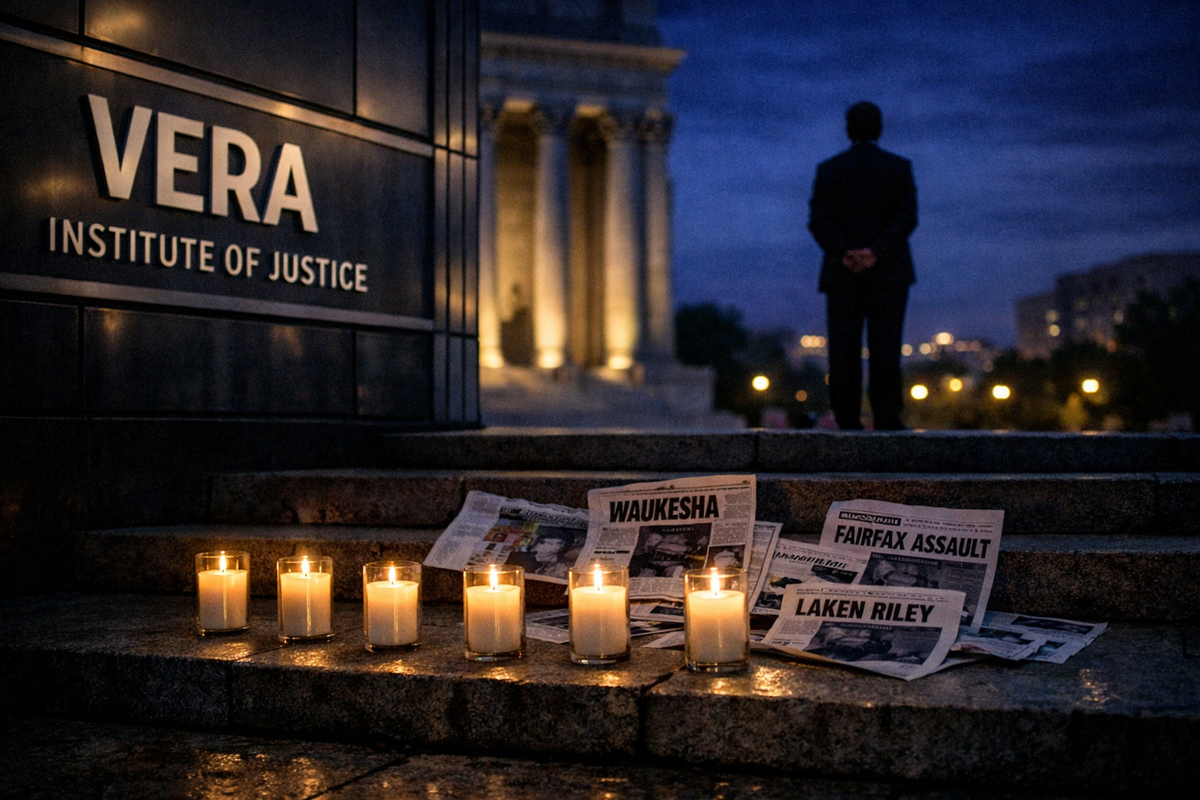
According to O’Keefe’s investigation on a quiet day in 2021, the Vera Institute of Justice received the largest anonymous donation in its 65-year history: $188 million.
To put that in perspective, it was:
And almost nobody noticed.
The donation appeared buried in Vera's 2021 Form 990—the tax filing nonprofits must make public. Line 1b of Schedule B (Schedule of Contributors) showed a single contribution: $188,000,000. The donor's name was redacted, as IRS rules allow for contributions over $5,000.
For an organization that champions transparency in criminal justice, that manages hundreds of millions in taxpayer dollars, and that advises governments on life-and-death policy decisions, the secrecy is remarkable.
Who gave Vera Institute $188 million? And why don't they want you to know?
BREAKING: Vera Institute Director Confesses Non-Profit ‘Tips Illegals Off’ Regarding ICE Whereabouts Using Secret “Notification Systems” In Order to “Avoid the Area”
— James O'Keefe (@JamesOKeefeIII) July 31, 2025
“We know which states are being targeted… If you see someone [from ICE], you can text the group and it’ll go on… pic.twitter.com/ypeaHhud98
Before we chase the money, understand what Vera is.
Founded in 1961, the Vera Institute of Justice positions itself as a research and policy organization working to "end mass incarceration" and "transform the criminal justice system." Its work includes:
By 2020, Vera had become one of the most influential criminal justice organizations in America, with an annual budget exceeding $200 million and partnerships with jurisdictions across the country.
Then came the Senate investigation.
In 2024, Senator Chuck Grassley's staff documented how Vera's partnerships with progressive prosecutors had led to what the report called "disastrous consequences"—including the release of violent criminals who went on to commit murders, assaults, and in one case, a massacre at a Wisconsin Christmas parade that killed six people.
The Trump administration subsequently terminated $167 million in federal grants to Vera, calling the organization's work "contrary to public safety."
But by then, Vera had something federal grants couldn't give them: independence.
That $188 million donation meant Vera could operate without federal oversight, continue its work without accountability to taxpayers, and push even more aggressive criminal justice policies.
The question is: who wanted that badly enough to write a check for nearly $200 million?
On Vera: Sources Confirm Donors Funneled Millions of Dollars Through Universal Music Group, Fidelity, Bank of America, and Goldman Sachs to ‘Tip Illegals Off’ While Progressive Caucus Insider Admits Caucus Secured “Injunctions” to “Stop Deportation Flights”
— James O'Keefe (@JamesOKeefeIII) August 20, 2025
“I think pressuring… pic.twitter.com/ePKsQGJ1X9
Anonymous mega-donations are rare but not unheard of in American philanthropy. When they happen, detective work usually reveals patterns. Let's examine the most likely candidates.
The Case For:
Vera already has deep ties to the Soros network. According to tax records:
Nicholas Turner, Vera's president (salary: $602,333), previously worked closely with OSF-funded initiatives. Multiple Vera board members have OSF ties.
The Case Against:
Likelihood: 40%
The Case For:
Jeff Bezos's ex-wife has become famous for massive, rapid-fire donations with minimal strings attached. Her giving pattern matches:
In 2020-2021, Scott gave away over $12 billion to 1,257 organizations, much of it unrestricted. Criminal justice reform was a stated priority.
The Case Against:
Likelihood: 30%
The Case For:
Silicon Valley has increasingly funded criminal justice reform:
The Case Against:
Likelihood: 20%
The Case For:
This is the darkest scenario, but worth examining:
The Case Against:
Likelihood: 5%
The Most Likely Scenario:
What if it's not one donor, but several?
Here's how it could work:
This would explain:
Common intermediaries for this approach:
Likelihood: 60%

"Why do you care who donated?" defenders might ask. "It's legal, and the money does good work."
Here's why it matters:
Even with the federal grant termination, Vera still receives significant state and local government contracts. When a nonprofit manages taxpayer dollars, the public has a right to know who else is funding it.
Questions we can't answer:
Vera partners with District Attorneys' offices across America. These prosecutors make decisions about who goes to prison and who walks free.
If we don't know who's funding Vera, we can't assess conflicts:
The Milwaukee partnership—which led to the Waukesha massacre—shows the life-and-death stakes of Vera's prosecutor relationships.
Vera runs programs that directly interfere with ICE operations. As documented in undercover video, Vera-funded systems notify illegal immigrants when ICE is coming, helping them evade arrest.
If a foreign entity funded Vera, this would be:
Even if the donor is domestic, their interest in obstructing immigration enforcement deserves scrutiny.
Vera doesn't just study criminal justice—it actively lobbies for:
These aren't academic positions. They're political advocacy.
When a mystery donor gives $188 million to advance these specific policies, voters deserve to know who's trying to change their criminal justice system from behind a curtain of anonymity.

Is this legal?
Yes. Current IRS rules allow nonprofits to keep donors anonymous if:
But legal doesn't mean ethical.
The Campaign Legal Center, a nonpartisan watchdog, argues that major donations to politically active nonprofits should require disclosure:
"When organizations engage in policy advocacy that affects millions of Americans, the public has a right to know who's funding that advocacy. Anonymous mega-donations to policy organizations are 'dark money' whether they're on the right or the left."

Vera's $188M is part of a larger trend: anonymous mega-donations to politically active nonprofits.
Recent examples:
This "dark money" isn't illegal—but it's corrupting the policy process.
Here's how it works:
In Vera's case:
The public deserves to know: who wanted this outcome badly enough to spend $188 million?
“It is the spirit and not the form of law that keeps justice alive.”
— Earl Warren,
Nicholas Turner, Vera's $602,333-a-year president, frequently speaks about the need for transparency in criminal justice:
"The system must be accountable to the communities it serves. Decisions made in secret, without public scrutiny, inevitably lead to injustice."
By that standard, Vera should disclose its $188 million donor.
The organization that demands transparency from police departments, prosecutors' offices, and ICE won't reveal who's funding its own operations.
The irony is remarkable. The hypocrisy is worse.
Six people died in Waukesha after a violent criminal—released under policies Vera promoted—drove through a Christmas parade.
Senate investigators called Vera's work "disastrous."
The federal government terminated $167 million in grants.
And through it all, a mystery donor's $188 million keeps Vera operating, advising, influencing policy, and shaping criminal justice decisions that affect millions of Americans.
Who is that donor?
And why won't Vera tell us?
to be continued...
EDITOR'S NOTE: The Vera Institute of Justice declined to comment for this article. The identity of the $188 million donor remains unknown.
