The Breakwater Breached: Thousands of Migrants Cross Into Ceuta in a Single Day as Guardia Civil Nears Collapse

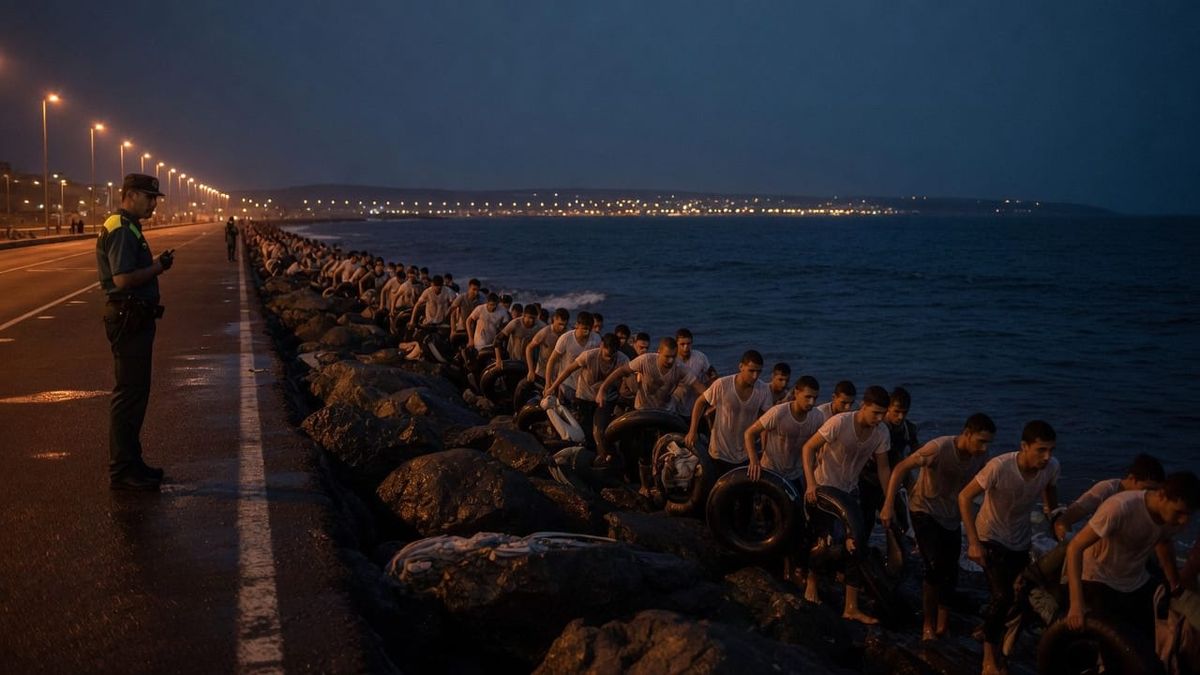
The breakwater at Tarajal does not look like a frontier of empire. On Thursday it looked like a breach. Young men in wet clothes and flotation rings, some families among them, came around the rocks or over the fence in numbers that Spanish state television put between 2,000 and 3,000 in a single day. They walked onto local roads. Some shouted “¡Viva España!” The Guardia Civil said they were massively entering from the sea. Officers described themselves as overwhelmed and one step from operational collapse.
🇪🇸 Spain will not deport any illegal minor migrant from Ceuta
— Visegrád 24 (@visegrad24) July 31, 2026
The Ministry of Youth and Childhood announces that it will transfer, “as quickly as possible,” the illegal minors who entered Ceuta to autonomous communities that have “capacity below their normal intake levels.” pic.twitter.com/tNOzzn9zri
This was not a sudden storm. Over the preceding week to ten days, local authorities recorded 1,500 to more than 2,000 arrivals, the great majority young Moroccan men, with Algerians and others mixed in. Reception facilities hit saturation. The CETI, built for roughly 512, held more than 700 with hundreds sleeping outside. Centers for unaccompanied minors operated at 1,600 to 2,400 percent of capacity. Ceuta’s president, Juan Jesús Vivas, called it a total humanitarian and social emergency and asked Madrid to declare a national emergency under a single command, including army deployment.
“BOUNDARY, n. In political geography, an imaginary line between two nations, separating the imaginary rights of one from the imaginary rights of the other.”
— Ambrose Bierce, The Devil’s Dictionary, 1911
Madrid refused the formal emergency declaration. The Interior Ministry said mass migration does not meet the legal threshold under civil-protection rules. It did send three platoons of soldiers, divers, a vessel, and more police. Interior Minister Fernando Grande-Marlaska was scheduled to visit. Spain and Morocco quickly agreed on the rapid return of those who entered illegally. Prime Minister Pedro Sánchez and the ministry framed the episode as the work of criminal networks exploiting a recent court decision.
The Ruling That Changed the Numbers
Three weeks earlier, Spain’s Supreme Court had settled a doctrine. In Sentencia 814/2026 the court held that the special “rechazo en frontera” regime—the so-called hot returns long practiced at Ceuta and Melilla—applies only when migrants attempt to overcome physical elements of containment, such as the land fences. Swimming around a breakwater or arriving by sea does not qualify. Those intercepted in the water must be processed under ordinary return procedures with fuller guarantees.
Several cars were set on fire on the border between Ceuta and Morocco as thousands of migrants have been storming the border fence pic.twitter.com/OEymoPVPww
— Visegrád 24 (@visegrad24) July 31, 2026
The distinction is technical. Its effect was immediate. Arrivals by sea, already a steady pressure, accelerated. Smuggling networks, according to both Spanish and Moroccan officials, advertised the new legal reality. Young men from Castillejos and nearby towns launched themselves into the water knowing that once they reached Spanish territory the old summary return was off the table. The court had not abolished returns. It had simply made the fast path unavailable for the maritime route. The result on the ground was the same as an invitation.
“The free lands are gone, the continent is crossed, and all this push and energy is turning into channels of agitation… a people composed of heterogeneous materials… is now thrown back upon itself.”
— Frederick Jackson Turner, “The Significance of the Frontier in American History,” 1893
Ceuta is a Spanish autonomous city of roughly 84,000 people, the European Union’s land-and-sea border on the African continent. Its history is older than the modern Moroccan state. Portugal took Ceuta in 1415. The city remained with Spain after the Iberian Union ended. Melilla has been Spanish since 1497. Neither was part of the French or Spanish protectorates that became independent Morocco in 1956. That legal continuity does not erase the demographic and political pressure that has defined the enclaves for decades.
Networks and the Algeria Visit
The timing invites harder questions. Sánchez visited Algiers on 20 July to reopen a relationship frozen since Spain’s 2022 recognition of Morocco’s autonomy plan for Western Sahara. Energy and commercial talks followed. Some analysts floated the possibility of Moroccan signaling through migration flows, a tactic observed in the much larger May 2021 crisis when more than 8,000–10,000 people crossed in days. Madrid and Rabat both rejected the suggestion. Official statements from both capitals blamed people-smuggling organizations and the Supreme Court ruling. Morocco, they said, had prevented thousands of attempts in the preceding days. Cooperation on returns was described as exemplary.
The denials do not erase the structural facts. Morocco controls the approaches. Spain depends on Moroccan cooperation for the daily management of the enclaves. When that cooperation tightens or loosens, the numbers move. The 2021 episode remains the reference point for every Spanish official who remembers the images of young men streaming through the same Tarajal sector. The current surge is smaller in absolute terms so far, but the local system is smaller too. Vivas warned that at 300 arrivals a day the city would soon resemble 2021.
Opposition leader Alberto Núñez Feijóo called the situation a national-security emergency, demanded activation of the National Security Law, border closure, full army mobilization, and effective diplomacy with both Morocco and the European Union. Local police unions described the border as having collapsed. Residents organized to protect businesses. Bodies continued to wash up. Reports put the recent death toll in the water at 25–30, with higher cumulative figures for the year and the preceding months.
The Cost on the Ground
The minors present a particular jurisdictional trap. Under Spanish law they fall to the autonomous city, not the central state. Ceuta’s system, already strained, absorbed hundreds more in days. Adults waited outside the CETI under blankets. The city reopened emergency facilities. Transfers to the mainland began in small numbers. None of this alters the core arithmetic: a city of 84,000 cannot absorb several thousand additional young men in a week without visible strain on public order, housing, and social services.
A court decision calibrated to individual rights produced a collective incentive structure that smugglers and desperate young men exploited faster than the political system could react. Madrid’s refusal to declare a formal emergency preserved legal form while the operational reality on the ground deteriorated. The rapid Spain-Morocco return agreement is an attempt to reassert control after the fact. Whether it can be executed at the required scale, under the ordinary procedures the court requires, remains the practical test.
Spain's far-left Prime Minister Pedro Sánchez starts his speech in Ceutahttps://t.co/AzPD42xpBO
— Visegrád 24 (@visegrad24) July 31, 2026
“France is the frontier of freedom… We would be both wrong and foolish to regard it as such. It is a stern reality.”
— J. B. W. Gardiner, Vanity Fair, April 1919
Ceuta is a Spanish frontier of a different kind. It is small, exposed, and dependent on the goodwill and capacity of a neighboring state whose strategic interests do not always align with Madrid’s. The images from Tarajal this week—wet clothes, flotation rings, crowds on the road, exhausted officers—are the visible expression of that exposure. The court ruled on procedure. The street and the sea answered with volume. The question left hanging over the enclave is whether the combination of legal doctrine, political caution, and Moroccan leverage still permits effective control of the only European land border on the African continent.
📬 Share, Comment, and Support Our Work
Share this. Restack it. Forward the email. That's the whole ask.
Support the work. The reporting linked above took weeks of tracing records, filings, and on-the-record statements. It doesn't happen on faith. If you find it useful, become a paid subscriber and help fund the next one.