The Man With the Mansion and the Motherland
The Ghomi case is not an isolated story. It fits inside a much larger pattern of Iranian procurement networks operating inside the United States — using front companies, layered financial structures, U.S.-based citizens and dual citizens to move controlled technology to Tehran.

While America debated Iran policy, a Newport Beach tech boss was running his own foreign policy — and getting rich doing it
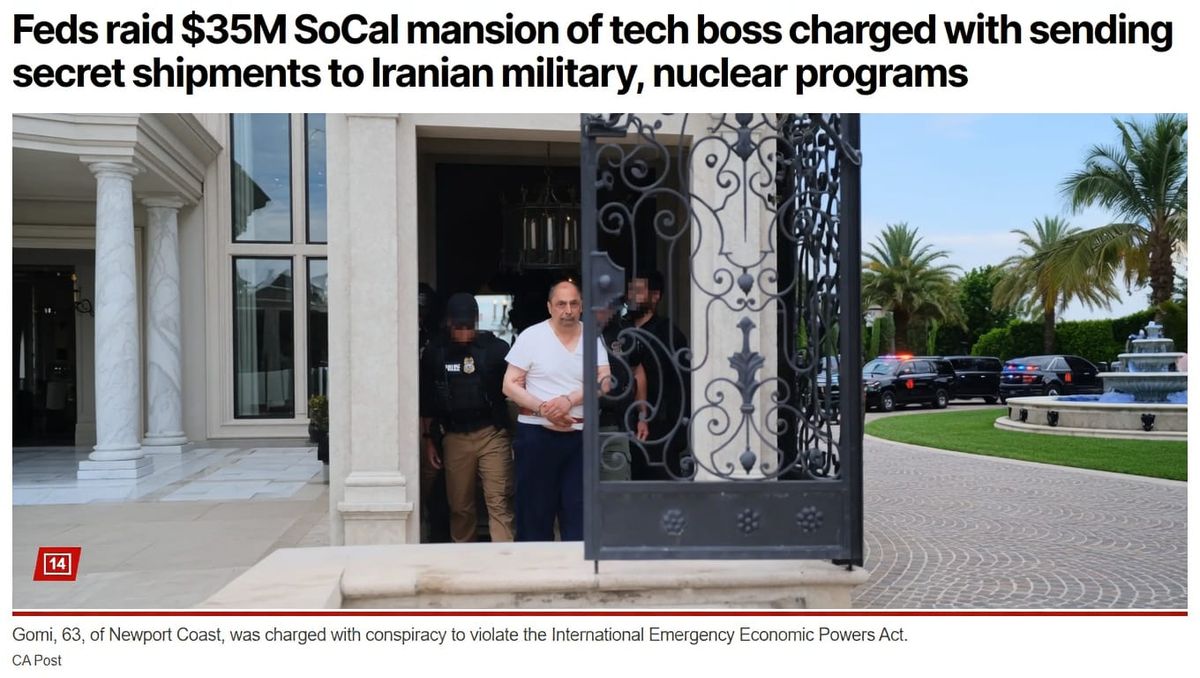
The arrest happened before dawn. Dozens of federal agents in tactical gear, carrying automatic weapons, gathered in the parking lot of a tony Newport Beach shopping plaza and then sped in convoy to the end of a cul-de-sac on a bluff above the Pacific Ocean. Iron gates. Dual fountains. Six chandeliers visible from the front steps. Custom tile. Fourteen thousand square feet of Italianate splendor, purchased on the proceeds of what the Justice Department now says was a decade-long covert operation to arm America's enemy with American technology.
The man inside the house was Jamshid Ghomi, 63. Dual citizen of Iran and the United States. Founder of a Tehran computer networking company called Faraz Pardaz Rayaneh. Resident of Newport Coast, California, where the median home price is $4.2 million and his spread was worth $35 million. When agents called for him to come out, one of his adult sons appeared at the door and asked what was going on.
A fair question. Here is the answer federal prosecutors gave.
Running the Motherland's Network
For more than a decade, Ghomi allegedly used his Tehran-based company to procure U.S. networking equipment — Cisco hardware, computer components, controlled technology — for customers inside Iran, in systematic violation of U.S. sanctions law. This was not a gray area. This was not dual-use ambiguity or export-control paperwork that got lost. Ghomi and his co-conspirators, according to court documents, referred to Iran in their internal correspondence as the "Motherland." They knew exactly what they were doing and they built an elaborate infrastructure to hide it.
The infrastructure worked like this: Ghomi personally negotiated purchases directly with suppliers in Minnesota and Nebraska. The hardware then moved through a front company in the United Arab Emirates, then to his company in Tehran. He used freight forwarders and intermediaries in Dubai specifically to obscure the true destination. He ran hundreds of additional purchases through his own personal eBay and PayPal accounts. Over the course of the operation, prosecutors allege he arranged the secret shipment of more than 250 tons of controlled American technology.

Two hundred and fifty tons. That is not a rogue transaction or a few suspicious wire transfers. That is a logistics operation.
The customers on the Iranian end included hundreds of companies and government entities, many of them already under U.S. sanctions. A portion of the business, prosecutors say — smaller but strategically significant — went directly to Iran's military and nuclear programs. Not to civilian infrastructure. To the apparatus that American policy, across multiple administrations of both parties, has designated an existential threat to U.S. national security and to Israel.
The Books Were a Fiction
While Ghomi was allegedly pulling in more than $10 million a year from his computer hardware business, he was reporting a maximum income of $20,000 to the IRS. The $35 million mansion on the bluff was purchased somehow. The chandeliers were hung. The custom tile was laid. The fountains ran. Federal investigators are now pursuing Ghomi for money laundering and tax evasion in addition to the sanctions violations, which means the financial architecture of his life is about to be pulled apart the way the networking equipment was pulled apart from its shipping containers in Dubai.
This is the part of the story that should draw the attention of anyone who covers the national security beat seriously. The gap between $20,000 in reported income and a $35 million mansion is not a rounding error. It is a signal. It is the kind of signal that either did not register with American financial institutions and regulators for more than a decade, or that registered and was not acted upon. Either answer raises serious questions about the enforcement infrastructure that is supposed to catch exactly this kind of evasion.
 Gene Goodwin
What Los Angeles' Top Federal Prosecutor Said
Bill Essayli, the first assistant United States Attorney in Los Angeles, was present for the arrest and made a statement that is worth reading carefully. "Ghomi is accused of aiding our declared enemies by selling U.S.-origin computer networking parts to Iran and earning millions of dollars in violation of U.S. sanction laws," he said. "We will hold him accountable by seeking an appropriate prison sentence and by seizing his assets, including his $35 million Newport Beach mansion." And then: "Our nation's laws prohibiting doing business with one of the world's largest state sponsors of terrorism must be enforced and obeyed."
Essayli added that Ghomi's arrest reflects the federal government's commitment to enforcing sanction laws "as the U.S. wages war in Iran."
That last phrase matters. The United States is not in a diplomatic gray zone with Tehran right now. This is not the era of the JCPOA negotiations or strategic ambiguity about the Iranian nuclear file. The current posture is one of active military engagement. Against that backdrop, running a decade-long hardware pipeline to Iran's military and nuclear programs is not just a financial crime or a sanctions violation. It is something closer to material support for a combatant in an active conflict.
The Pattern Is the Point
The Ghomi case is not an isolated story. It fits inside a much larger pattern of Iranian procurement networks operating inside the United States — using front companies, layered financial structures, U.S.-based citizens and dual citizens, and commercial platforms like eBay and PayPal to move controlled technology to Tehran. The sanctions architecture that Congress and successive administrations built to deny Iran access to American technology is only as effective as the enforcement apparatus that polices it. When a man can ship 250 tons of controlled hardware to Iran's military over a decade while living in a $35 million mansion and reporting $20,000 in annual income, the enforcement apparatus has failed.
The predawn convoy to the bluff above Newport Beach was a correction. Whether it is the beginning of a serious reckoning with how Iran runs procurement networks inside American commercial infrastructure — or just another headline — remains to be seen.
The fountains are still. The iron gates are open. The Motherland will need a new hardware supplier.
The Unredacted covers national security, institutional power, and the stories the mainstream press won't touch. Subscribe at theunredacted.co.