THE MINAB SCHOOL: Shajareh Tayyebeh IRGC Navy Girls' School.

WHAT THE EVIDENCE SHOWS AND WHAT IT DOESN'T
A girls' elementary school in southern Iran was destroyed on February 28. Children died. That is confirmed. What destroyed it is not. Here is how to read the evidence that is actually available.
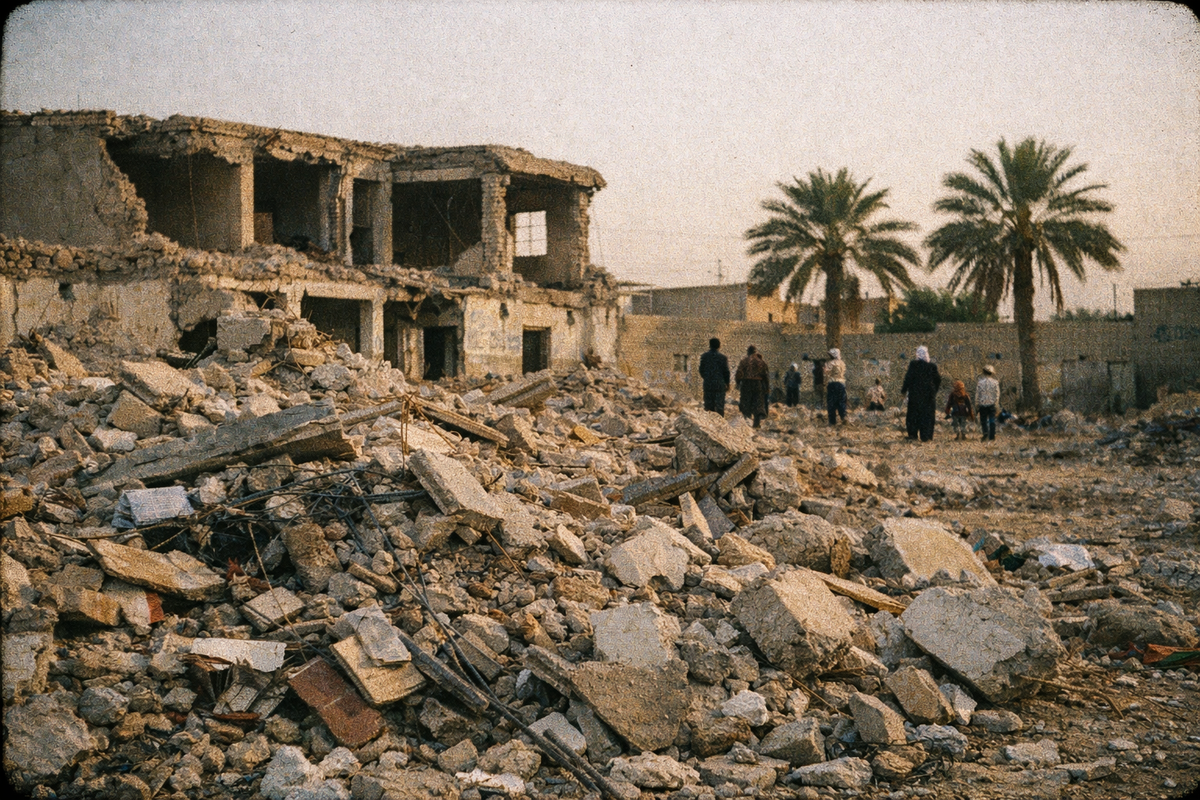
Something destroyed the Shajareh Tayyebeh girls' elementary school in Minab, a coastal city in Iran's southern Hormozgan province, on the morning of February 28, 2026. Children were inside. People died. That much is documented.
Everything else about this story is contested, unverified, contradicted by physical evidence, or sourced entirely from institutions with a documented interest in a specific narrative.
This is not a minor distinction. Attribution in wartime determines international law, diplomatic legitimacy, and the moral framing of an entire conflict. Iran understands this. Its state media moved immediately. The question for readers is whether they should.
The Islamic regime is claiming more than 50+ “martyrs” were killed at a girls school in Minab …except they forgot to mention that the school is literally part of the Asif corps of the IRGC on base, which was targeted. Not only that, it’s also being used as an IRGC admin, command… https://t.co/abnNtSDbc7
— Emily Schrader - אמילי שריידר امیلی شریدر (@emilykschrader) February 28, 2026
What the Death Toll Tells You Before You Investigate Anything Else
The reported death toll from the Minab school changed six times in eight hours.
Tasnim News Agency: "at least 57 students dead." IRNA: "at least 40." Mizan (the judiciary's official outlet): "85." Iran's state TV by 5:30pm ET: "115 dead." Al Jazeera citing state media: "108 students killed." Earlier regional reports: "51." Later AP relay: "85."
Six different death figures. All sourced to the has been Iranian state and semi-official outlets. None independently verified. No Western journalist on the ground. No Red Cross access. No satellite imagery analysis of the damage footprint published at the time of writing by any independent forensic body.
This is not a function of the fog of war. It is a function of controlled information release from a single-source environment. Every figure came from one information ecosystem: the Islamic Republic's state and semi-official media apparatus, which is the same apparatus that spent twelve hours Saturday denying Khamenei was dead.
Compare this to Gaza on October 17, 2023, when the Hamas-controlled Palestinian Ministry of Health announced 471 killed at al-Ahli Arab Hospital within hours of the blast that was caused by a misfired Palestinian rocket. US intelligence agencies subsequently assessed the number at between 100 and 300. Human Rights Watch, which conducted a detailed forensic investigation, found the reported toll "significantly higher than other estimates" and noted it "appears out of proportion with the damage" visible on site. The initial single-source figure was weaponized before it could be examined. The Minab figures are operating identically.
What the Satellite Imagery Shows
Multiple analysts examining available satellite and geographic data of the Minab area posted their findings publicly within hours of the incident.
The school sits inside or directly adjacent to an IRGC military compound. Multiple verified accounts from Iranian opposition figures and open-source intelligence analysts, including a post from the Iran-focused account Tarikh Eran, published satellite map analysis showing the Shajareh Tayyebeh school marked in proximity to what is documented as IRGC naval base infrastructure in Hormozgan province.
The Middle East Forum's Michael Rubin noted: "Certainly, it is possible a bomb went awry; the elementary school is close to an Islamic Revolutionary Guard Corps base."
Minab sits in Hormozgan province. Hormozgan is the province directly bordering the Strait of Hormuz. It is one of the most heavily IRGC-militarized provinces in Iran. The IRGC Naval Force has its primary Persian Gulf operational infrastructure in this province. Missile launch sites are documented throughout the area. The IRGC was actively launching retaliatory missiles from Iranian territory on February 28. Hormozgan province was an active launch zone.
What the Video Evidence Shows
Multiple video clips circulated on social media within hours of the strike. Several were analyzed independently.
The Tarikh Eran account, which covers Iranian affairs and has a documented track record of open-source analysis, posted: "Footage shows whatever hit the school was a failed rocket launch from IRGC, it wasn't Israel or US. Analysis of the area shows the school is in the middle of a military area full of IRGC bases."
A separate analysis posted by David Khait stated: "A failed missile launch in Iran caused the projectile to fall on a school. Images captured the moment it failed, fell back to ground, and struck."
These are social media analyses, not formal forensic investigations. They carry the appropriate weight of open-source claims requiring verification. They are also the only directional video analysis available at the time of publication. The Iranian government has not released ballistic data. CENTCOM has not released targeting data for Minab. Israel has not confirmed or denied a strike on this location.
What is visible in circulated footage is consistent with a failed launch trajectory, not with the impact signature of a precision munition. This is the same pattern that investigators found at Al Ahli.
The Al Ahli Template
On October 17, 2023, an explosion destroyed a parking area at the al-Ahli Arab Baptist Hospital in Gaza City. Palestinian officials blamed an Israeli airstrike within minutes. The Ministry of Health in Gaza said 471 people were killed. Major outlets including Al Jazeera repeated the attribution. Several governments condemned Israel. Protests erupted across the Arab world.
Within 48 hours, the picture was materially different.
Human Rights Watch conducted a forensic investigation reviewing photos, videos, satellite imagery, witness interviews, and expert consultations. Its conclusion: the explosion "resulted from an apparent rocket-propelled munition, such as those commonly used by Palestinian armed groups." HRW found the evidence made an Israeli airstrike "highly unlikely." The US, France, and other Western intelligence services assessed independently that a misfired Palestinian Islamic Jihad rocket was responsible. France's Directorate of Military Intelligence called a misfired rocket the "most probable cause" based on classified imagery, satellite data, and intelligence sharing.
The West Point Lieber Institute, which analyzes international humanitarian law, concluded: "It seems that the explosion at the Al-Ahli Hospital was caused by the malfunctioning of a rocket fired by Palestinian Islamic Jihad."
The firing pattern matters. According to the IDF, approximately 450 rockets fired from Gaza had already misfired and landed inside Gaza in the 11 days before October 17, 2023. That is roughly 5 percent of all rockets fired. Human Rights Watch had previously documented that between 10 and 20 percent of rockets from Palestinian armed groups fail. The rockets have "only rudimentary guidance systems and are prone to misfire."
Iranian ballistic missiles and rockets are more sophisticated than Gaza-era rockets. But they are being fired in massive volume, in rapidly deteriorating command conditions, from a military apparatus that lost its supreme commander, defense minister, and army chief of staff in the same 24-hour window. The IRGC launched what it called the biggest offensive in its own history while its chain of command above the regional level was institutionally severed.
Misfire rates under those conditions are not comparable to peacetime or even normal wartime operations.
What CENTCOM Said and Did Not Say
CENTCOM Spokesman Captain Tim Hawkins issued this statement on the Minab school: "We take these reports seriously and are looking into them. The protection of civilians is of utmost importance, and we will continue to take all precautions available to minimize the risk of unintended harm."
This is not a denial. It is also not a confirmation. It is the standard holding statement issued when a claim cannot be confirmed or refuted with the information currently available.
CENTCOM separately confirmed, with specificity, that it had struck 24 provinces across Iran. It confirmed specific target categories: IRGC command facilities, missile sites, air defense installations, military airfields, leadership compounds. It has not listed a girls' school in Minab in any confirmed target list. It has not confirmed any strike on educational infrastructure. The US military's targeting process, as described by CENTCOM, uses multiple intelligence streams to distinguish military from civilian targets.
The question is whether the Minab school was mistakenly targeted, was collateral damage from a nearby military strike, or was hit by a returning IRGC rocket. Those are three distinct scenarios with three distinct legal and moral frameworks. None of them has been resolved by the available evidence as of the time of writing.
What Iran's Behavior Suggests
Iran blamed the US within minutes of the strike. Iranian Foreign Minister Araghchi posted to X immediately, calling the school "bombed in broad daylight, when packed with young pupils." President Pezeshkian condemned it as a "barbaric act" and blamed US and Israeli "aggressors." Iranian state TV had footage of the rubble within the hour.
Speed of attribution in wartime is an investigative signal, not proof. But Iran demonstrated in the same 24-hour period that it would actively manage information to serve institutional interests. Foreign Minister Araghchi told NBC News that Khamenei was alive "as far as I know" while Khamenei was already dead. Iranian state media spent all day denying Khamenei's death before announcing his "martyrdom" Sunday night.
An institution that will manage the information environment around its supreme leader's death for twelve hours before confirming it will not hesitate to manage the information environment around a school strike. That is not a judgment about the children or the casualties. It is a judgment about the source.
What We Do Not Know and Why It Matters
Several critical facts remain unverified as of this writing.
No independent forensic analysis of the impact crater has been published. Crater size and shape are the single most reliable indicator of munition type: large, deep craters indicate high-explosive warheads from precision munitions; small, shallow craters with radial burn patterns indicate rocket propellant fires, which is what HRW found at Al Ahli.
No confirmed satellite imagery analysis of the blast footprint from an independent provider has been released.
No Western journalist has accessed the site. Iran's internet was cut to approximately 4 percent connectivity after the strikes.
No US or Israeli military has confirmed a strike at the school's coordinates.
No IRGC rocket firing log from Hormozgan province on February 28 has been released or leaked.
The children are real. The destruction is real. The institutional pressure to attribute that destruction to the United States before any of this evidence is available is also real, and it has a documented playbook from October 17, 2023.
⚠️ 𝐁𝐫𝐞𝐚𝐤𝐢𝐧𝐠 𝐍𝐞𝐰𝐬 ⚠️
— Iran Spectator (@IranSpec) March 1, 2026
🇮🇷 | Iran admits — It was an IRGC missile that killed 148 school-girls…
The regime in Iran has now officially confirmed that the IRGC mistakenly bombed an Iranian school yesterday, killing many children.
This is a very tragic event… pic.twitter.com/ly2KEgQUsk
The Standard the Evidence Requires
The Lieber Institute's conclusion about Al Ahli applies with equal force to Minab: "Facts matter. While it may be tempting to allocate blame in response to the suffering playing out on our TV screens and our social media feeds, rushing to conclusions and throwing around allegations of war crimes or worse without at least a reasonably firm understanding of the facts does not help."
This does not mean the US or Israel could not have struck this school. Precision warfare produces imprecision. Munitions malfunction. Targeting errors occur. All of those are documented historical facts in every air campaign in modern history.
What it means is that the evidence publicly available as of March 1, 2026 does not confirm US or Israeli responsibility. The school sits inside or adjacent to an IRGC military compound in one of the most active IRGC missile launch provinces in Iran. The IRGC was firing massive retaliatory salvos from that province on that date. Video analysis consistent with a failed launch trajectory is the only directional forensic claim published so far. The death toll changed six times in eight hours from a single-source information environment.
That is not proof that Iran's rocket killed those children. It is a framework of documented facts that the major outlets covering this story, as confirmed US-Israeli responsibility, have not addressed.
The Al Ahli investigation took weeks. The Minab investigation has had hours. The moral weight of dead children does not resolve the factual question of who killed them. Getting that question right is the only thing that justifies calling it journalism.