The Queens firebombings and the price of progressive experiments

The only thing necessary for the triumph of evil is for good men to do nothing.” — Edmund Burke
In the working-class enclaves of western Queens, where the American dream is still forged in Spanish, Creole, and Hindi, the line between refuge and ruin has worn paper-thin.
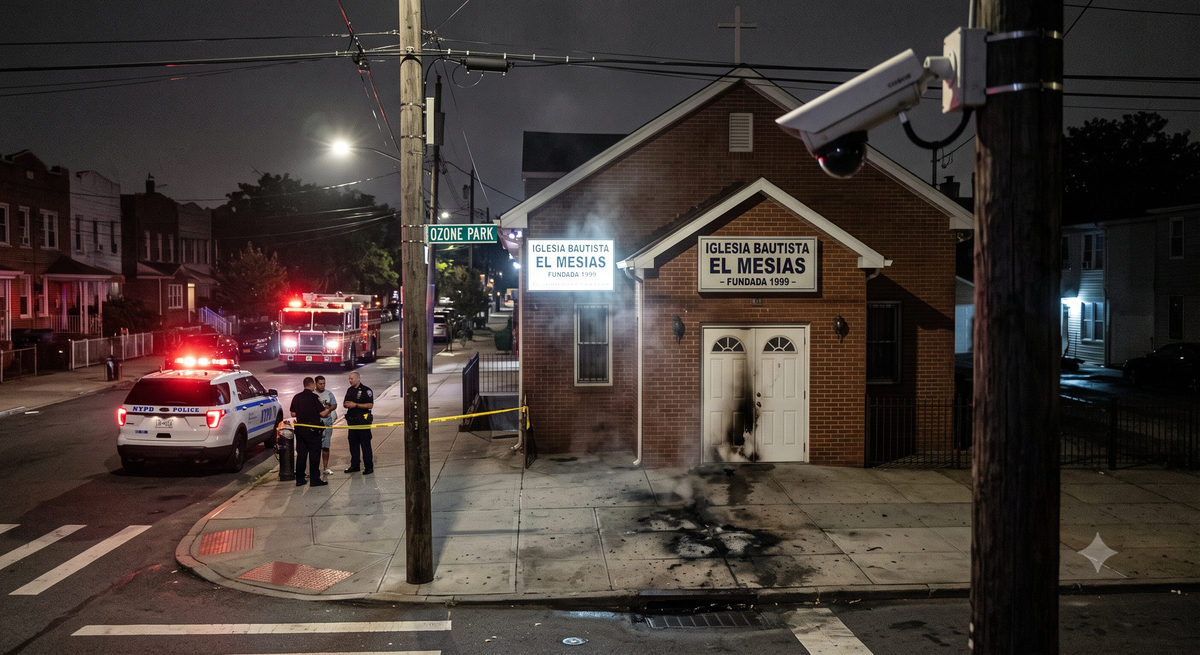
Just after midnight on July 8, that thin line was crossed. Surveillance footage captured a 36-year-old man methodically igniting and hurling Molotov cocktails at the pillars of the community. First struck was Iglesia Bautista El Mesias in Ozone Park, a storefront Baptist congregation that has anchored local families for over two decades. Next came a nearby Jehovah’s Witnesses Kingdom Hall in Woodhaven, followed swiftly by a commercial building on Rockaway Boulevard.
The suspect, identified as Yogesh Sayrange, a Guyanese national living illegally in the United States, was apprehended minutes later near a neighborhood deli. Inside his backpack, police found two more unexploded incendiary devices.
Mercifully, the crude bombs exploded on the asphalt, and swift action by the FDNY prevented structural infernos. No one was killed. But the message of terror, scrawled in gasoline and shattered glass across a quiet immigrant neighborhood, was unmistakable.
🚨 NOW: Outrage is erupting after two New York City churches were FIREBOMBED overnight and NYPD refuses to publicly release the 36-year-old suspect's identity
— Eric Daugherty (@EricLDaugh) July 9, 2026
He struck 2 churches and had MORE Molotov cocktails with him, ready to deploy
NYC is riddled with degenerates who HATE… pic.twitter.com/TcAbkkHUxz
The Anatomy of a Bureaucratic Failure
The Queens firebombings will be parsed by the media as an isolated flashpoint of madness, a lone wolf striking out in the dark. But to look closely at the suspect’s trajectory is to see the premeditated failure of an entire administrative apparatus.
This was no sudden psychological break. Sayrange was a walking constellation of red flags that New York’s criminal justice system chose to ignore. He was already wanted on an active warrant linked to a June 25 firebombing of a Brooklyn smoke shop, where he was caught on camera sporting a Guy Fawkes mask. Court records indicate pending mid-June cases involving threats with a knife and an axe. Despite being a repeat violent offender with federal authorities tracking his illegal status, Sayrange was free to roam the streets of Queens with a backpack full of explosives.
The echoes here are heavy. In 2012, another Guyanese national, Ray Lazier Lengend, went on a virtually identical firebombing spree across Queens, targeting a mosque, a Hindu temple, and local businesses. Then, as now, the suspect was driven by an erratic cocktail of personal grudges and anti-religious animus.
But in 2026, the ecosystem has changed. The vulnerability of these neighborhoods is amplified by a progressive governing class that has prioritized abstract ideological crusades over the gritty, basic duty of maintaining public order.
The Price of Progressive Experiments
For years, New York’s dominant political faction, headlined by DSA-aligned figures like Zohran Mamdani, has championed a policy mix of aggressive decriminalization, the dismantling of cash bail, and fierce local resistance to federal immigration detainers. They pitched this as an exercise in compassion, a shield for the vulnerable.
But the vulnerability they imagined does not match the vulnerability on the ground.
The families living in Ozone Park and Woodhaven are not elite coastal progressives playing with sociology experiments. They are blue-collar, deeply religious, self-starting immigrants who fled instability in Latin America and the Caribbean precisely to find a rules-based society. They do not view churches as political symbols; they view them as lifelines.
When municipal policies actively handcuff law enforcement from holding violent, non-citizen repeat offenders, it is not sanctuary for the working class. It is a sanctuary for chaos. The refusal of the NYPD to initially name the suspect or clarify his status only deepened the public’s conviction that managing the political narrative has become more important than securing the streets.
The High Cost of Everyday Safety
Councilmember Joann Ariola was quick to praise the NYPD’s rapid arrest but rightly demanded a deeper investigation into why houses of worship are being targeted with impunity. Whether driven by radicalization, severe mental illness, or simple malice, the underlying pathology matters less than the systemic failure to prevent it.
The solution is not a mystery. Restoring the rule of law requires the deployment of basic, unglamorous governance tools: strict post-crime deportation for violent offenders, ending the revolving door of catch-and-release for arsonists, and rebuilding the bridge between local policing and federal enforcement.
Federal prosecutors are expected to bring down heavy statutes regarding destructive devices and immigration violations. It will be a welcome deterrent, but it comes too late for a community that had to watch its sacred spaces targeted by a firebomber who should have been behind bars weeks ago.
Before the next Molotov finds its target, and before the luck of the FDNY runs out, New York must remember its oldest, highest law: Salus populi suprema lex esto. The safety of the people must be the supreme law. Everything else is just poetry written by people who do not have to live in the wreckage.
📬 Share, Comment, and Support Our Work
Share this. Restack it. Forward the email. That's the whole ask.
Support the work. The reporting linked above took weeks of tracing records, filings, and on-the-record statements. It doesn't happen on faith. If you find it useful, become a paid subscriber and help fund the next one.