The Romenklatura comes to McLean
Ro Khanna denounces hoarded wealth while his family holds up to $340 million behind trusts, LLCs, and 333 pages of unsearchable disclosures. The Soviets had a name for this arrangement.

This analysis draws on original reporting by Andrew Kerr at the Washington Free Beacon, published June 30, 2026. Read the full investigation here.
In the Soviet Union, the men who spoke most beautifully about equality lived behind the highest walls. The Party called them the nomenklatura. They rode in Chaikas past the bread lines. They shopped in closed stores where the shelves were always full. And they never saw a contradiction, because the system had trained them to believe that their privilege was not privilege. It was service.
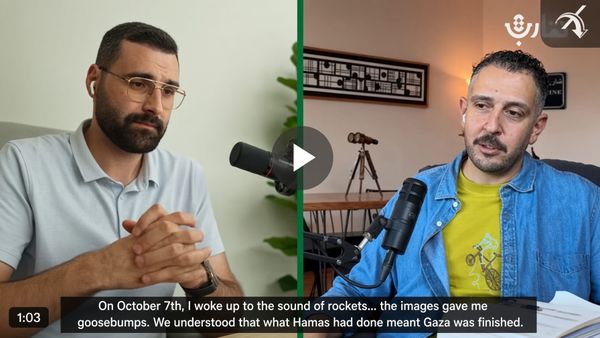
Ro Khanna: “Raise your hand if you are a pro-terror radical!”
— Stu Smith (@thestustustudio) September 28, 2025
Here’s a supercut of the worst moments from ArabCon this weekend. I’ve already dropped nearly 40 clips since Friday — and there are still more jaw-dropping ones to come. pic.twitter.com/UCQlXNZxeg
I thought of them this week reading Andrew Kerr's investigation in the Washington Free Beacon into the finances of Rep. Ro Khanna, the California Democrat now testing a presidential run on a platform of confronting the ultra-rich. Kerr's findings deserve wide attention, and credit belongs to the Free Beacon for the excavation. What follows is an attempt to place those findings in a tradition older than Silicon Valley.
The facts, per Kerr's reporting: Khanna's family assets run somewhere between $103 million and beyond $340 million, spread across more than 3,000 holdings. His two minor children hold between $26 million and $73 million in irrevocable trusts, the classic instrument for moving dynastic wealth past the inheritance tax. The children own million-dollar-plus stakes in three private Cleveland golf clubs. The family holds positions in a distressed-debt hedge fund and a $65 billion wealth management firm. The current house, 8,000 square feet in Northwest Washington with a four-story elevator, is listed at over $6 million while a Virginia LLC managed by a Cleveland lawyer quietly closed on a $10 million replacement in McLean.
None of this is illegal. That is not the point. The point is the architecture of concealment, and the doctrine that requires it.
Consider the disclosure itself. Khanna is legally obligated to report his family's holdings. He complies. But he files in the old analog format: 333 pages of non-searchable tables, a document technically public and functionally opaque. Students of Soviet information practice will recognize the technique. The archive is open. The finding aid is missing. Glasnost by volume.
Here is Thomas Massie with Ro Khanna accepting the Quincy award from Trita Parsi who is a Swedish national and a long time Iranian lobbyist, at the Quincy Institute for Responsible Statecraft which is funded by George Soros and Charles Koch.
— Jacktron (@jacktronprime) March 1, 2026
He boasted on Social Media how proud… pic.twitter.com/RzXA1uoSZx
Consider the language. Kerr's analysis of Khanna's public statements found a consistent pattern: the congressman attacks "billionaires," a category that excludes his centimillionaire father-in-law with surgical precision. This is not hypocrisy in the crude sense. It is line-drawing, and line-drawing was always the nomenklatura's essential skill. The enemy is defined so that the definition stops one rung above your own family. The Party fought "speculators" while its own members ran the special distribution networks. Khanna fights hedge funds while his children's trusts hold Silver Point Distressed Opportunity Fund, a vehicle that buys the debt of failing companies at a discount.
Ro Khanna: If our "elite" went to Epstein's island, how can we ever compete with China because China's "elite" didn't go to Epstein's island?
— MAZE (@mazemoore) July 1, 2026
This guy is such a clown.
Yeah Ro, the Chinese "elite" treat children wonderfully. The kids even get jobs in factories. pic.twitter.com/s9yqdbHxTy
Consider the stock trading. Khanna champions a congressional stock trading ban, warning of a "crisis of confidence" in democracy. Meanwhile the trusts held by his wife and children executed more than 4,100 trades worth an estimated $53 million in 2025 alone, making him the most prolific trader in Congress by volume. His defense is that he has "zero say" and "zero knowledge." Perhaps. But the Soviet official also had zero say over the special store. It simply existed, arranged by others, for his benefit. The absence of a signature was the whole design.
The deeper pattern is what the wealth does while its beneficiary performs opposition to it. Khanna's wife chairs the spring event at an elite McLean private school. Her family foundation gave the school $20,000 in 2024. She sits on the board of Georgetown, her alma mater, the kind of seat that universities extend in anticipation of donations. This is how a class reproduces itself: not through conspiracy but through the ordinary machinery of schools, boards, foundations, and clubs, each transaction respectable, the sum total a closed circuit.
The Soviets understood that the most durable privilege is the kind that has learned to speak the language of its own abolition. Mikhail Voslensky, the defector who wrote the definitive study of the nomenklatura, observed that the ruling class of the USSR was the first in history to deny its own existence. Its members were not owners, they insisted. They were servants of the people. The trusts were not theirs. The dachas were assigned. The special stores were logistics.
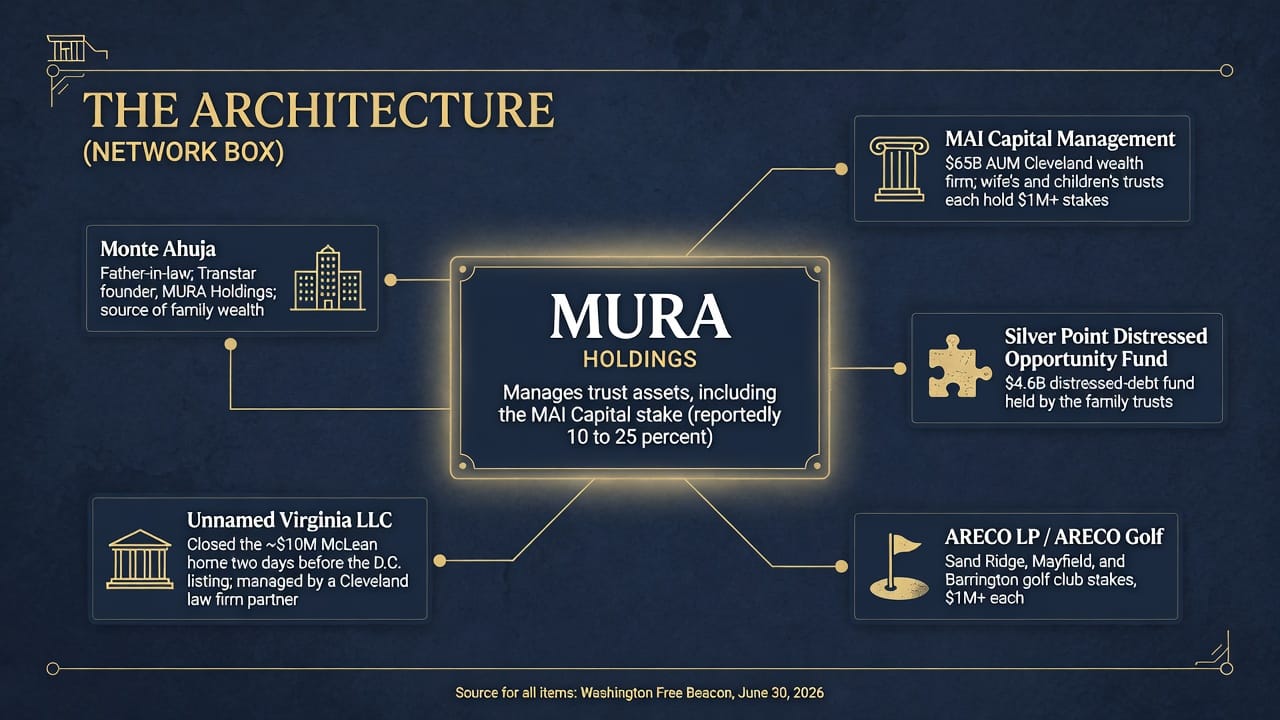
Khanna's formulation is nearly identical in structure. The wealth is not his. It belongs to trusts set up before his marriage. The trades are not his. The houses are purchased through LLCs he does not manage. Every statement may be technically true, and the technical truth is precisely the mechanism. A man can stand before a crowd in Fremont and demand a wealth tax on billionaires while his children's inheritance sits in irrevocable trusts engineered to outrun the estate tax, and no single sentence he speaks will be false.
Kerr notes one detail that lands harder than the golf clubs or the marble laundry rooms. Khanna's father-in-law, Monte Ahuja, arrived in America in 1969 with twelve dollars and built a genuine fortune in auto parts. That is the American story, and there is nothing to condemn in it. Ahuja does not campaign against wealth. His son-in-law does. The immigrant built the machine. The politician denounces machines while living inside this one.
After not mentioning the name Epstein even a single time during the Biden years, Ro Khanna has spent the past year running from TV show to podcast, making ridiculous and sensational claims about all things Epstein.
— MAZE (@mazemoore) June 27, 2026
After all his self-serving media appearances, Khanna has… pic.twitter.com/n5EfVYnkAU
This matters to readers of this publication for a reason beyond one congressman's balance sheet. Khanna endorsed Zohran Mamdani's mayoral campaign and has spent the spring positioning himself as the national voice of the movement whose municipal machinery we have documented in The Machine series. The DSA project in New York runs on the same rhetorical engine: the language of the dispossessed, operated by people whose funding networks we traced in our Singham network investigation. When the movement's presidential-tier spokesman turns out to hold his family's fortune in the exact instruments he campaigns against, that is not a personal embarrassment. It is a diagnostic reading on the whole apparatus.
The nomenklatura fell, eventually, not because anyone audited its stores but because the gap between the language and the life became impossible to sustain.