The Socialist Mayor's Two-Tier Inauguration—And the Lie About "Safety Concerns"


Zohran Mamdani billed his swearing-in as a "block party for all New Yorkers." What actually happened reveals how his administration plans to govern.
On New Year's Day, New York City's first openly socialist mayor took the oath of office in a ceremony that perfectly illustrated the gap between progressive rhetoric and progressive reality. Zohran Mamdani's team advertised an "Inauguration for a New Era Block Party" along the historic Canyon of Heroes, promising "tens of thousands" could "gather and participate in the ceremony, ensuring the day belongs to all New Yorkers."
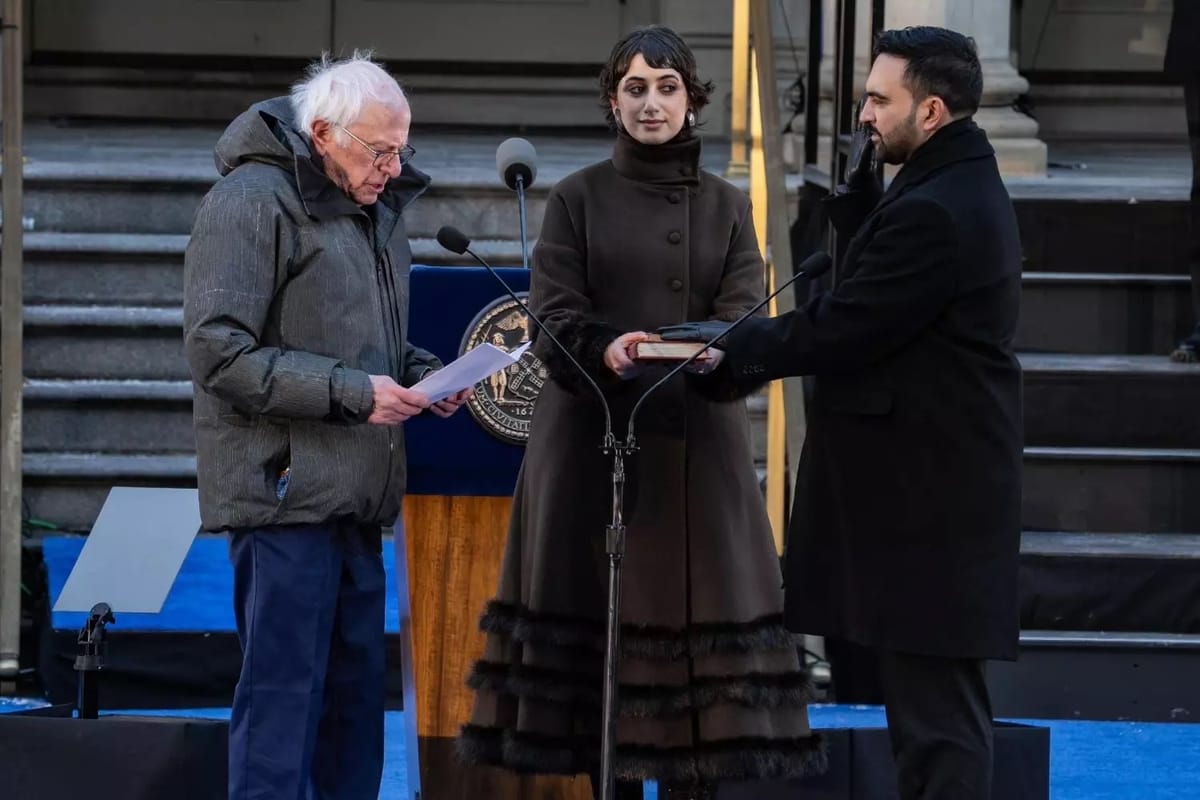
What they delivered was a two-tier event that separated 4,000 invited guests from 10,000 supporters based on access to basic human necessities. The invited sat comfortably in City Hall's outdoor plaza, watching Bernie Sanders administer the oath of office while Mamdani's wife Rama Duwaji held the Quran. The uninvited stood in barricaded pens along Broadway in mid-20s temperatures, watching Sanders and Alexandria Ocasio-Cortez on big-screen TVs without access to bathrooms or food.
The Mamdani administration's website warned there would be "no portable restrooms due to safety concerns" and "no food for sale within the block party." For an event billed as inclusive democracy in action, those restrictions reveal an interesting set of priorities about which New Yorkers deserve accommodation and which can be left in freezing pens for hours.
Consider the timeline. Attendees were told to arrive by 11 AM for a 1 PM ceremony. The ceremony started over 30 minutes late, meaning supporters who showed up on time spent more than 2.5 hours in barricaded areas without bathroom access. In 20-degree weather. While watching their mayor take an oath on television screens despite being physically present at the event.
One woman told the New York Post she waited 90 minutes just to get through security into a viewing area. "The police officers have not been informed about anything, they don't know which entrance or where anything is," she said. "I'm really, really unhappy." That's notable because it suggests the Mamdani transition team either failed to coordinate with NYPD on basic event logistics, or chose not to—possibly to avoid acknowledging that their "block party" required extensive police barricades and security checkpoints to control access.
The official explanation for denying bathrooms was "safety concerns." The Mamdani team did not elaborate on what specific safety threat portable toilets would pose to an outdoor inauguration. Porta-potties are standard at public events—marathons, concerts, festivals, protests. They're routinely deployed for gatherings far larger and more security-sensitive than a mayoral swearing-in. The NYPD manages them at New Year's Eve celebrations in Times Square, where a million people gather annually.
But Mamdani's team determined that bathroom access presented unacceptable risks to an event where 10,000 supporters stood in barricaded pens for hours in freezing temperatures. What they won't say is whether the "safety concern" was actually about controlling crowd movement and preventing supporters from leaving their designated viewing areas.
Because that's what the bathroom ban accomplished. Attendees who needed facilities had to exit the barricaded pens, find nearby establishments like Pret a Manger, and then go through security screening again to re-enter. According to the Post, "two Mamdani volunteers at one point raced to the bathroom at a nearby Pret a Manger while other spectators even took refuge in nearby stores to stay warm while he was talking."
Think about what that reveals. Volunteers working the event—people presumably with some official connection to the Mamdani team—had to abandon their posts and sprint to a coffee shop bathroom because the administration that employs them decided portable toilets were too dangerous. And supporters who wanted to hear their mayor speak had to choose between enduring hours without facilities or losing their viewing position.
Meanwhile, the 4,000 invited guests sitting in City Hall plaza presumably had access to the building's indoor bathrooms. The Mamdani administration did not disclose the criteria for receiving an invitation to the comfortable seating area versus standing in the outdoor pens. But the result was clear: a class division between those the new socialist government deemed worthy of basic accommodation and those it did not.
"It's definitely not a block party," Danny Mahabir, 30, told the Post. The Astoria resident had worn three layers of clothes and expected "a mix of food and music." Instead, he and others were "just stuck behind the barricades watching it on TV." Brooklyn resident Shane Turner, 30, agreed: "It's not exactly what I was expecting. I was expecting food and music."
A 25-year-old Queens woman was more direct: "I could've watched this from home."
She could have. The event was televised and streamed online. Supporters who showed up in person endured 90-minute security waits, stood in freezing temperatures without bathroom access, and watched their mayor on screens—all to say they were physically present for an inauguration designed to make them physically uncomfortable while claiming to center their participation.
The food situation was equally revealing. Mamdani's website advised that while there would be "no food for sale within the block party," there were "nearby markets and eateries" for those who wanted to eat. But accessing those establishments required leaving the barricades and going through security again. On one of the coldest days of the year. For an event scheduled around lunchtime.
That's not an oversight. That's a choice about resource allocation. The Mamdani team could have arranged food vendors. They could have provided portable toilets. Instead, they spent resources on big-screen TVs, sound systems, and barricades to contain supporters at a distance while invited guests sat comfortably near the stage.
The "safety concerns" rationale doesn't hold up under scrutiny. If bathrooms posed security risks, so would the nearby Pret a Manger that volunteers and attendees used throughout the event. If the concern was overcrowding, the solution would be fewer attendees or more space—not forcing 10,000 people into barricaded pens without facilities. If the issue was logistics, the NYPD deploys portable toilets at public events routinely.
What the bathroom ban actually accomplished was limiting crowd mobility. Attendees who stayed in their pens stayed in their assigned viewing areas. They didn't wander. They didn't congregate. They stood where the Mamdani administration put them and watched the ceremony on television.
The invited guests experienced a different event entirely. They sat in chairs. They watched the ceremony directly. They had access to indoor facilities. They were close enough to hear speakers without amplification. They were the audience that mattered to the new administration—close enough to witness Sanders placing Mamdani's hand on the Quran held by his wife, close enough to hear Ocasio-Cortez's remarks, close enough to matter.
Zohran Mamdani did the same exact gesture today at his swearing in that the left called a “Nazi salute” when @elonmusk did it. pic.twitter.com/JNOM7djZqO
— Brandon Straka #WalkAway (@BrandonStraka) January 1, 2026
The 10,000 in the pens were props. They provided the crowd shots for media coverage. They demonstrated popular support. But the Mamdani administration did not provide them with bathrooms, food, accurate arrival instructions, informed security personnel, or a ceremony that started on time.
"I came here to witness history," Turner told the Post, explaining why he wasn't disappointed despite the conditions. "The past four years felt like hell under the previous mayor." That's the sentiment that matters to Mamdani's team—not that their event planning was adequate, but that supporters will tolerate inadequate planning because the ideology is correct.
It's an instructive start to the administration. A mayor who campaigned on economic justice and worker dignity inaugurated his tenure by penning working-class supporters in freezing conditions without basic facilities while elite guests sat comfortably. A politician who ran against inequality created a two-tier event that made inequality visible and physical. A democratic socialist who promised power to the people demonstrated that "the people" means different things depending on whether you got an invitation.
The official narrative called it a "block party for all New Yorkers" ensuring "the day belongs to all." What actually happened showed which New Yorkers the administration believes deserve chairs and which deserve barricades. Which deserve bathroom access and which can be told it's a "safety concern" while being directed to nearby coffee shops. Which deserve proximity to power and which deserve TV screens.
Bernie Sanders flew in from Vermont to administer the oath. Alexandria Ocasio-Cortez addressed the crowd. The DSA network turned out its key figures to credential the new administration's socialist bona fides. And 10,000 supporters stood in 20-degree weather without bathrooms, watching their ideological leaders on television while shivering in pens.
That's not a block party. That's a preview of governance. The Mamdani administration just showed New York how it plans to treat the working-class voters who put it in power: as background scenery for the speeches of the actually important people who get chairs and bathroom access.
The supporters who left early to warm up in stores, who sprinted to Pret a Manger bathrooms, who waited 90 minutes for confused security personnel, who stood for 2.5 hours in freezing temperatures watching a ceremony on TV—they witnessed history. Just not the history they expected.
Zohran Mamdani’s inauguration in New York City has music that’s not even in English and Muslim men on stage that look like they’re in Afghanistan
— Wall Street Apes (@WallStreetApes) January 1, 2026
Buckle up America. This is the Islamic takeover of Americapic.twitter.com/M8IOQqcoHK
They saw a socialist administration's first act: calling a class-divided event a "block party," claiming "safety concerns" prevent basic accommodation, and expecting working New Yorkers to accept the explanation because the people in charge speak the right language about inequality while demonstrating it in practice.