The Welders Got Rich. The Senators Got Loud.

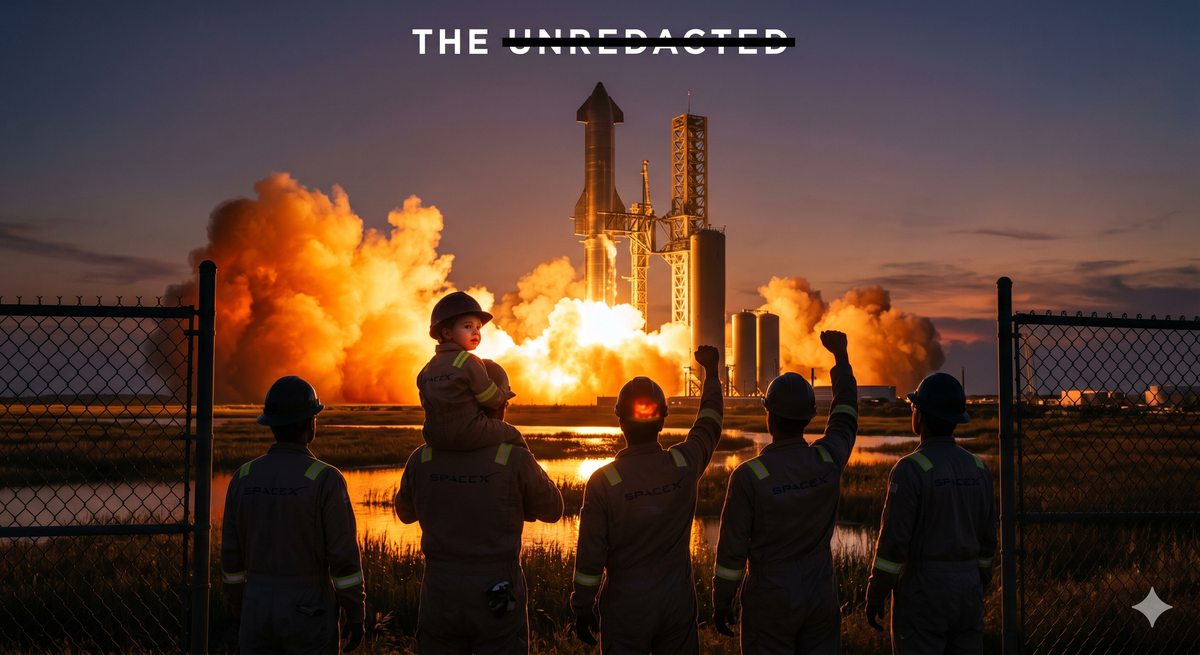
SpaceX turned cafeteria workers and welders into millionaires on Friday. Within hours, the people who never built anything demanded a cut.
Juan Hernandez learned to weld for the paycheck. In 2015 a friend mentioned a contractor job at a rocket company he had never heard of, paying $28 an hour. He took it. The company handed him a $10,000 stock grant he thought was nothing and let him buy more through payroll deductions. On Friday, when SpaceX closed its first day on the Nasdaq at $160.95, his stake was worth more than a million dollars. He is now teaching his three kids how to invest.
Multiply that story by 4,400. That is how many current and former SpaceX employees became millionaires this week, according to an analysis cited by the New York Times. About 400 of them are now worth $100 million or more. They are not venture capitalists. They are welders, machinists, launch technicians, baristas, janitors, and cafeteria staff. Bloomberg's own columnist put it plainly: the SpaceX cafeteria is about to be full of millionaires.
The ball ascends for the first time in its history, shining bright like Mars—a symbol of what comes next. Congratulations, @SpaceX on this historic achievement. $SPCX pic.twitter.com/1MBCXIiu4a
— Nasdaq (@Nasdaq) June 13, 2026
This is the part worth slowing down on, because it does not happen. Google's 2004 IPO created about 1,000 millionaires. Facebook's 2012 listing did roughly the same. Both windfalls went to the people who already had the resumes: Stanford engineers, early product managers, the credentialed class that always seems to be standing in the right spot. For 30 years the American equity machine has paid the same demographic. SpaceX paid the factory floor.
It did so on purpose. For two decades the company paid below-market salaries at every level and made up the gap in stock. Not just for propulsion engineers. For the cook. For the contractor welding fuel tanks. Tom Mueller, employee number one, hired in 2002, remembered Musk's standing message to staff: your salary matters less than your equity. That day is here.
The geography matters too. More than 3,400 work at Starbase in Cameron County, Texas, a facility that generates over 21,000 indirect jobs in one of the poorest corners of the country. SpaceX employed over 4,000 at its Starbase operations with roughly 70 percent hired locally, and plans to nearly double that to around 8,000 this year. The average Brownsville home has gone from $112,705 in 2018 to $196,920 today. Some call that a problem. It is also what happens when capital arrives somewhere capital had abandoned.
So how did Washington greet the largest wealth transfer to blue-collar workers in the history of public markets? It reached for the tax code.
$NVDA shared a video of Jensen Huang congratulating $SPCX on its historic IPO debut.
— Shay Boloor (@StockSavvyShay) June 12, 2026
Nvidia highlighted a nearly decade-long partnership with the company from the first DGX-1 handoff in 2016 to the custom DGX Spark delivery at Starbase. pic.twitter.com/FhgIsl01OP
Senator Elizabeth Warren posted within hours that the typical American household would have to work 11 million years to match Musk's fortune. "We need a wealth tax," she wrote, on a platform SpaceX's sister company owns. She added a demand for an AI tax and a swipe at the SEC. Senator Bernie Sanders used the moment to renew his push on Social Security caps. Representative Pramila Jayapal kept it simple: "Nobody should be a trillionaire. Tax the damn rich." Zohran Mamdani, soon to run America's largest city, replied to a headline about Musk with "Reason number 1,000,000,000,000 why we should tax the rich."
Warren had spent the week before the bell trying to stop the listing outright. In a 12-page letter to the SEC she demanded a delay, citing analysts who called the valuation "nonsensical" and "smoke-and-mirrors accounting." There are real questions buried in there. SpaceX posted $18.67 billion in revenue against a $4.94 billion loss in 2025, and Musk keeps roughly 82 percent of the voting power through supervoting shares. An investor can weigh those risks and decide. That is what a market is. But Warren did not write to protect the welder. She wrote to keep the company off the exchange where the welder's shares became real. The senator who says she fights for workers tried to slam the door before they could collect.
Notice what is missing from every one of those statements. None of them mention Hernandez. None mention the 4,400. None mention the technician who can finally buy a house in a town that had nothing for a generation. The wealth they claim to care about just landed in the hands of exactly the people they claim to fight for, and the response was to demand it be taxed away before the lockup periods even expire.
The honest objection is that Musk got richer than anyone in history, and he did. He owns roughly 42 percent of the equity and became the first trillionaire on paper. A reasonable person can find that staggering. But the senators are not proposing to tax only Musk. A wealth tax does not stop at the man with the rockets. It reaches the welder with 6,500 shares the moment his paper becomes real. The people cheering loudest for the policy would hit the workers the policy pretends to protect.
🚨AMERICAN DREAM REALIZED!
— Jay Gatling (@apinionsvary) June 13, 2026
A LEGAL Mexican immigrant joined SpaceX in 2015 as a $28/hr contract welder.
His $10k in stock is now worth $880k - one of 4,400 SpaceX employees who became millionaires Friday.
Congratulations to him! 👏🏼🇺🇸 pic.twitter.com/GoUJaR2YiH
There are real caveats and an honest piece keeps them. Many employees sold early, certain Musk would never go public, and some traded shares for restaurant gift cards. They are consumed by regret. Morningstar values the stock at $63, less than half the listing price, and the lockups mean nobody cashed out Friday. Paper wealth at a $2 trillion valuation is still paper. The bet could yet sour.
But the structure stands regardless of next quarter's tape. A company proved you can run the most demanding manufacturing operation on earth, pay the people who build the hardware in ownership, and watch them come out ahead of the analysts who spent 20 years explaining why it would fail. That is not a grievance. That is the thing the grievance industry was supposed to want.