Why Moscow Needed a Passive Jew

THE UNREDACTED
Essay · Active Measures
The Tashkent Front: How Moscow Erased the Fighting Jew, and Who Is Still Doing It
A million and a half Jews fought the Nazis. The Soviet state spent decades teaching the world they hid. The lie had a purpose then, and it has the same purpose on the streets and campuses of New York today.
A few years ago, a retired Israeli brigadier general named Zvi Kantor said goodbye to a new friend, a Red Army tank veteran named Arkadi Timor, who mentioned he was off to visit his old commander. The commander, Timor added, held the title Hero of the Soviet Union, the Red Army's highest distinction. Kantor, who had crossed the Suez Canal in one of the first tanks during the Yom Kippur War, was stunned. "A Hero of the Soviet Union recipient living in Ashdod, and I had no idea?"
That conversation, as Liel Leibovitz recounts in Tablet last month, became the Chaim Herzog Museum of the Jewish Soldier in World War II, which sits inside an IDF base at Latrun, halfway between Tel Aviv and Jerusalem. It tells the story of 1.5 million Jewish men and women who fought the Nazis, and the 250,000 who fell. Leibovitz runs the arithmetic: of roughly 18 million Jews alive when the war began, subtract the 6 million murdered and the old and the very young, and nearly a third of all Jews able to fight did. No other people came close.
The museum is full of stories that should be famous. There is the Cambridge student who trained as an intelligence officer, interrogated Heinrich Himmler, and later became Israel's sixth president: Chaim Herzog himself. There is the Aboulker family of Algiers, who on November 7, 1942, led 377 resistance fighters, 315 of them Jewish, in fake uniforms with fake orders to the Vichy command, seized the police station and the radio station, and handed the city to the Allies overnight.
Kantor, an Israeli-born career soldier, told Leibovitz that he had grown up thinking of Jews in the war as lambs to the slaughter. The museum's curator, Tamar Ketko, has described the same problem: museums present Jews of the war years as spiritual and intellectual, as people things happened to, rarely as fighters. That image did not arise by accident. A decorated Red Army hero could live unknown in Ashdod because, in the largest Jewish community that fought, the forgetting was manufactured. The factory was in Moscow.
Jews in Uniform Against Hitler
The Front That Never Existed
In the Soviet Union, during the war and for decades after, there was a joke that every Russian-speaking Jew of my parents' generation knew by heart. Asked where a Jew had fought, the answer was "on the Tashkent front." Tashkent, the capital of Uzbekistan, was a thousand miles from the nearest battle. It was where evacuated families, many of them Jewish, waited out the war. The joke said Jews were cowards who sat in the rear while others bled.
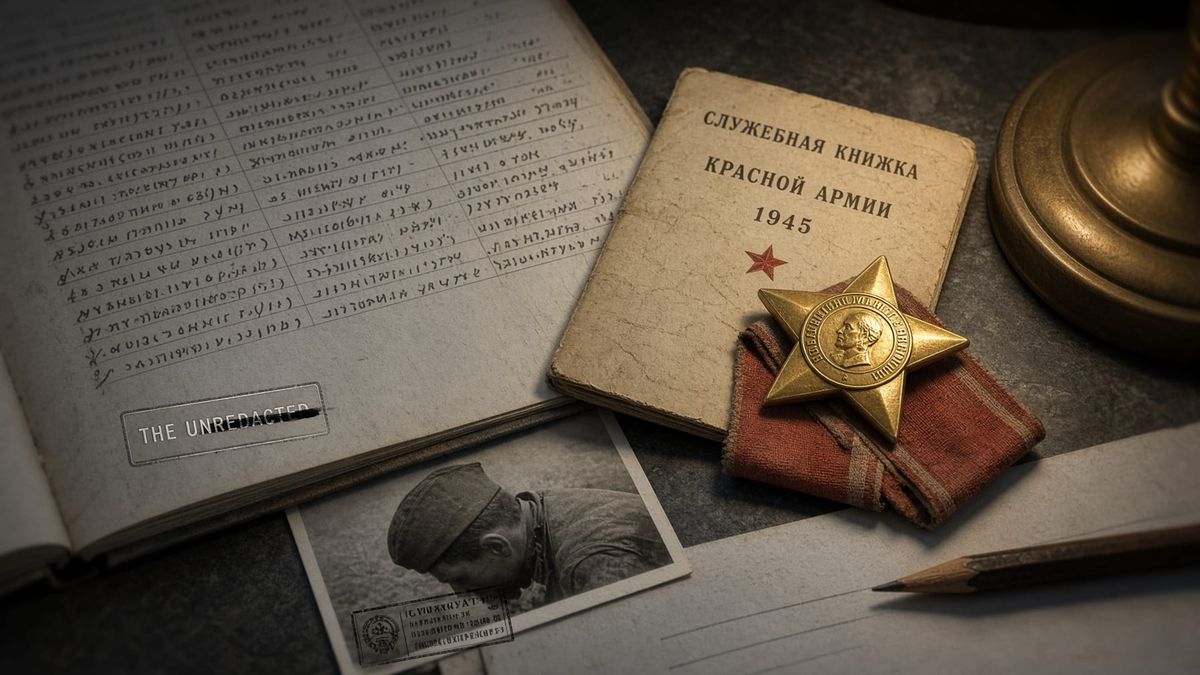
The record says otherwise. About half a million Jews served in the Red Army. Roughly 40 percent of them were killed, close to 198,000 people. Nearly 40 percent of Jewish Red Army personnel held officer rank, by far the highest share of any ethnic group in the Soviet military. A researcher named Shenker spent years documenting 156 Jewish Heroes of the Soviet Union, the country's highest military title, along with Jews who were shortlisted and denied the award because they were Jews.
The Tashkent Front, by the Numbers
Sources: The Forward, The Jewish Chronicle.
The state that awarded those medals also punished anyone who counted them. Miriam Aizenshtadt, a journalist, compiled a list of 135 Jewish Heroes of the Soviet Union and wrote profiles of dozens more. She was executed. Counting Jewish heroes was treated as nationalism, which in Soviet terms made it a crime.
Why Moscow Needed a Passive Jew
The Soviet treatment of Jewish wartime memory followed a precise logic, and it is worth naming because it is still running. Moscow allowed the Jew two images. The first was the anonymous victim, folded into "peaceful Soviet citizens" so that the dead could not be claimed as Jewish. The second was the shirker, the man on the Tashkent front. Both images had the same function: they denied Jews agency. A people who were only ever killed, or who only ever hid, had no claim to collective dignity, and no claim to a state.
The image Moscow could not allow was the fighter. A Jew with a rifle is a Jew with a claim. When that Jew appeared anyway, in 1948 and again in 1967 in the uniform of Israel, the Soviet apparatus moved to its next tool. After the Six-Day War, Soviet propaganda recast the Jewish soldier as the new Nazi. Zionism was equated with fascism in books, cartoons and state committees, and in 1975 the Soviet bloc carried a United Nations resolution declaring Zionism a form of racism. The Jew who fought back was no longer a coward. He was a criminal.
The Soviet Toolkit, Then and Now
| Technique | Soviet version | New York version |
|---|---|---|
| Erase the fighter | "The Tashkent front" | Jewish strength recast as aggression |
| Dissolve the victim | "Peaceful Soviet citizens" at Babi Yar | "Room to mourn everyone" on October 7 |
| Use a proxy word | "Zionist" in place of "Jew" | "Openly Zionist infiltrator," said of a campus rabbi |
| Criminalize the soldier | Zionism equals Nazism | "Death to the IDF" outside a synagogue |
| Punish the counting | Executed for listing Jewish heroes | Complaints lost in a "black box" |
The Manual, Translated
This publication has documented how that toolkit arrived in New York. In June we traced how "Zionist" works as the proxy word in DSA rhetoric, and the protests that followed it to synagogue doors, including the November 2025 demonstration outside Park East Synagogue where the crowd chanted "death to the IDF." The Soviet move after 1967 was to turn the Jewish soldier into a war criminal. The chant performs the same transfer in four words.
At the City University of New York, once the ladder that lifted generations of Jewish New Yorkers, a report by SAFE CUNY counted zero Jews among the system's top 80 leaders. At a City College event last year, a moderator was recorded calling the campus Hillel director an "openly Zionist infiltrator" while the room applauded. The Soviet system needed one word to put a Jew outside the protected community without saying "Jew." It is still the same word.
The Fighters Are Still Here
The Tashkent lie has an answer, and it is the one the Latrun museum gives. The Jewish fighter is not a myth to be retired. He is a fact to be recorded. He is also not only a figure from 1944. On March 12 of this year, a man drove an explosives-laden pickup through the doors of Temple Israel in West Bloomfield, Michigan. The FBI called it a Hezbollah-inspired terror attack. All 140 children inside survived. The security director was struck and knocked unconscious, and trained staff did their jobs. Those staff members will never get a medal from Moscow, and they do not need one.
Eighty Years of One Lie
- 1941–1945About 500,000 Jews serve in the Red Army. The "Tashkent front" joke spreads in the rear.
- Late 1940s–1950sCounting Jewish heroes becomes nationalism. A journalist who listed 135 of them is executed.
- 1967–1975After the Six-Day War, Moscow brands Zionism the new Nazism; the UN adopts Resolution 3379.
- 2002Israel's government approves a museum of the Jewish soldier at Latrun.
- 2023The museum opens, shortly before October 7.
- 2025–2026"Death to the IDF" outside a Manhattan synagogue; a rabbi called an "infiltrator" at City College.
Soviet active measures worked best when Jews absorbed them. Veterans' own testimonies describe hearing the Tashkent taunt for decades after the war, from neighbors who had never seen a front. The point of the operation was never only to persuade gentiles. It was to persuade Jews that courage was not theirs to claim, so that when the next accusation came they would answer it with apologies instead of facts.
The museum opened shortly before October 7, 2023, and Leibovitz reports it is now struggling to stay afloat in a country in its third year of war. He hopes that one day it, rather than Yad Vashem alone, becomes the required stop for visiting dignitaries. The idea is sound. A visitor who learns only how Jews died has learned exactly what Moscow wanted taught.
The museum at Latrun keeps a database where families can add the name of a Jewish soldier. Every name entered is one less man on the Tashkent front. In New York, the same work starts with saying out loud what the chant outside the synagogue is for.
Receipts
- Kantor and Timor, Herzog, the Aboulkers, the one-third calculation, the museum's finances: Liel Leibovitz, "The Fighting Jews," Tablet, Oct. 19, 2026; museum guidebook; Maj. Gen. Chaim Erez address; curator's statement: Dr. Tamar Ketko; Allied breakdown: The Jewish Press
- Tashkent front, Red Army service, deaths and Heroes: The Forward; JTA; officer share: The Jewish Chronicle
- Miriam Aizenshtadt: Euro-Asian Jewish Congress
- Park East Synagogue protest, Temple Israel attack: The Unredacted; SAFE CUNY report and City College event: The Unredacted