Nick Shirley Found the Empty Daycares. Then the Money Led to Albany.
YouTuber and a Post reporter found social daycares billing Medicaid millions with no visible patients. Nine of those businesses gave Kathy Hochul's campaign $55,000. The state's own regulators reached them last.
Nine social adult daycare businesses in Flushing billed Medicaid almost $250 million between 2018 and 2024. Those same nine businesses contributed $55,000 to Kathy Hochul's 2022 campaign. New York's own regulators did not find this. A YouTuber and a tabloid reporter did.
Start with what the money bought and what the money shows.
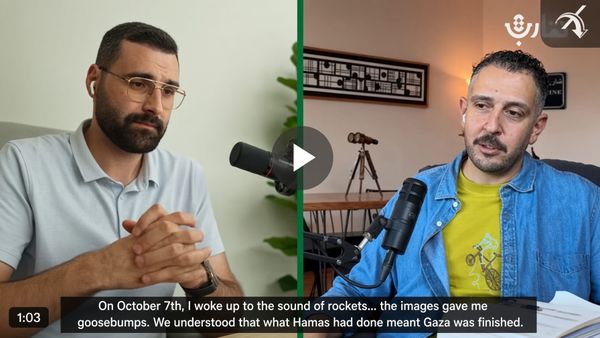
In July, Nick Shirley walked into a social adult daycare center in Flushing tied to nearly $12.9 million in public payments and thousands of patients on paper. The center did not look like a $12.9 million operation. It looked empty. Shirley found few people inside. A man presenting himself as the manager could not say who owned the business. Shirley kept the camera running.
He went to the other daycares, home-care outfits, and pharmacies clustered in the same neighborhood. The pattern repeated: reported billing that suggested a crowd, physical locations that held almost no one. Local operators told him competitors were recruiting elderly clients with cash and other incentives. Those allegations are unproven in court. They also match schemes federal prosecutors have already charged in New York. This is not the first Flushing daycare that turned out to be a billing operation wearing a storefront. In February, prosecutors charged a separate $120 million social adult daycare fraud in the same neighborhood, part of a pattern The Unredacted mapped across one square mile of Queens: 77 centers, more than $100 million a year, rooms nobody sits in.
Shirley later returned with Dr. Mehmet Oz, who runs the federal Centers for Medicare and Medicaid Services, and put the operators on camera again. On July 24 he published the full report and alleged the businesses he examined touched more than $190 million in questionable public spending. That figure is his, not a prosecutor's, and an empty room is not by itself proof of a false claim. But Shirley found the story, went to the addresses, and documented the gap between the billing and the business. The state did not.
Got this fraudster a while back ✅ No wonder Hochul and Mamdani went silent when I exposed these daycare fraudsters.
— Nick shirley (@nickshirleyy) August 13, 2026
These politicians rely on the fraud to push their agendas. pic.twitter.com/0JVzaK3iVM
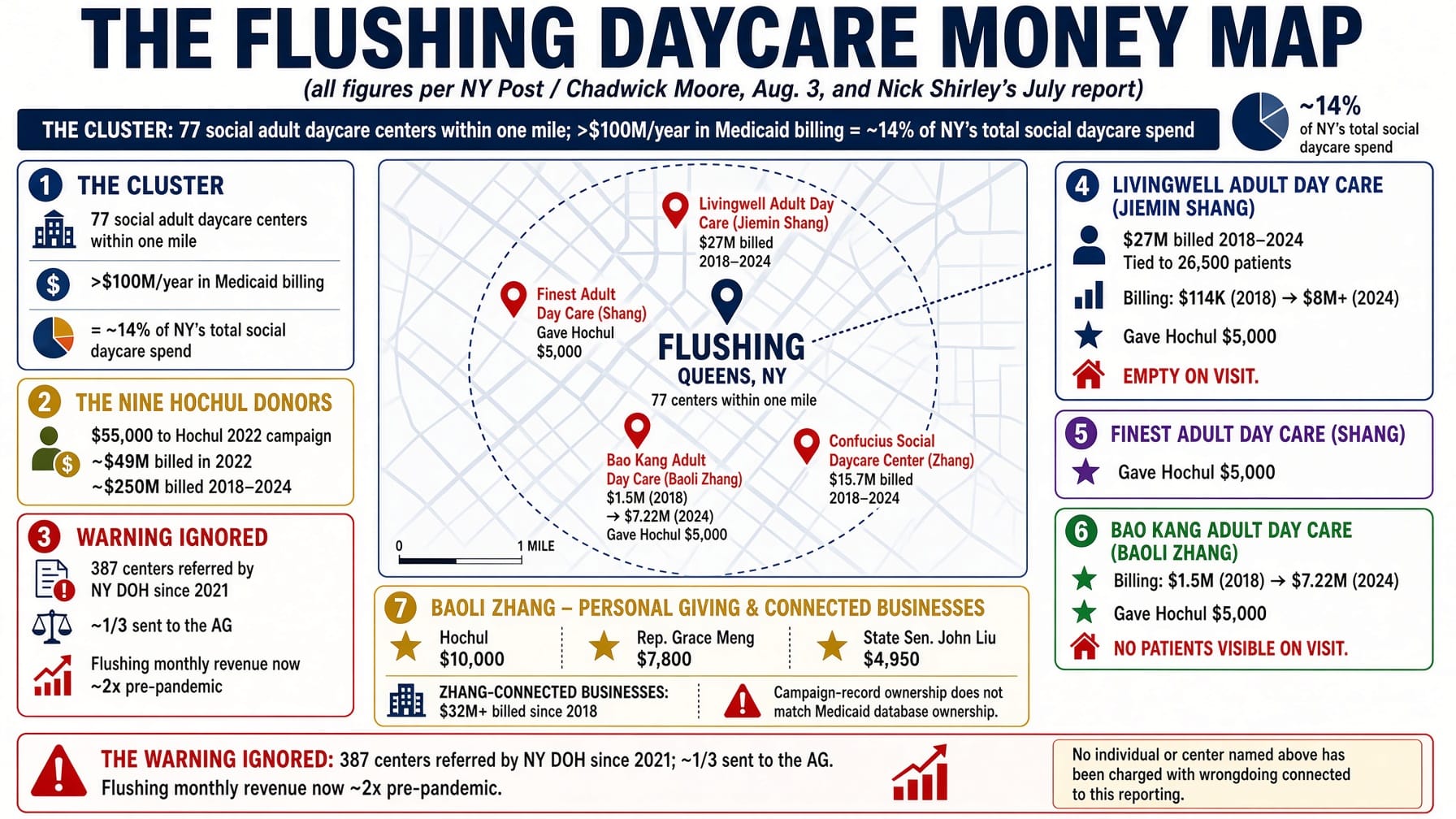
Post reporter Chadwick Moore published his own investigation. Moore identified 77 social daycare centers inside a one-mile radius, together billing Medicaid more than $100 million a year, roughly 14 percent of the entire state's social daycare spending, concentrated in a single Flushing neighborhood.
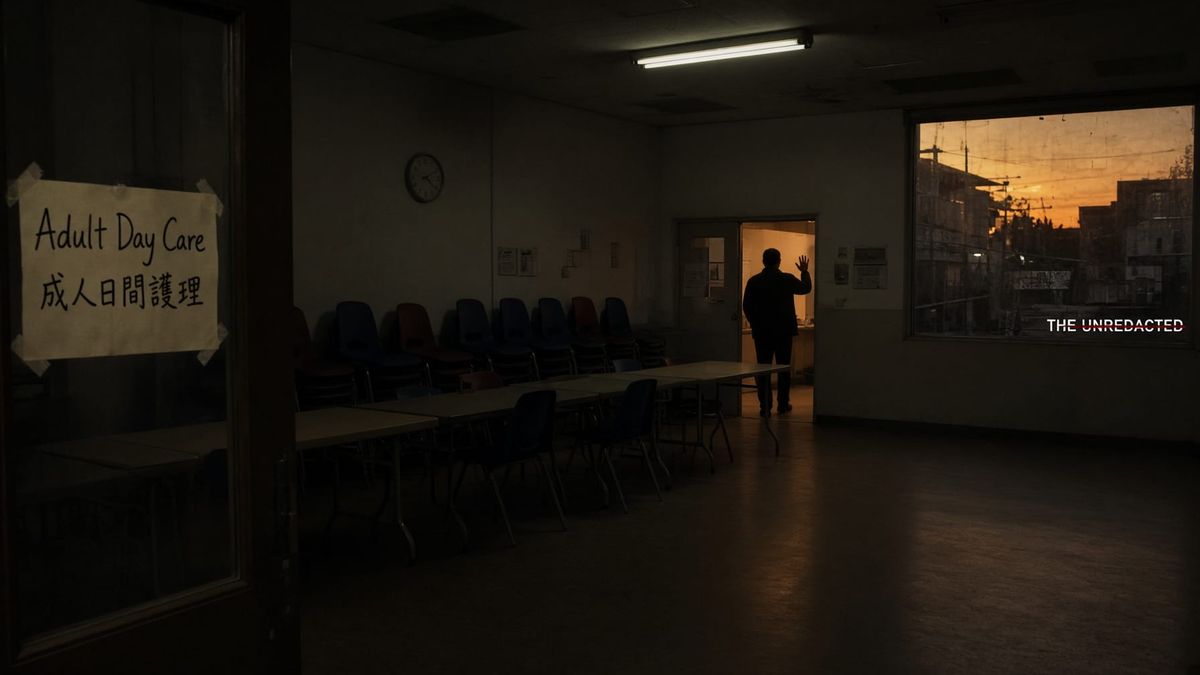
He and photographer Matthew McDermott went to the largest providers. At Livingwell Adult Day Care they found dimmed lights, rows of empty tables, no visible seniors, and a worker who ordered them out and threatened to call police. Livingwell billed Medicaid $27 million from 2018 to 2024 for services tied to 26,500 patients. Its annual billing climbed from $114,000 in 2018 to more than $8 million in 2024. At Bao Kang Adult Day Care, no patients were visible either.
That is the operation. Here is the money's destination.
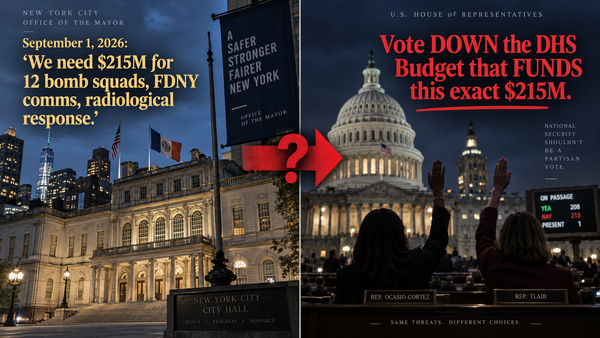
Moore pulled the campaign finance records and found what Shirley's footage had not reached. Nine of these social daycare businesses gave a combined $55,000 to Hochul's 2022 campaign. In that same year, those nine businesses billed Medicaid nearly $49 million. Across 2018 to 2024, they billed almost $250 million. An industry living on state-controlled healthcare dollars had become a donor to the person at the top of the state.
The contributions do not prove a payoff, and the record does not show Hochul intervening on any of these businesses' behalf. State the limit plainly and keep moving. What the filings establish is narrower and still damning: the same entities drawing enormous sums from a state program had bought a seat at the state's political table.
Now name the operators.
Baoli Zhang is among the most prominent figures in Moore's reporting. Zhang is an accomplished erhu musician who has played Carnegie Hall and Lincoln Center, and a well-connected figure in New York's Chinese community. He personally gave Hochul $10,000. Bao Kang, which Zhang identified as his business in campaign records, gave another $5,000. Businesses connected to Zhang have billed Medicaid at least $32 million since 2018. Bao Kang's annual billing rose from $1.5 million in 2018 to $7.22 million in 2024. Confucius Social Daycare Center, another Zhang business, billed $15.7 million from 2018 to 2024.
The ownership records do not line up. Zhang named himself owner or manager of some centers in his campaign disclosures while Medicaid databases list other people. He did not answer the Post's questions about the discrepancy. That gap, between who signs the political checks and who appears on the healthcare filings, is exactly the thread an auditor pulls first.
Zhang's political giving does not stop at the governor. He has contributed $7,800 to Rep. Grace Meng and $4,950 to state Sen. John Liu. Liu called Zhang a respected community leader, said he was proud of the support, and added that any facility suspected of fraud should be investigated. Meng said she welcomed good-faith investigations but opposed "MAGA campaigns targeting Asian American senior citizens."
That answer changes the subject. The investigation is about businesses billing Medicaid, not about the seniors who use them. And those seniors are the point in a way Meng's framing obscures. Many have limited English and depend on the operators for transportation, translation, and access to services. Their Medicaid identities can generate several separate reimbursement streams at once. This is the same machinery federal prosecutors described in the Brooklyn case The Unredacted covered in June, where a daycare operator who bought his way into the Democratic establishment's photo lines was later charged with paying seniors roughly $500 a month to rent out their Medicaid cards. Vulnerability is not a shield here. It is the mechanism.
Jiemin Shang runs Livingwell, according to the Post. Livingwell gave Hochul $5,000 in 2022. Finest Adult Day Care, another Shang business, gave another $5,000. None of these men or centers has been charged with wrongdoing connected to this reporting. The point is not a verdict already reached. It is the questions no one in state government has answered.
There is a reason these centers are worth more to a politician than a check. They assemble large blocks of elderly voters who rely on the staff to get to the polls and navigate the ballot. One industry source told the Post the arithmetic directly: put a hundred people in a room and turn them out, and it moves a primary. The daycare is a billing operation and a turnout operation at the same address.
The state cannot say it was not warned. Since 2021, the New York State Department of Health has referred 387 social adult daycare centers for investigation, and about a third went to the attorney general for possible action. The billing kept growing anyway. Monthly revenue for Flushing's daycare centers now runs at nearly twice its pre-pandemic level. This is the same pattern that let CDPAP spending balloon past $12 billion while state officials called it a crisis and did nothing: the referrals go out, the invoices get bigger, and no one at the top connects the two.
Hochul's office says campaign contributions do not influence state decisions and points to Medicaid reforms, taxpayer savings, and fraud prosecutions under her administration. Fine. Then there is a clean way to prove it.
The governor can back a full audit of the centers in this reporting. Investigators should compare reported attendance against Medicaid claims, identify the actual owners of each company, and examine the related transportation, pharmacy, and home-care billing running through the same neighborhood. They should reconcile the ownership names on the campaign disclosures against the names in the state and federal healthcare databases, because right now those two records do not match, and the mismatch is the case.
Shirley found the story and put the first operators on camera. Moore checked the centers independently and found the contributions. That is the whole indictment: the money going out of the treasury and the money coming into the campaign describe the same nine businesses, and the only institution that failed to connect them is the one that cuts the checks. New York's government still owes an answer for why a YouTube channel and a tabloid reached these businesses before its own regulators did.
📬 Share, Comment, and Support Our Work
Share this. Restack it. Forward the email. That's the whole ask.
Support the work. The reporting linked above took weeks of tracing records, filings, and on-the-record statements. It doesn't happen on faith. If you find it useful, become a paid subscriber and help fund the next one.