'Freeze the rent' is really about outrage and revolt

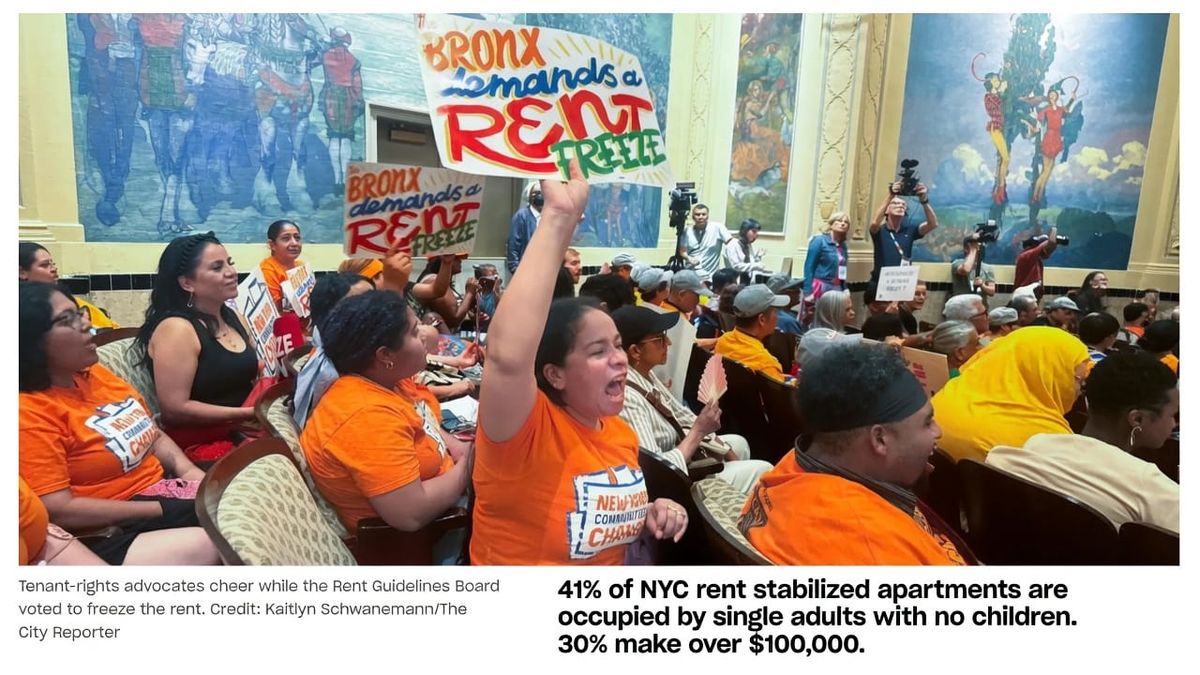
A New York City landlord weighs in on how the annual rent-setting process stopped being about rent.
Thursday's decision on rent-stabilized apartments in New York City will prove that what is supposed to be a deliberative, analytical process has been hijacked by Mamdani allies.
We are about to find out if New York City mayor Zohran Mamdani's campaign promise to freeze the rent on the 2.4 million New Yorkers who live in rent-stabilized apartments will come to pass. This huge decision will be made on Thursday night by the Rent Guidelines Board, which, despite its boring name, actually provides some of the most raucous theater in town. Members of the public have been warned to leave their drums and noisemakers at home.
Other major cities in America with rent controls tend to use simple formulas to determine how much rents can go up each year. Los Angeles allows rent hikes equal to 90 percent of the increase in the local Consumer Price Index, with a minimum of 1 percent and a maximum of 4 percent. San Francisco's math is even cleaner: 60 percent of the local CPI increase.
44% of rent stabilized units in NYC are occupied by people born outside of the US…
— Geiger Capital (@Geiger_Capital) June 26, 2026
American-born citizens are subsidizing the foreign-born to live in our financial capital, while driving up prices of the remaining supply. https://t.co/tiuh1IxdNX pic.twitter.com/57BZoudeLr
New York does it differently. Nine members, a formula nobody outside the building can reconstruct, months of hearings nobody outside the building attends, and a vote that, it turns out, was decided before any of that happened.
By Thursday night we knew. The board voted 7 to 1 to freeze rents on both one-year and two-year leases for the city's roughly 1 million stabilized units, the first time in the RGB's history that a two-year lease has ever been frozen. Six of the nine members were Mamdani's own appointments. The seventh yes vote belonged to a landlord representative the mayor had personally appointed, who stood up and told the room, with what can only be described as ideological discipline, that a zero percent increase was in landlords' own best interest. The one no vote came from a holdover appointee of Eric Adams. The math was never close, because the math was never the point.
What was the point arrived a few hours earlier, in the form of a resignation letter.
Christina Smyth, one of the board's two landlord advocates, walked out before the vote and told the public exactly what she had watched happen from inside the room. The hearings, the testimony, the data on insurance costs and fuel costs and maintenance costs that the board's own staff had compiled, all of it, she wrote, was theater. The result had been fixed "last year on the campaign trail." She did not resign because she lost a vote. She resigned because she had finally understood that there was never a vote to be had, only a verdict to be delivered with the appearance of deliberation attached to it.
Motion passes, after a lengthy speech acknowledging landlord struggles, Wynn acknowledges a rent freeze is in landlords best interest. A zero percent increase on 1 and 2 year leases beginning Oct. 1 passes unanimously. pic.twitter.com/NwwYUlERKg
— Hannah Fierick (@HannahFNYP) June 25, 2026
This is worth sitting with, because it is the whole story compressed into one gesture. An independent fact-finding body, built by statute to balance the interests of tenants and the small owners who house a third of the city, became a single-purpose instrument the moment its composition changed. Mamdani did not abolish the Rent Guidelines Board. He did not need to. He simply filled six of nine seats with people who already agreed with him, then let the board's own procedural legitimacy do the work of laundering a campaign promise into municipal policy. The hearings still happened. The public comment period still ran its course. The report on insurance premiums rising 10.5 percent year over year still got published in April, four months before anyone needed it. None of it touched the outcome, because none of it was ever connected to the outcome. The data and the decision occupied separate universes that happened to share a meeting room.
Tenants and activists at the rent guidelines board hearing are singing and chanting while the theater waits to fill up pic.twitter.com/Eh4EvG6IQy
— Moses Jeanfrancois (@mosesjeans) June 25, 2026
Mamdani, for his part, used the word "independent" to describe the board in his victory statement, which is the kind of detail that would be funny if it weren't so exact a description of how institutional capture actually works in practice. You do not need to lie about an institution's independence once you have already secured its outcome. You only need to keep using the word, publicly, sincerely, until the word and the thing it once described quietly stop referring to each other.
The Democratic Socialists of America understood what had happened, and unlike the mayor, did not bother with the euphemism. Days after the DSA's own slate swept three congressional primaries across the city, the organization's social accounts were already celebrating the freeze as a movement victory, not a board's independent judgment. "We're going to deliver a rent freeze for millions of New Yorkers," the post read, before the vote had even happened. That is not a prediction. That is an organization describing its own command of a regulatory process in the future tense, with total confidence, because it already knew the outcome the way you know the outcome of a play you directed.
This is the texture that gets lost when the story is filed under housing policy. A rent freeze is a number. Whether the number is correct is a real and answerable question, and serious people on both sides of it have made serious arguments. Ann Korchak of the Small Property Owners of New York and James Whelan of the Real Estate Board of New York both said, in their own ways, what landlords have been saying since April: insurance costs are up, fuel is up, maintenance is up, and a frozen rent roll on a building with rising fixed costs is not relief, it is a slow transfer of the building's equity to whoever holds the mortgage. That argument can be wrong. It cannot be dismissed as theater, because it is the only part of Thursday's proceedings that was not theater.
Abolishing private property in 2 easy steps
— Daniel Di Martino (@DanielDiMartino) May 27, 2026
Step 1 - Rent control: Rent is lower than costs and taxes so you can't do maintenance.
Step 2 - Seizure: You don't have the money to do maintenance and the state uses it as an excuse to take your property.pic.twitter.com/xEkMbR0EZb
What should worry New Yorkers who do not own a single rent-stabilized unit, who have no stake in the landlord's side of this ledger, is the method, not the number. A government that wins an argument by changing the referee rather than the rules has told you something true about how it intends to govern for the next four years. The RGB was one of the few remaining bodies in city government explicitly designed to produce outcomes its own appointing authority might not like. That was the design feature, not a bug to be patched. Mamdani patched it anyway, in his first six months, using the most boring possible instrument: appointments.
The rent freeze will poll well, because it is popular, because the people it helps are visible and the people it costs are not, and because "the mayor froze your rent" is a sentence that fits on a flyer in a way that "the mayor restructured an independent board's composition until it agreed with him" never will. But the second sentence is the true one, and it is the sentence that will still be true in 2029, long after this particular freeze has thawed into whatever comes next.
The network
| Vote | 7–1, RGB, June 25, 2026 |
| Mamdani appointees | 6 of 9 seats |
| Resignation | Christina Smyth, same day |
| Stabilized units affected | ~1,000,000 |
 Gene Goodwin