Hasan Piker Went to Cuba With Code Pink. Now the Treasury Wants Answers.
A March convoy carried "humanitarian aid" to Cuba and put its speakers on state television beside the regime's president. Now Hasan Piker, Medea Benjamin, and dozens of others are under Treasury scrutiny for sanctions violations.

City Journal's Stu Smith has been on this convoy since it left the ground, filing the receipts in real time. What follows builds on his reporting.
Last week the State Department released a report detailing decades of Cuban espionage and its collaboration with far-left radical organizations in America. Dozens of groups and individuals are named in it. It is the latest move in a department-wide push to counter Cuban influence, and it did not come alone.
My latest for @CityJournal!
— Stu Smith (@thestustustudio) July 31, 2026
In March, Hasan Piker, Code Pink’s Medea Benjamin, and dozens of other American activists traveled to Cuba with the Nuestra América Convoy, billed as a humanitarian mission.
The convoy delivered more than 20 tons of aid in an effort Reuters… pic.twitter.com/53APflwWI7
The push now includes subpoenas. Fox News reports that the Treasury Department is examining DSA-aligned streamer Hasan Piker, Code Pink leader Medea Benjamin, and as many as 40 others over a widely publicized trip to Cuba in March 2026. At issue is whether they violated American sanction rules by visiting a designated state sponsor of terrorism and engaging in what looks like advocacy on its behalf.
Piker and Benjamin both say they are victims of the Trump administration. The trip they took says otherwise.
Organizers called it the Nuestra América Convoy and billed it as an effort to deliver "critical humanitarian aid." It did other things too. It gathered some of America's most extreme activists in one place. And it gave the Cuban government an American audience to propagandize.
Benjamin floated the idea in December 2025, modeling the convoy on the Gaza flotillas that have drawn international attention. Organizers formalized plans at a January 2026 meeting of Progressive International, a transnational organization Code Pink belongs to. Progressive International was founded by the Bernie Sanders-affiliated Sanders Institute and the Democracy in Europe Movement 2025 (DiEM25) to oppose President Trump and the rising global right. At that meeting, the participants agreed to convene next in Havana. That follow-up became the convoy.
Weeks before it launched, CUNY's Graduate Center hosted a pro-regime conference that drew many future convoy participants. Among the attendees was Leima Martínez Freire, an official of the Cuban Institute of Friendship with Peoples, or ICAP. U.S. intelligence agencies and some Cuban defectors view ICAP as a front for Cuban intelligence. The "friendship society" model is not new. It is a Soviet inheritance, the same apparatus that ran the World Peace Council and its subsidiaries on laundered Moscow cash for four decades. We traced that lineage in The KGB's Holy War: How Soviet Intelligence Created Liberation Theology, which followed the friendship-front playbook from the Lubyanka to Latin America. Freire announced that ICAP's travel agency, Amistur, had made the delegation's travel arrangements, and that ICAP had scheduled a meeting with the delegation at its Havana headquarters. The United States sanctioned both ICAP and Amistur on June 4.
Hasan Piker has landed in Cuba and, naturally, one of the first people he runs into is Jodie Evans — Neville Roy Singham’s wife, Code Pink co-founder, and People’s Forum board member. pic.twitter.com/mfECQLSbcH
— Stu Smith (@thestustustudio) March 20, 2026
In late March, dozens of activists converged on Havana to "deliver aid." The roster explains the trip. It included Piker, Benjamin, People's Forum executive director Manolo De Los Santos, Isra Hirsi, daughter of Minnesota Representative Ilhan Omar and an organizer in Columbia University's encampment protests, and Democratic Socialists of America organizer James Ray, who shared a photograph of himself outside North Korea's Embassy in Havana.
De Los Santos is not a bystander in this. His group, The People's Forum, is the financial hub. It took over $20 million from Shanghai-based Maoist Neville Roy Singham between 2017 and 2022, and it is the entity through which the "Let Cuba Live" money moved when 23 New York City Council members signed on. We laid out that funding chain in Shanghai Money, Havana Survival: How a Beijing-Aligned Network Recruited 23 NYC Lawmakers. The convoy is the field operation. The Forum is the checkbook.
Aid delivery is one of the few reasons Americans are permitted to travel to Cuba under sanction rules. It was not the whole itinerary.
Benjamin delivered a speech alongside Cuban President Miguel Díaz-Canel that was broadcast on Cuban state media, and she used it to criticize the United States. The speakers who followed her discussed their readiness to take up "AKMs," Soviet-era rifles, to defend the island from Americans. Code Pink's social media showed convoy participants painting a mural and conducting photoshoots with young children. Those activities could serve as opportunities for networking, relationship-building, and training.
Code Pink has a history here. A report from the Network Contagion Research Institute (NCRI) outlines a relationship with the Cuban government that appears to run through Code Pink's repeated delegations. For years the group has partnered with ICAP to organize trips to Cuba, including a 2015 delegation whose participants may have met members of the Cuban Five spy network. Benjamin has appeared alongside ICAP officials at joint press conferences held at ICAP headquarters, according to the NCRI report. The same report identifies Benjamin fielding phone calls from Press TV, a sanctioned Iranian regime-controlled outlet, and then mirroring its talking points shortly afterward. Code Pink's conduct has prompted repeated calls from Congress asking the Department of Justice to open a full investigation of the group under the Foreign Agents Registration Act.
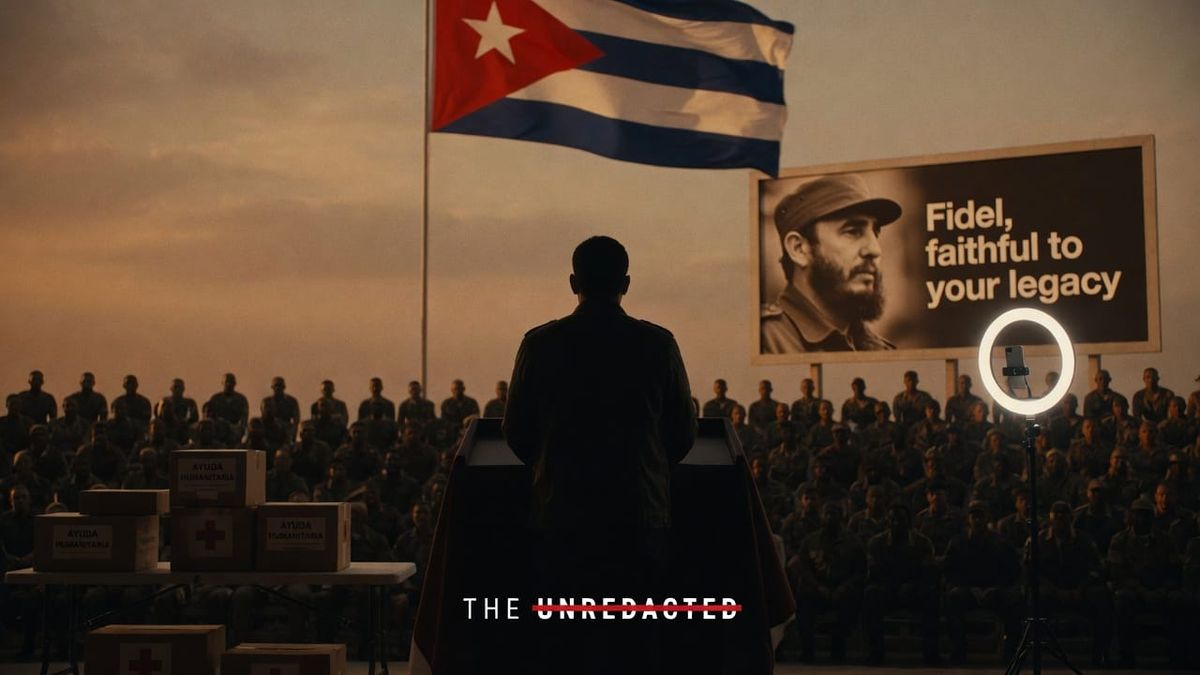
Piker traveled as part of an "influencer delegation" organized in part by the Democratic Socialists of America. He framed his participation as journalism, a way to enter the Communist country without running afoul of sanctions. The journalism defense is his standard-issue armor. It is the same posture that lets three of fourteen likely 2028 Democratic presidential candidates keep agreeing to appear on his show after he called Hamas a thousand times better than Israel, which we documented in The Permission Structure: Hasan Piker, Hamas, and the Democratic Party's Capture Problem. Then he produced a short documentary that reads like regime material. It featured Cuba's medical innovations, the global reach of its international medical missions, and its claimed non-adversarial history with the United States. It credited China with upgrading the island's solar power capacity. It gave Cuba's deputy foreign minister extended, largely uninterrupted speaking time. The film ends on a closeup of Code Pink and The People's Forum, then a Fidel Castro billboard reading "Fidel, faithful to your legacy," as Piker narrates the revolutionary slogan, "Patria o muerte, venceremos."
His other Havana activities included partying with the pro-Hezbollah rap group Kneecap, distributing "wads of cash," and "living large." That itinerary is hard to square with full-time journalistic work. Past DSA delegations understood the difference. Their National Political Committee reportedly barred delegates from even going to the beach.
Treasury Department subpoenas, announced in May, are the first step in determining whether the convoy violated U.S. sanctions laws. Because Cuba is designated a state sponsor of terrorism, sanctions evasion there draws heightened legal and regulatory scrutiny, and the prohibitions are broad. Even the National Lawyers Guild, a leading far-left legal group that regularly represents radical protesters, is clear about how easy it is to run afoul of sanctions law in Cuba. A trip presented as humanitarian or journalistic can still create exposure if participants spend money at prohibited businesses or provide direct or indirect support to Cuban state entities.
🚨 Hasan Piker Parties in Havana, Hands Out Cash, and Raises Obvious Sanctions Questions
— Stu Smith (@thestustustudio) March 22, 2026
On stream today, Hasan Piker openly describes partying in Havana with Kneecap, drinking at local bars, and “peppering people with wads of cash” across the city.
His takeaway? Cuba is just… pic.twitter.com/t3Kls1Ywoo
"The Cuban military largely controls the most profitable elements of Cuba's tourism sector," said Max Meizlish, a research fellow at the Foundation for Defense of Democracies. "So the U.S government maintains a list of properties, entities, and other business ventures linked to the regime's military, intelligence, and security services called the 'Cuba Restricted List.'"
The Nuestra América convoy sent more than 20 tons of aid to Cuba with the purpose of what Reuters characterized as "circumvent[ing] U.S. sanctions." If that holds, the State Department's investigation may lead to charges.
Benjamin and Piker have answered with defiance. Benjamin says Code Pink plans to launch "encampments" this summer as protest. She has pushed back on the Treasury Department questionnaire, calling it "intimidation" meant to waste her group's time and resources. The shipments have continued. Benjamin recently said the organization sends thousands of pounds of supplies to Cuba every two weeks and is preparing for travel tied to commemorative events on the island this August.
Piker has taken the same line. He maintains his innocence, frames the Treasury scrutiny as politically motivated, has not acknowledged receiving a subpoena, and claimed earlier this month that he had not been subpoenaed. He continues to insist his activities fall within journalism.
Aid to Cuba that potentially violates sanctions has often escaped scrutiny by overwhelming the government's enforcement capacity. That is changing. The administration sanctioned ICAP and has emphasized holding the Cuban government to account in support of the Cuban people.
Meizlish described the approach as "an unprecedented U.S. sanctions enforcement against the Cuban regime," and argued the tougher posture is warranted. "I think it's a good thing for the U.S. government to be stepping up enforcement and making sure that U.S. persons aren't providing support to a murderous regime," he said.
The full target list has not emerged. Treasury took the first step, but Florida's attorney general and the Department of Justice can each open their own. Benjamin sends another shipment in two weeks.
This piece builds on Stu Smith's reporting for City Journal.
📬 Share, Comment, and Support Our Work
Share this. Restack it. Forward the email. That's the whole ask.
Support the work. The reporting linked above took weeks of tracing records, filings, and on-the-record statements. It doesn't happen on faith. If you find it useful, become a paid subscriber and help fund the next one.