Iran Put “Kill Trump” on Parade. The Threat Has Been Building for Two Years
Two years after an assassin’s bullet grazed Donald Trump in Butler, Pennsylvania, Iran’s ruling system has turned threats against him into a public ritual.

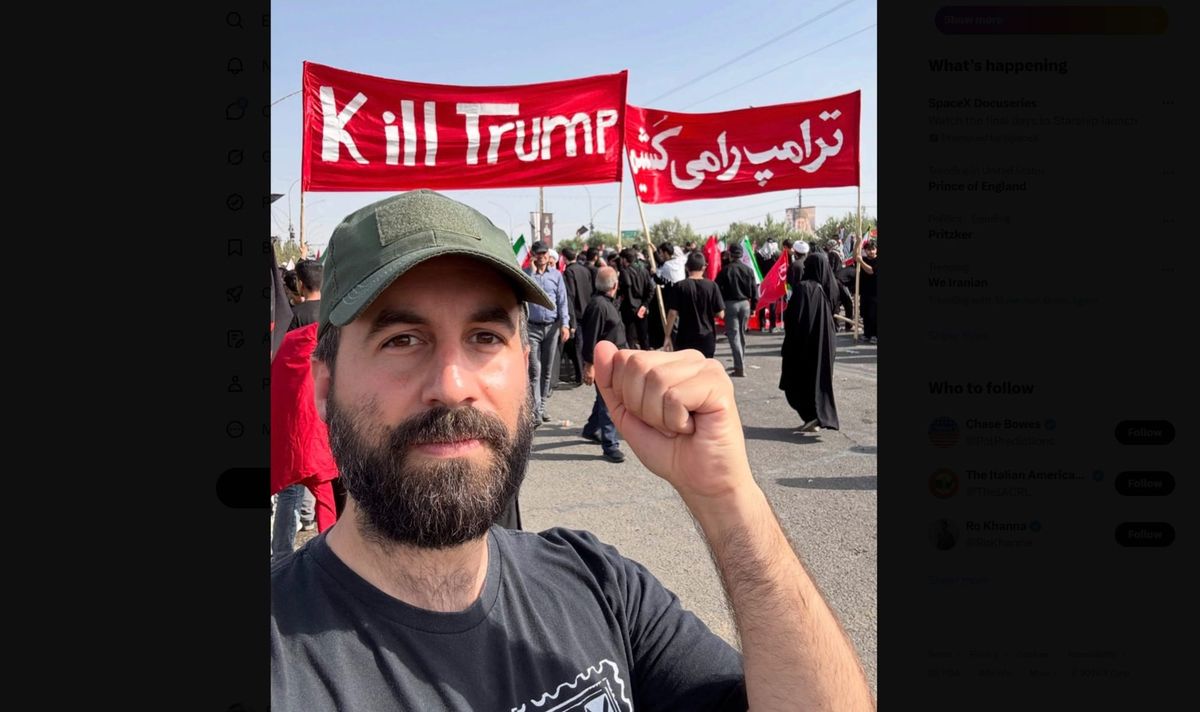
Iran put the threat on parade.
At the funeral of Ayatollah Ali Khamenei, mourners carried banners declaring, “We Will Kill Trump.” In Tehran, a crowd passed beneath a billboard showing Donald Trump with a bullet aimed at his head. They threw stones at it.
This was not anonymous internet chatter. It was a regime spectacle.
Two years earlier, on July 13, 2024, an assassin’s bullet grazed Trump’s ear at a rally in Butler, Pennsylvania. Corey Comperatore was killed. Two other rallygoers were wounded. The FBI called it what it was: an attempted assassination.
Then, in September 2024, Ryan Wesley Routh was arrested after Secret Service agents found him with a rifle near Trump International Golf Club in West Palm Beach. A jury later convicted him of attempting to assassinate Trump.
They tried to kill him at a campaign rally.
They tried to kill him at his golf course.
And now the Iranian regime has placed his name, his face, and a public call for his murder at the center of the funeral rites for its dead supreme leader.
The threats are not random. They are part of a record.
Senior Iranian official Ahmad Alamolhoda:
— Open Source Intel (@Osint613) July 12, 2026
"The fatwa to kill the American dog Trump must be implemented through an organized mechanism, so it is not left unfulfilled like in the Rushdie case. Our revenge will continue until America collapses like the USSR." pic.twitter.com/Lncf9oV1fB
The Iranian Record
The Islamic Republic has sought vengeance since January 2020, when Trump ordered the strike that killed Qassem Soleimani, commander of the Islamic Revolutionary Guard Corps’ Quds Force.
Soleimani was not a conventional military officer. He ran Iran’s external operations. He armed proxies. He built networks. He directed the regime’s political warfare from Iraq to Syria, Lebanon, Yemen, Europe, and Latin America.
Trump killed him.
Iran did not forget.
In November 2024, federal prosecutors charged Farhad Shakeri, an Iranian national and alleged IRGC asset based in Tehran, in a murder-for-hire scheme that targeted Trump. According to the criminal complaint, Shakeri told the FBI that an IRGC official ordered him to surveil and kill Trump.
The timeline was explicit.
Prosecutors said that, on October 7, 2024, the IRGC told Shakeri to produce an assassination plan within one week. If he could not do it, the regime allegedly instructed him to pause until after the election because it expected Trump to lose and become easier to kill.
Shakeri remains at large in Iran.
That was not a slogan. It was an alleged operational order from an arm of the Iranian state.
The Justice Department also charged two New York men, Carlisle Rivera of Brooklyn and Jonathon Loadholt of Staten Island, in the same wider murder-for-hire case. The charges alleged an Iranian-directed network that targeted Trump, Iranian dissidents, and American citizens.
The case file matters because it establishes the basic fact Washington keeps trying to compartmentalize.
Iran does not merely threaten Trump.
Iran builds the capacity to act on its threats.
REPORT: Ivanka Trump was targeted for assassination by an Islamic Revolutionary Guard Corps trained terrorist.
— Benny Johnson (@bennyjohnson) May 23, 2026
Mohammad Baqer Saad Dawood Al-Saadi, who was recently captured, made a pledge to kill the First Daughter and had a blueprint of her Florida home. pic.twitter.com/KZobER4d08
The Family Target
The pattern extends to Trump’s family.
In May, U.S. authorities brought Mohammad Baqer Saad Dawood Al-Saadi into custody after he was arrested abroad and transferred to New York. Federal prosecutors charged Al-Saadi, an Iraqi national, with terrorism-related crimes tied to alleged plots and attacks across Europe, Canada, and the United States.
Prosecutors described Al-Saadi as a commander in Kataib Hezbollah, the Iranian-backed Iraqi militia, and alleged he provided support to both Kataib Hezbollah and the IRGC.
The charges were serious. Conspiring to provide material support to foreign terrorist organizations. Conspiring to bomb public places. Providing material support for terrorism. Terrorism that crossed national borders.
The alleged targets included synagogues in New York, Los Angeles, and Scottsdale. A Bank of New York Mellon site in Amsterdam. A Bank of America location in Paris. Jewish targets in London. The U.S. consulate in Toronto.
Al-Saadi pleaded not guilty.
But separate reporting from people familiar with the case established another detail. Al-Saadi allegedly spoke of targeting Ivanka Trump. He reportedly possessed a blueprint of her Florida home and posted material suggesting that private residences and Secret Service protection would not shield the Trump family.
He was reportedly close to Iranian proxy leadership and motivated by the same source of revenge: the killing of Soleimani and other Iranian-backed militia leaders.
The indictment did not charge an assassination plot against Ivanka Trump. That distinction matters.
But the alleged evidence does, too.
A senior figure in an Iran-backed militia allegedly mapped the president’s daughter’s home, spoke of targeting her, and now faces federal terrorism charges in Manhattan.
The regime’s threat network is not confined to the president.
It reaches for the family.
"WE WILL KILL TRUMP."
— Fox News (@FoxNews) July 10, 2026
That message has been displayed on massive banners and signs as thousands gather for slain Ayatollah Ali Khamenei's burial ceremony in Iran.
The crowd repeatedly vowed revenge for Khamenei's death, with signs also threatening Vice President JD Vance,… pic.twitter.com/EOYqlONM5C
 Gene Goodwin
The Funeral Was Evidence
Then Khamenei died.
The regime responded as it always does. It turned death into political mobilization. It turned mourning into a threat campaign.
At the funeral processions, crowds chanted against the United States and Israel. They marched with banners promising Trump’s death. In Tehran, they threw rocks at his image beneath a graphic depicting a bullet aimed at his head.
The public display matters because Iran’s system is not built around loose rhetoric. The Islamic Republic uses public rhetoric to create political permission. Clerics say the words. State broadcasters amplify them. Militia commanders repeat them. Crowds display them. Operatives hear them.
There is no clean line between incitement and action in a regime that uses proxies as instruments of state power.
The “Kill Trump” banners were not an embarrassing deviation from Iranian policy.
They were Iranian policy in public.
 Gene Goodwin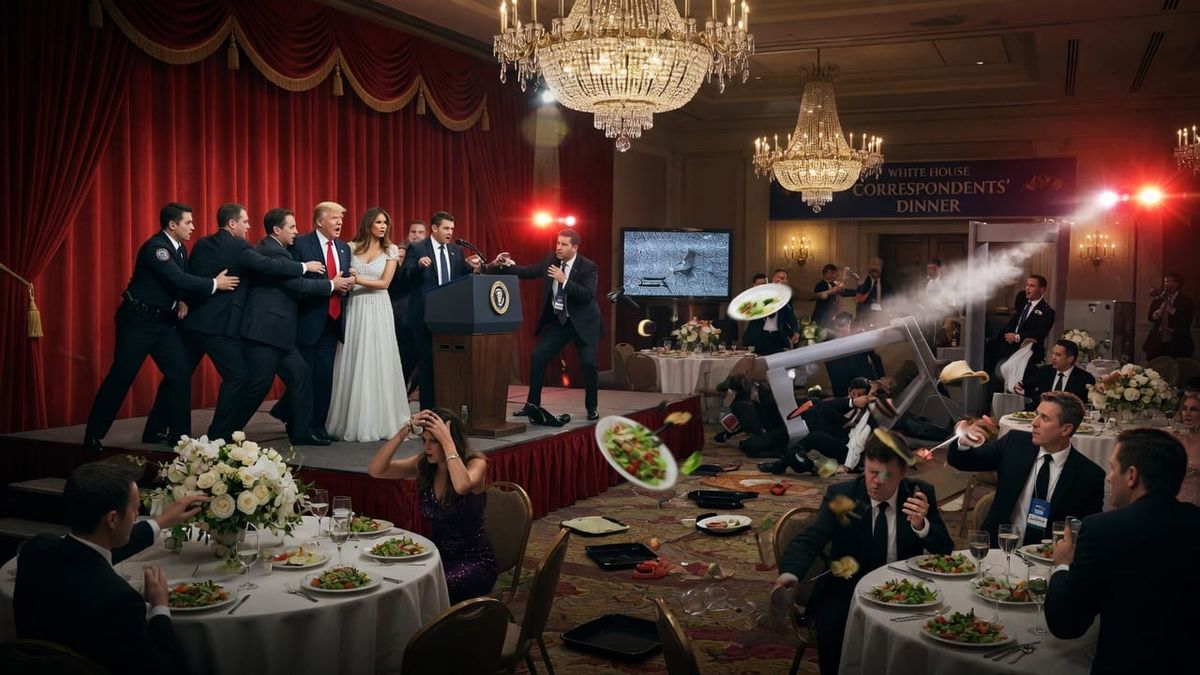
The Intelligence Dispute
Then Israel warned Washington.
CNN reported that Israeli intelligence had shared information indicating that Iran had developed a new plan to assassinate Trump. U.S. officials did not independently verify the intelligence. Subsequent reporting said American assessments had detected Iranian hardliners’ desire to target Trump but no new, specific operational plan.
That distinction should guide the reporting.
No confirmed new plot is not the same as no threat.
The public evidence is overwhelming. Iran’s leaders and affiliates have threatened Trump for years. Federal prosecutors charged an alleged IRGC asset with a plan to kill him. A Kataib Hezbollah commander allegedly discussed targeting Ivanka Trump. Iran’s political culture publicly celebrated the prospect of Trump’s murder at Khamenei’s funeral.
The question is not whether an American analyst has a folder marked “active plot.”
The question is whether the American government can recognize an assassination campaign before it produces another shooter.
Trump’s Order
Trump does.
On July 10, he told the New York Post that he had left instructions for what should happen if Iran succeeded in assassinating him.
“If anything happens,” Trump said, “to just literally bomb them at levels that they’ve never seen before.”
The statement was not an improvisation. Trump made a similar warning in January 2025, saying he had issued firm instructions for Iran to be wiped out if Tehran assassinated him.
That is deterrence in plain language.
Iran has made the president a target. Trump has made the cost of killing him clear.
His message is intended for the people who matter. The IRGC. The Quds Force. Kataib Hezbollah. The security officials who authorize surveillance. The intermediaries who recruit assets. The clerics who turn murder into duty.
They should understand the consequence.
Okay @cenkuygur they totally don’t want to kill Trump 🤦🏻♂️ https://t.co/QApcodn80j pic.twitter.com/HxqJChqOJX
— Kosher (@koshercockney) July 10, 2026
The Case File
The American political class likes to treat threats as separate events.
Butler was a lone shooter.
Palm Beach was a separate case.
Shakeri was an Iranian criminal complaint.
Al-Saadi was a terrorism indictment.
The Khamenei funeral was a foreign spectacle.
The intelligence report was an assessment dispute.
That is how bureaucracies lose the plot.
The events belong in one file.
A president was shot in Butler. A would-be assassin waited at his golf course. The Justice Department charged an alleged Iranian asset with a plan to murder him. A commander in an Iran-backed militia allegedly targeted his daughter’s home. Then Iran held a funeral where crowds demanded the president’s death.
The pattern is not conjecture.
It is the record.
Iran did not whisper its threat. It did not hide it in an encrypted chat. It carried the threat through the streets.
The United States should treat it accordingly.
Every IRGC facilitator should be identified. Every proxy intermediary should be mapped. Every financial channel should be traced. Every operative with access to American targets should be investigated.
It should begin now.
The banners were not subtle.
Neither is the evidence.
🚨 IT'S OFFICIAL: Exactly 2 years since they tried to kill our President, Donald J. Trump
— Eric Daugherty (@EricLDaugh) July 13, 2026
And they tried — but failed — MULTIPLE assassination attempts since July 2024
HE'S FEARLESS!
The man refused to stop fighting for USA.
🇺🇸🇺🇸🇺🇸 pic.twitter.com/Dfw0SB0kiB
📬 Share, Comment, and Support Our Work
Share this. Restack it. Forward the email. That's the whole ask.
Support the work. The reporting linked above took weeks of tracing records, filings, and on-the-record statements. It doesn't happen on faith. If you find it useful, become a paid subscriber and help fund the next one.