Jeffries Opens the Tent to People Who Want to Burn It Down

Essay
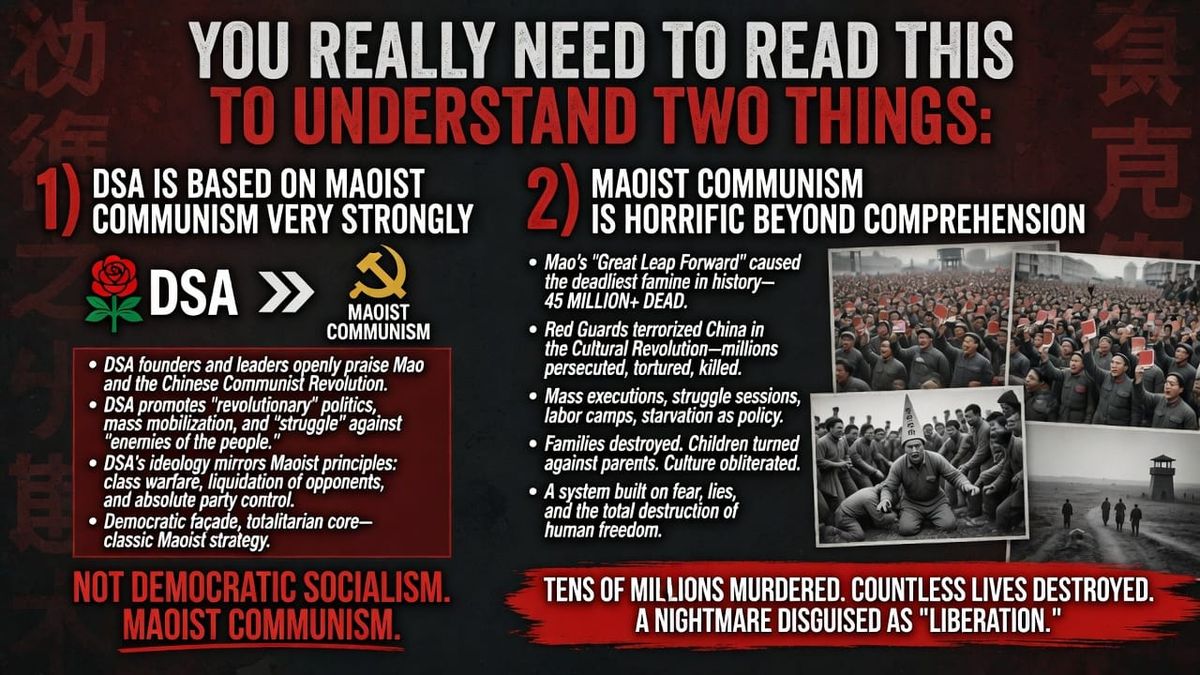
Jeffries says he rejects the DSA platform but welcomes its members into a “broad caucus.” You cannot reject a movement’s program and adopt its members and pretend the program stays outside the door.
Fifty-eight percent of Democrats now hold a positive view of socialism. Thirty-two percent hold a positive view of capitalism. Among Democrats with a college degree, the socialism figure climbs to seventy-one percent. That is a CBS News poll, published this past Sunday, and it is not an outlier. A recent Economist/YouGov survey found a majority of Democrats would vote for a candidate who calls himself a democratic socialist. A party that used to define itself against this has changed.
I did not come to this argument from the right. I still believe a serious center-left is good for a free country. So I want to be fair to the people I am about to disagree with, because the fairness is the point.
Here is what happened this week. On NBC’s “Meet the Press,” Kristen Welker asked Hakeem Jeffries, the leader of the House Democrats, a direct question: do democratic socialists belong in the Democratic Party? Jeffries answered that he does not support defunding the police, does not support open borders, does not support abolishing the Senate, and that his party is focused on the cost of living. He said he does not back the DSA platform, even as candidates aligned with the group prepare to join his caucus in the next Congress. They will be part, he said, of a “broad caucus.”
He rejects the program. He welcomes the members. He wants you to believe those two things sit side by side.
Read it again. He wants you to believe a movement can walk in while its agenda waits on the porch.
It cannot. A caucus is not a coat closet where people check their beliefs at the entrance. The members arrive with the platform. They vote it. And a disciplined faction joins a bigger tent for one reason, which is to drag the leadership toward that platform over time, which is the thing Jeffries is pretending not to understand.
Be precise about what the platform holds, because the soft language depends on you not looking. This is not an argument about the top marginal tax rate. The organized democratic-socialist project, as its own conventions and materials describe it, contemplates shutting down the Senate, restacking the Supreme Court, ending immigration enforcement, and hollowing out private property as most people understand it. These are proposals to knock out the walls the building stands on.
I concede the honest version of the other side’s case. Young people did not arrive at socialism because they read Marx. They arrived because a home you can buy, a hospital bill you can survive, and a degree that does not follow you for twenty years all drifted out of reach, and the word “capitalism” got stuck to that experience of being priced out of your own country. The grievance is real. Anyone who wants to answer it should say so plainly.
A real grievance does not validate every cure. Here is where a liberal has to hold the line a liberal exists to hold. The promise on offer is the old one, the warmth of the collective, the state taking the essentials off your hands. Across the Atlantic, Britain’s Andy Burnham has been making a cleaner version of it, arguing that the country handed private markets control of housing, water, energy, and transport and left ordinary people exposed. It is a seductive account. It also skips the part where Britain ran the experiment. The nationalized, high-inflation model of the 1970s did not keep anyone warm. In 1976 the country had to be rescued by the International Monetary Fund, a humiliation for a great power, before its economy was rebuilt on other terms.
Take out the referee and it feels like winning right up until you are the one who needs the whistle.
That is the trade the number at the top of this essay describes. A generation is being offered comfort in exchange for a set of institutions, and it is being told the institutions are what stand between it and the comfort. They are not what stands in the way. The Senate you are told to resent is the brake on the next majority, the one that will come for you when the wheel turns. The Court is the check that protects you on the day your side is out of power.
Which brings me back to Jeffries. Leadership in a moment like this has one job, and it is not to be liked by the loudest faction in the room. The job is to tell that faction the truth. We will fight with you for cheaper housing and honest healthcare. We will not help you take apart the machinery of self-government to get there. He had the question in front of him, asked plainly, on national television. He listed the things he does not support and opened the door anyway. He wanted credit for rejecting the platform and the votes of the people who hold it. That is not moderation. It is a missing spine sold as breadth.
This lands harder in 2026 than it would in another year. This is the two hundred fiftieth anniversary of the republic, and by accident the two hundred fiftieth year of Adam Smith’s “Wealth of Nations,” a book the founding generation read as the economic companion to their politics. They had bet everything on the claim that rights come from something higher than the government. They also understood that a person who does not own his own labor is not politically free, whatever the ballot says. The order they built is not a mood you swap out for a better one. It is what lets you argue with the people in charge and still keep your house.
Benjamin Franklin, asked what kind of government the founders had given us, is said to have answered: a republic, if you can keep it. The keeping was never the dramatic part. It looks like a leader with an easy question and a hard answer sitting right there, taking the applause. The tent is not too small. Some of the people being waved into it have said, on the record, what they mean to do to the ground it stands on.
Source note: Jeffries’s remarks from his August 16, 2026 appearance on NBC’s “Meet the Press”; polling from CBS News (Aug. 2026) and Economist/YouGov. This essay engages themes drawn from Jonathan Turley’s recent commentary and his book “Rage and the Republic.” Related-story links are placeholders pointing to theunredacted.co — swap in the live URLs before publishing.
📬 Share, Comment, and Support Our Work
Share this. Restack it. Forward the email. That's the whole ask.
Support the work. The reporting linked above took weeks of tracing records, filings, and on-the-record statements. It doesn't happen on faith. If you find it useful, become a paid subscriber and help fund the next one.