Miles Guo’s Fall Exposes a Bigger Political Network

“Violence can only be concealed by a lie, and the lie can only be maintained by violence.” — Aleksandr Solzhenitsyn
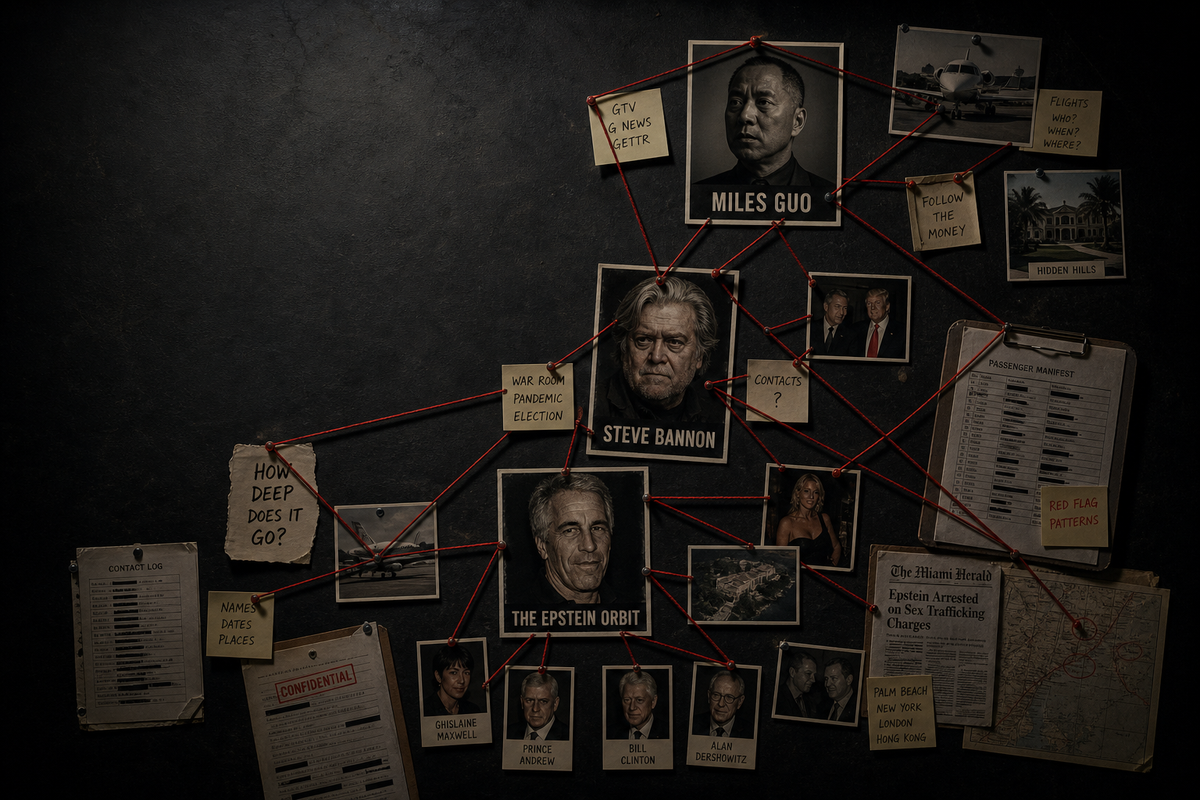
Bannon, Epstein, and the Guo case
Miles Guo’s sentence is not only the end of a fraud case. It is the collapse of a political fantasy built on grievance, vanity, and trust. For years, Guo presented himself as a dissident, a truth teller, and a man at war with the Chinese state. That persona helped him gather followers, money, and protection. It also helped him hide the obvious fact that he was using political belief as a vehicle for private enrichment.
What makes the case more than a routine fraud prosecution is the company it kept. Guo moved in circles where politics, money, and moral theater were never cleanly separated. Steve Bannon was one of the most prominent figures in that orbit. Their relationship gave Guo a kind of American legitimacy that a fugitive businessman could not have manufactured on his own. Bannon, for his part, gained access to a ready-made narrative of anti Communist resistance, one that could be folded into his larger project of populist mobilization.
The result was not merely a partnership. It was a system of mutual amplification. Guo brought capital, spectacle, and a cause. Bannon brought political translation. Together, they turned a private con into something that looked, to some supporters, like a movement.
“Guo led a massive scheme to steal more than $1 billion from thousands of victims,” said Attorney for the United States Sean S. Buckley. “Rather than being satisfied with the many legitimate opportunities the U.S. afforded to him, Guo exploited the trust that thousands placed in… pic.twitter.com/AnGN5QI7Ch
— US Attorney SDNY (@SDNYnews) June 30, 2026
That is why Guo’s fraud worked for so long. He did not sell ordinary investment products. He sold belonging. He sold participation in a moral struggle. He sold the feeling of being inside a hidden history, one in which the buyer was not just an investor but a patriot, a dissident, a believer. Once money is wrapped in that kind of emotional and ideological packaging, scrutiny becomes harder. Doubt starts to look like betrayal.
The sentencing in New York brought the scale of the deception into focus. Prosecutors said Guo and his network raised more than a billion dollars through false claims, sham entities, and fabricated financial schemes. The purchases were vulgar in the way so many frauds are vulgar. Mansions. Luxury cars. A yacht. The familiar evidence of stolen money converted into status. But the point is not the spectacle. The point is the mechanism. Guo turned political loyalty into capital and then turned capital into private luxury.
 Gene Goodwin
The Epstein connection adds another layer, though a narrower one. The significance is not that Epstein and Guo were part of the same criminal enterprise. The significance is that Epstein appears in the background of the same world, a world of influence, access, and informal power, where people measure one another not by principle but by usefulness. In that sense, the Epstein material is revealing less as evidence of a direct tie than as a sign of how far Guo’s orbit extended. He was visible to people who understood exactly what kind of operator he was.
This is the part of the story that should interest anyone studying political fraud. The modern grifter rarely works alone and rarely works in silence. He builds a surrounding ecology of validation. He recruits people who need the money, the platform, the cause, or the proximity. Some know they are dealing with a fraud and accept the bargain anyway. Others convince themselves that politics excuses everything. Still others are seduced by the promise that they have been admitted into something larger than commerce.
Guo understood this instinctively. He knew that a dissident identity could shield him from normal skepticism. He knew that anti Communist fervor could be used as an emotional solvent, dissolving basic questions about money and ownership. He knew that if he could hold enough of the right kinds of attention, the rest would follow. For a while, it did.
#HappeningNow outside the home of #MilesGuo in NYC , who was arrested by the DOJ. I spoke with one of the organizers. She stated the reason why Miles was arrested is because the #CCP has Weaponized the #DOJ and #FBI
— Viral News NYC (@ViralNewsNYC) April 8, 2023
For licensing email viralnewsnyc@gmail.com pic.twitter.com/LacxarXr4z
Bannon’s role matters because he helped make that illusion harder to puncture. He was not simply an observer. He was a validator. And in politics, validation is power. A damaged man becomes credible when he is surrounded by credible people. A dubious enterprise becomes harder to challenge when it is spoken about in the language of crusade. That is one of the oldest tricks in political life and one of the most durable.
 Gene Goodwin
The Guo case shows how easily the language of liberation can be turned into a business model. It also shows how elite networks, even when they are not formally criminal, can help sustain men who are plainly untrustworthy. That is what makes the Epstein thread relevant. It points to a broader milieu in which people like Guo are not anomalies but instruments. They are useful because they can be made to carry messages, money, and risk for others.
In the end, Guo’s sentence is about punishment, but the real lesson is structural. Fraud of this kind succeeds when people confuse ideological excitement with moral seriousness. It succeeds when they mistake access for legitimacy. It succeeds when public theatrics crowd out judgment. Guo’s downfall does not just expose one man’s lies. It exposes the vulnerability of political publics that are eager to believe in saviors, enemies, and hidden wars.
At #FreeMilesGuoRally in NYC , @JimmyLevyMusic performs and shows support for Miles Guo
— Viral News NYC (@ViralNewsNYC) April 8, 2023
For licensing email viralnewsnyc@gmail.com pic.twitter.com/XAwEcHqOHw