DSA in New York Built a $53 Million Propaganda Shop with Your Money.
Mamdani put his DSA field operation on the city payroll, gave it the official channels to every community's press and clergy, and aimed it at June 23. The receipts are public.

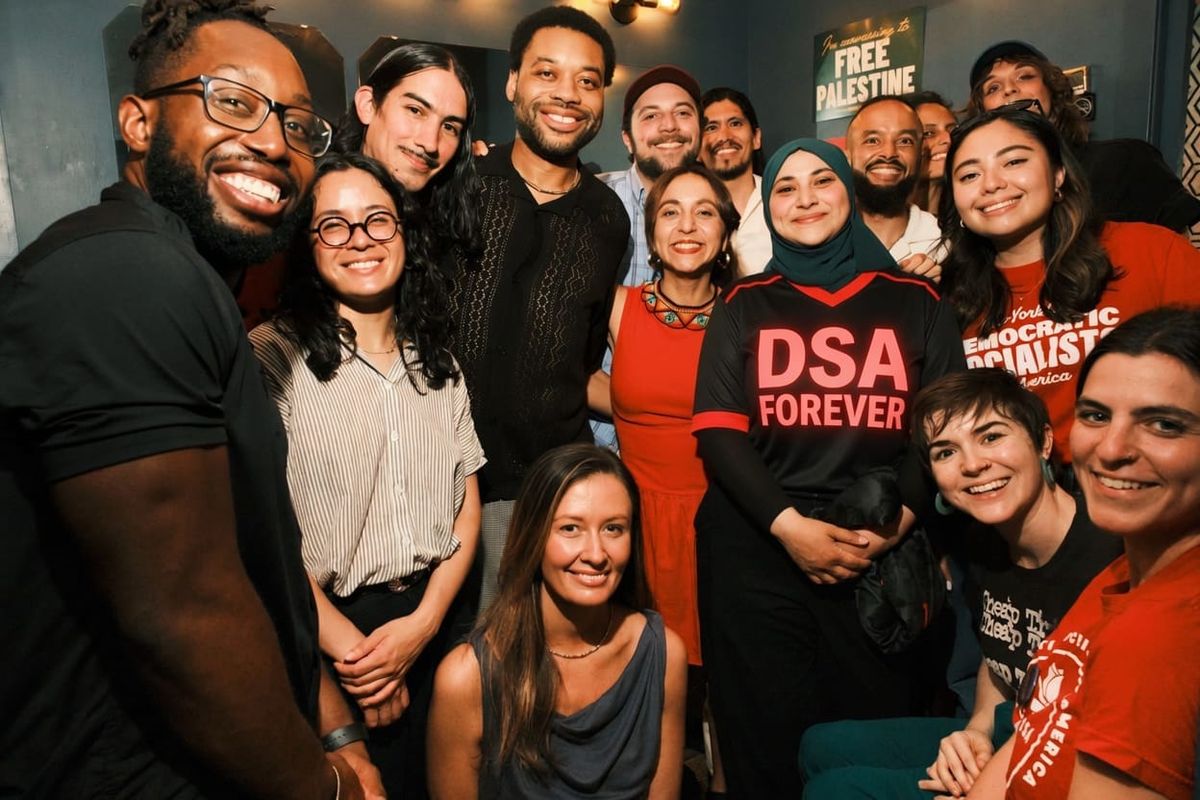
MAGA, Republicans, Jews, or anyone DSA disapproves of will not win another election in NYC.
I grew up in the Soviet Union, so when I tell you I've seen an Office of Mass Engagement before, understand that I'm not reaching for a metaphor. We had one. Ours didn't bother with the focus-grouped name. Its job was deciding which citizens were "the people" and which were the problem, and it kept a supply of approved Jews in stock for whenever the state needed one to stand next to the flag and denounce the rest of the tribe.
In Mother Russia, at least, it is funded by the Communist Party. Our Pravda office costs $53 million a year, and congratulations, we're paying for it.
Tascha Van Auken runs the operation. On January 2, his first business day in office, Zohran Mamdani signed an executive order creating the Office of Mass Engagement and installed Van Auken, the DSA organizer who built his campaign field machine, as its commissioner. The machine she built: 100,000 volunteers, 3 million doors knocked, 4.5 million phone calls. City Hall's own press release promised she would bring "the same urgency, discipline, and principles" to government. The same operation. Different letterhead. The taxpayer now covers the rent.
🚨 Mamdani’s Mass Engagement Office Pick Called for “Defeating the Republican Right and the Neoliberal Center”
— Stu Smith (@thestustustudio) January 2, 2026
Today, Mayor Zohran Mamdani signed an executive order creating a new Office of Mass Engagement. He tapped Tascha Van Auken, the architect of his campaign’s field… pic.twitter.com/2N5wYzf2Ul
The office costs $53 million a year. This is not an engagement office. It is a political machine with a city seal, and the evidence is in the city's own documents.
Exhibit A: The Org Chart
The executive order consolidates five existing city offices under Van Auken's command. Two matter most: the unit that manages City Hall's relationship with the ethnic press, and the office that handles the faith communities. One commissioner. One political organization. Every official channel between the mayor and a community's newspaper, clergy, and civic leadership.
Then the job postings. The office hired "campaign directors," on the city payroll, at $140,000 to $150,000 a year. The word campaign appears in the taxpayer-funded job title. There is also a deputy director of "co-governance," a term that appears nowhere in the city charter and everywhere in DSA's organizing documents. Van Auken's salary is $250,000.
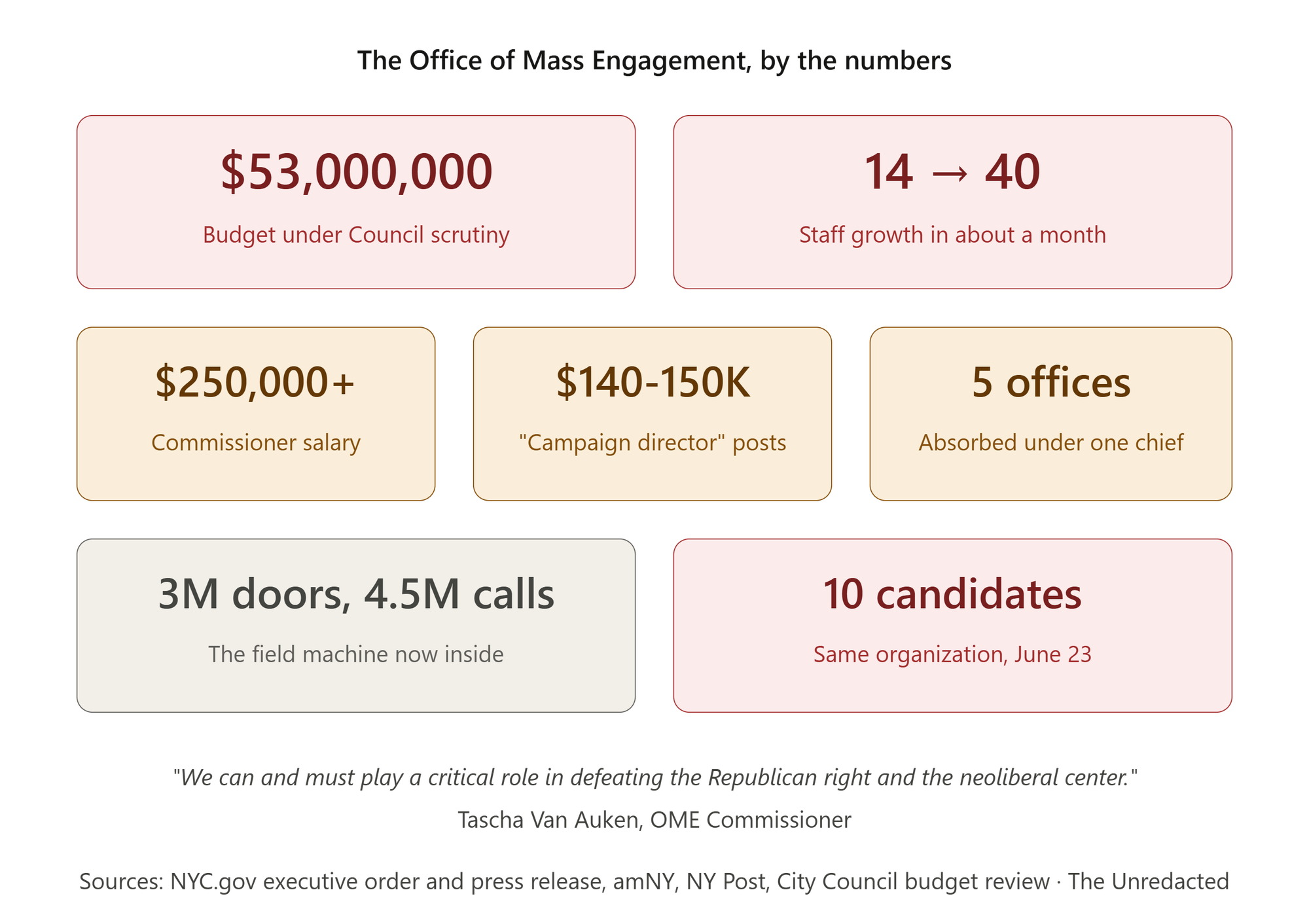
Headcount went from 14 to 40 in roughly a month. The original payroll estimate was $1.6 million. The actual figure: $5.1 million. The City Council spent this week asking what "political guardrails" exist around the office. The hearing was unnecessary. The guardrails are the politics.
What has the office produced in five months? Canvassing operations for the mayor's rent freeze agenda. A political machine normally buys its reach with ads, mail, and organizers, disclosed in filings and paid by donors. This one broadcasts with the seal of the City of New York on every door knock, billed to the people being canvassed.
Exhibit B: The Commissioner's Own Words
🚨 Mamdani’s Mass Engagement Office Pick Called for “Defeating the Republican Right and the Neoliberal Center”
— Stu Smith (@thestustustudio) January 2, 2026
Today, Mayor Zohran Mamdani signed an executive order creating a new Office of Mass Engagement. He tapped Tascha Van Auken, the architect of his campaign’s field… pic.twitter.com/2N5wYzf2Ul
Van Auken has stated the mission on the record: "We can and must play a critical role in defeating the Republican right and the neoliberal center." The neoliberal center is the mainstream Democratic Party, roughly seventy percent of the city. The official who decides which community voices reach the mayor has announced that her project is defeating most of the community.
"We can and must play a critical role in defeating the Republican right and the neoliberal center."
Her description of the job: "strengthening feedback loops so public input shapes policy" and "building the relationships and systems, human and digital, that make long-term co-governance possible." Decoded: the office decides what counts as input, builds the loop, and the loop tells the mayor whatever the office puts into it.
Exhibit C: The Method
Van Auken's first deputy commissioner is Jagpreet Singh, a DSA member and former political director of the activist group DRUM Beats. Singh is on video describing how community leaders were pressured to line up behind Mamdani: they had "no other choice," and refusing would "end up being a problem." From a campaign volunteer, that is hardball. From the number two official of a $53 million city office that controls a community's access to City Hall, its press channels, and its faith portfolio, it is a business model.
The office's newest initiative, Organize NYC, was announced by the mayor with Van Auken at his side. Its first task: bringing tenant "feedback" to Rent Guidelines Board hearings. A city office run by one political party selects the voices, delivers them to an official proceeding, and presents the output as the will of the people. The office stands at both ends of its own feedback loop.
Tascha gave so many people the courage to knock that first door, make that first call and build the bridges with our neighbors that got us this far.
— Zohran Kwame Mamdani (@ZohranKMamdani) November 16, 2025
Together, we fought for a city for all of us. Now, we’ll build a City Hall for all of us. pic.twitter.com/sSlcekYwGc
Exhibit D: The Filter, Already Running
The faith portfolio sits inside OME. The office's official faith liaison to one million Jewish New Yorkers is Rabbi Miriam Grossman, a member-leader of Jews For Racial and Economic Justice and a veteran of Jewish Voice for Peace's rabbinical council, whose record includes protesting outside Chuck Schumer's house against military aid to Israel. Out of a million Jews, City Hall selected the rabbi whose career is built on opposing what most of them feel connected to.
At the mayor's Jewish Heritage event, co-sponsored by JFREJ and JVP after the city's major Jewish organizations boycotted, the people who run the actual schools, security networks, and social services of Jewish New York stood outside. The activists who knocked doors for the mayor stood inside, holding the microphone, photographed as "the Jewish community." A government office that decides which voices are legitimate has an older name: a censorship office. Every community in the city will pass through this filter. The Jewish community went first.
🚨 BREAKING: Zohran Mamdani has brought Jagpreet Singh, a DSA member and former political director of DRUM Beats, into his administration as First Deputy Commissioner in the Office of Mass Engagement.
— Stu Smith (@thestustustudio) January 28, 2026
In this clip, Singh explains how organizers pressured community leaders to… pic.twitter.com/j0WiLCeKD9
Exhibit E: June 23
On June 23, DSA runs seven Assembly candidates, one state Senate candidate, and two congressional candidates, the largest socialist slate for a state legislature in American history, each multiplying donations up to 12 to 1 with public matching funds. DSA does not endorse candidates; it staffs them. Its electeds coordinate through a body named Socialists in Office, and decisions are made in the chapter, not the district. The mayor confirmed the arrangement himself, telling an audience his signature free bus policy "was not my idea." The ideas come from the organization. The officeholders deliver them.
Several slate candidates are not running for open seats. They are running to remove sitting Democrats whose offense is insufficient compliance. Every winner becomes another terminal of the machine that holds City Hall, runs the $53 million engagement office, and controls the official pipeline to every community's media and clergy.