THE FLUSHING MEDICAID MACHINE:
A New York Post investigation found 77 social adult day cares in one square mile of Flushing billing Medicaid over $100 million a year. Reporters walked in and found empty rooms. Federal prosecutors have already charged one operation. The state charged the rest with nothing.

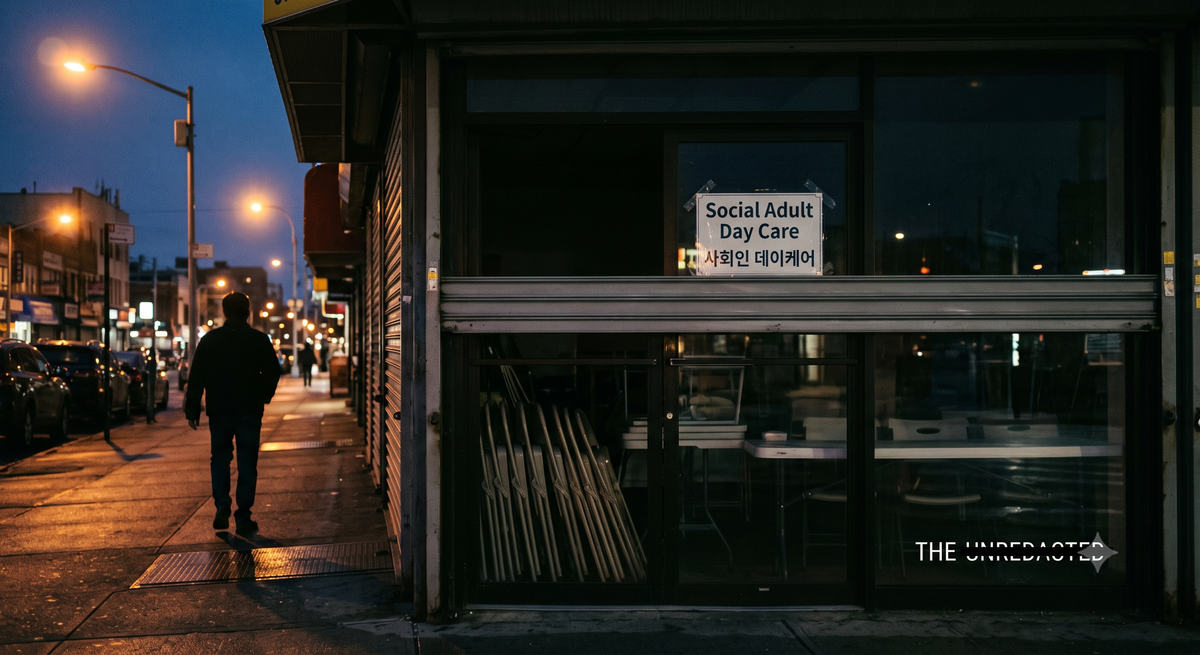
The Flushing Medicaid Machine: 77 Storefronts, $733 Million, and Rooms Nobody Sits In
A New York Post investigation published this week put a number on something federal prosecutors have been circling for months. One square mile of Flushing, Queens, holds 77 social adult day care centers. Together they bill Medicaid more than $100 million a year. That single neighborhood accounts for 14 percent of all social adult day care spending in New York State.
Then the Post did the thing that turns a spending anomaly into a story. Reporters walked in.
They found shuttered storefronts. They found open ones with empty rooms and no patients. At Bao Kang Adult Day Care, a worker said she sees one or two hundred people a day, then looked at security monitors showing every common area empty. At Merry Adult Day Care, a masked worker told the reporters to leave. This is the Post's reporting, and it is the load-bearing fact of the entire case: the billings and the emptiness occupy the same address at the same time.
The Post named the biggest billers. Sunrise Senior Service topped the list at roughly $45 million for almost 57,000 patient-claims. Bao Kang claimed around $32 million for nearly 44,000. Livingwell Day Care took $27 million for over 26,500. These are private businesses. According to the Post, the largest of them each claimed between $20 million and $40 million from Medicaid over six years. None of these particular centers has been charged with a crime. That is not a mitigating detail. That is the story.
The Post is not the only reporter who walked these blocks. Independent journalist Nick Shirley ran his own investigation using public CMS and HHS data, and his figures come out lower than the Post's: he clocked Sunrise Senior Service at $12.9 million in a single year against nearly 8,000 listed patients, out of a single-story storefront too small to hold the claimed volume. He named Palace Daycare on similar terms. The two investigations put different dollar totals on the same operators, which is worth stating plainly rather than blending. What they agree on is the behavior. When Shirley pressed Sunrise's owner on the numbers, the owner refused to engage and called the police, the same reflex the Post's reporters met at other centers when they asked where the patients were.
Consider what the money is supposed to buy. New York added social adult day care as a covered Medicaid service in 2014. The program is meant for seniors with chronic illness or disability who need structured supervision, personal care, and meals. It is not a drop-in center. It is a clinical intervention with a Medicaid line item attached. Between January 2019 and October 2024, the state paid out $2.4 billion for it.
The growth curve is where the arithmetic stops making sense. CMS data shows Flushing's Medicaid-eligible senior population grew 20 percent from 2018 to 2024. Over the same window, the number of seniors billed by these day cares surged 390 percent. A CBS News analysis found the Flushing facilities bill Medicaid for the equivalent of more than 90 percent of every Medicaid-eligible senior in the neighborhood.
The mechanism is not a mystery, because prosecutors already laid it out. In February 2026, the Justice Department charged two Flushing men, Inwoo Kim and Daniel Lee, with running a $120 million scheme through two day cares and a pharmacy. The DOJ complaint describes the model in plain terms: pay seniors cash and supermarket gift certificates to enroll, then bill Medicare and Medicaid for services never provided or medically unnecessary. Medicaid paid Kim's day cares $62 million. Medicare paid his pharmacy $58 million. On one day, according to prosecutors, one of the centers billed for over a thousand patients. Its certificate of occupancy allowed 81.
The Post found the same code word on the street that the indictment found in the bank records. A local pharmacy owner, Kenny Chan, told the paper that seniors walk in asking for "benefits." In Flushing, benefits means the kickback.
The Kim case is not the only one. A separate Brooklyn scheme produced a $68 million conviction. And it is the same chassis we documented in June, when federal prosecutors charged Brooklyn operator Pervez Siddiqui and seven co-defendants in a $38 million adult daycare fraud run out of APNA and Ashiana, a scheme whose recruiters worked NYCHA buildings and bus stops looking for anyone holding a Medicaid card. It is the same chassis, one program up, in the $1.2 billion looting of New York's home-care system, where the state let 600 unregulated middlemen bill Medicaid for care that was never delivered and, in some cases, for patients living overseas.
Different neighborhood, different immigrant enclave, different Medicaid line. Same three moving parts every time: a program with soft rules, recruiters paying cash for a card, and a state that keeps paying the invoices.
Since 2021, the state's own Medicaid Inspector General has referred 387 centers for investigation and elevated a third of them to the Attorney General for law enforcement action. The state knows the numbers. The state has known for years.
So the question is not whether fraud exists in this program. A federal indictment, a Brooklyn conviction, 387 state referrals, and a $38 million Brooklyn case built on the identical model settle that. The question is why 76 other storefronts in the same square mile, billing the same public treasury under the same broken oversight, continue to operate while reporters can walk in off the street and film the empty chairs.
CMS Administrator Dr. Mehmet Oz gave CBS the only sentence that matters here. Looking at the density, he asked how many social adult day care centers one neighborhood could possibly need. He has separately called the clusters a clubhouse for criminals. He is the federal official. He is describing a state program. New York runs Medicaid. New York licenses these centers. New York decides whether the invoices get paid.
The invoices keep getting paid.
The paper trail is public. The billing figures are public. The empty rooms are on video. What is missing is not evidence. What is missing is a state authority willing to treat 77 storefronts billing for phantom patients as the scandal a single indicted pair already proved it to be. Until Albany does, the lights stay off and the money keeps moving.
📬 Share, Comment, and Support Our Work
Share this. Restack it. Forward the email. That's the whole ask.
Support the work. The reporting linked above took weeks of tracing records, filings, and on-the-record statements. It doesn't happen on faith. If you find it useful, become a paid subscriber and help fund the next one.