On America's Birthday, a Mayor Redefined What Independence Means

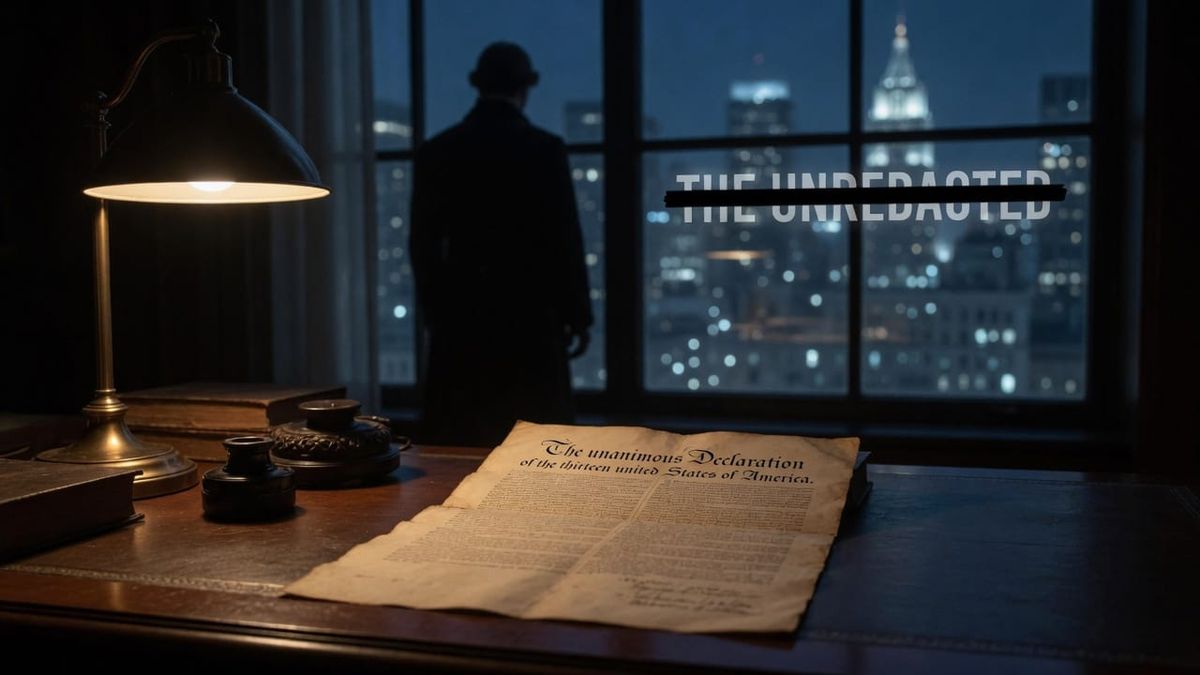
Zohran Mamdani's July 4th speech used the language of the founding to argue for its opposite: a nation organized around dependence on the state rather than independence from it.
When the founding fathers signed the Declaration of Independence in the summer of 1776, they articulated a principle that was radical in its simplicity: that human beings have a right to govern themselves. Not a right granted by authority, but an inherent right. Not a privilege bestowed by the powerful, but a natural law. The word itself—independence—meant freedom from external domination. Freedom from the subordination of one's will to the will of another. Freedom from dependence on the power of a distant monarch to decide how you would live. The American experiment was built on this: the idea that a free people could govern themselves, that they needed no master, that dependence on authority was the enemy of human flourishing.
Socialist Mayor of New York City, Zohran Mamdani, just gave a speech on what he thinks it means to be an American on America’s 250th Birthday.
— America (@america) July 3, 2026
He attacked our nation as “an arena of supremacy” that “persecutes” and claimed ICE is “invading our streets”. pic.twitter.com/kyHY6TXHfi
Two hundred and fifty years later, on America's birthday, the mayor of New York City stood behind George Washington's desk and offered a competing vision. Not explicitly, but in the grammar of his speech and the vision it contained, Zohran Mamdani presented to the nation a redefinition of what American patriotism means. And in that redefinition lies an inversion so profound that it requires us to ask what we mean when we speak of American independence at all.
Mamdani's speech was careful. It used the language of American ideals. It spoke of striving toward perfection, of the privilege of shaping one's nation, of inclusion and welcome. It positioned itself as an extension of the founding vision. But the substance of the speech offered something fundamentally different: a vision of America not as a nation of independent people, self-governing and free from domination, but as a nation organized around dependence on centralized state power to provide for basic needs. Not independence from authority, but dependence on it.
The contrast becomes clear when you examine what Mamdani identified as America's failures and what he proposed as remedies. The failures: hungry children, homelessness, inadequate healthcare, corporate power. The remedies, which emerge from his broader political philosophy and from the DSA platform he represents: government control of housing, government-provided food, government healthcare, government restriction of corporate activity. In each case, the solution to the problem is not the expansion of individual freedom or individual capacity, but the expansion of dependence on centralized state power. What was once seen as a threat to American freedom—the concentration of power in the hands of the state—is now presented as the path to American perfection.
The Founding Fathers feared concentrated power. Mamdani is offering concentrated power dressed in the language of American ideals.
This is not a disagreement about policy. It is a disagreement about the foundation of American civilization. The Founding Fathers believed that a free people needed to be protected from the unlimited power of government. They built a system of checks and balances to distribute power, to limit it, to prevent any single authority from exercising domination over the people. Their fear was tyranny—the subordination of the will of the people to the will of those in power. The answer they offered was constitutional government, limited power, and reliance on the initiative and independence of the people themselves.
Mamdani is offering something else: a vision of America in which the people are provided for by government, in which their needs are met through state action, in which they are protected not from the power of the state but by it. Independence is transformed into interdependence with the government. Self-governance becomes governance by the state on behalf of the people. Freedom becomes freedom from want, which requires, paradoxically, dependence on those who provide.
What makes this not merely a policy dispute but a civilizational inversion is the rhetorical move Mamdani makes. He does not say: "I believe Americans should prefer dependence on government to independence from it." Instead, he uses the language of the founding to argue for its opposite. He speaks of "striving toward perfection," as if the Declaration's ideals naturally lead to the expansion of state power. He speaks of "righteous dissent" as if criticism of government power is somehow patriotic, while the actual structural principle—limiting government power—is exclusionary.
🚨 President Trump is DIRECTLY countering Zohran Mamdani's anti-American speech today
— Nick Sortor (@nicksortor) July 4, 2026
"We are an INCREDIBLY good, kind, and generous people, always ready to help a friend or a neighbor in need.
No one has EVER given more to charity, ended more hunger, cured more disease, or… pic.twitter.com/1N73s3z0U5
The inversion is complete when you recognize that Mamdani is presenting a vision of America that is fundamentally at odds with what made America exceptional in the first place: the belief that ordinary people, freed from the domination of centralized authority, could govern themselves and flourish. He is not making this argument explicitly. He is making it by redefining patriotism, using the language of inclusion and perfection to describe a system built on dependence rather than independence.
The contrast with President Trump's speech at Mount Rushmore becomes instructive, not because Trump's speech was flawless or even because his warnings about communism were perfectly calibrated, but because it articulated something that Mamdani's speech obscured: that there is a real choice being made about what kind of nation America will be. Trump spoke of exceptionalism grounded in what the founding fathers built. Mamdani spoke of perfection grounded in what the government could provide. One looks to the people for the answer. The other looks to the state.
This matters most on America's 250th birthday because it forces us to ask: what are we actually celebrating? Are we celebrating the founding principle—that a free people can govern themselves, that they do not need a master, that independence is a human good—or are we celebrating a nation that has abandoned that principle in favor of the comfort and security of dependence on centralized power?
Mamdani, standing behind George Washington's desk, surrounded by newly naturalized citizens, is answering that question. He is saying that what America should become is not a nation of independent people, but a nation of people cared for by the state. He is saying that what the Declaration's promise of self-governance really means is governance by the state in the service of meeting needs. He is saying, without saying it directly, that dependence on government is superior to independence from it.
The tragedy is not that this vision is being offered. There have always been those who believed that centralized power, properly exercised, could improve human life. The tragedy is that this vision is being offered while using the language and symbols of the founding—the desk, the flag, the naturalized citizens—to suggest that it is an extension of the founding rather than a rejection of it. The Founding Fathers feared concentrated power. Mamdani is offering concentrated power dressed in the language of American ideals.
🇨🇳 WATCH. FOLLOW THE PROPAGANDA. On America’s 250th birthday, Zohran Mamdani is parroting the rhetoric and propaganda scripted in Shanghai and Beijing by the Communist Party of China in its COGNITIVE WARFARE against America, designed to shame Americans, dismantle national pride… https://t.co/vUPSPwkDaV
— Asra Nomani (@AsraNomani) July 4, 2026
On America's 250th birthday, we might have expected a celebration of the principle that made the nation possible: the belief that human beings do not need masters, that they can govern themselves, that independence is both possible and desirable. Instead, we received a vision of a nation reordered around the opposite principle: that people need the state to provide for them, that independence is a luxury available only to the wealthy, that the path to perfection runs through the expansion of state power and the cultivation of dependence on it.
The question for America, as it enters its next century and a half, is whether it will remain a nation founded on independence or become a nation organized around dependence. Mamdani has made his choice. He is betting that Americans, when offered the comfort and security of government provision, will choose it over the risks and responsibilities of freedom. On America's birthday, that is a bet worth taking seriously.
Today, America wakes 250 years later as a beacon of hope, a republic entrusted to its people, an idea that changed the world.
— The White House (@WhiteHouse) July 4, 2026
A nation worth preserving. A dream worth pursuing. A freedom defended by every generation.
Happy 250th, America! 🇺🇸 pic.twitter.com/zbQNQmU22L
Sources: NYC Mayor's Office prepared remarks, July 3, 2026; Trump speech at Mount Rushmore, July 3, 2026; DSA platform documentation.