The Power of the Purse: Mamdani's Budget Chief Reports to the DSA
NYC's budget director briefed dues-paying DSA members behind closed doors on how he closed a $12B gap. The briefing isn't the scandal. The co-governance system it reveals is.

Sherif Soliman briefed dues-paying socialists behind closed doors on how he closed a $12 billion budget. The briefing is not the scandal. The system it reveals is.
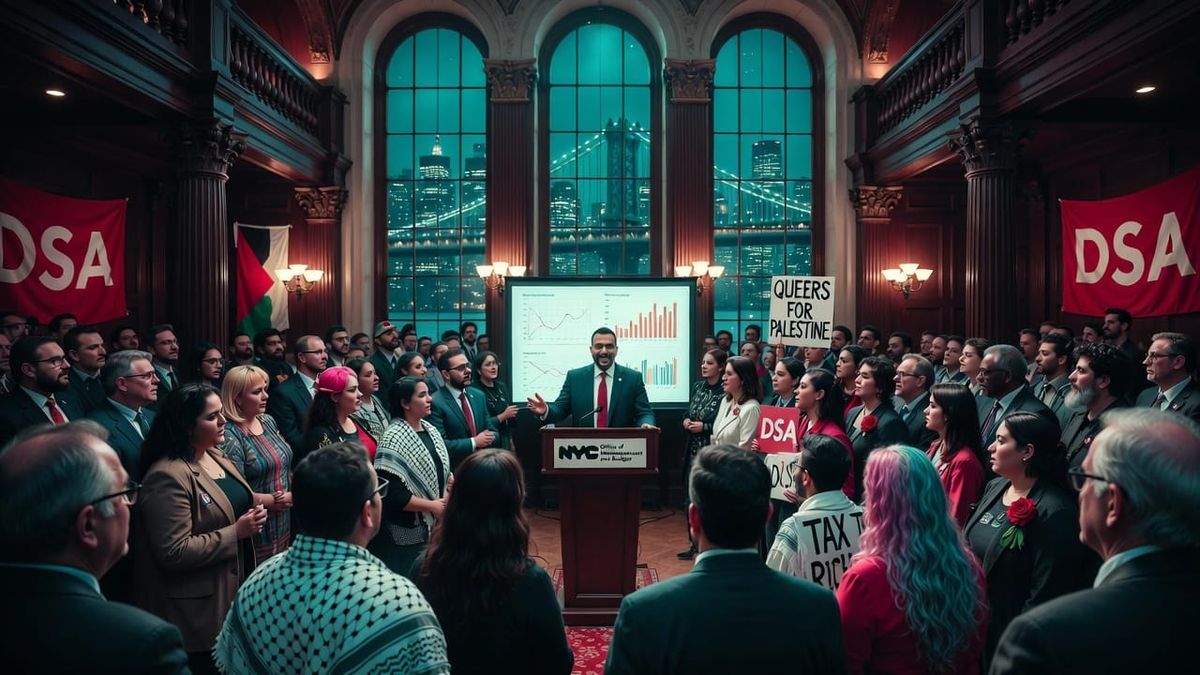
On the evening of June 1, members of the New York City Democratic Socialists of America filed into the Brooklyn Masonic Temple on Clermont Avenue in Clinton Hill. The event was billed as a debrief on the DSA's "Tax the Rich Campaign." The invitation made the terms clear: become a dues-paying member, get in the room. Then the city's budget director took the floor.
"I have the privilege of working alongside our mayor to lead the Office of Management and Budget," Sherif Soliman told the crowd, according to an attendee who described the event to Politico. Then the line that should stop every New Yorker cold: "So I have the power of the purse."
He does. Soliman runs a $124.7 billion budget. He is Mayor Zohran Mamdani's lead negotiator with the City Council. No major policy moves in this city without his sign-off on the money. And on June 1, he spent roughly ten minutes explaining to a private socialist organization, at a members-only political event with a recruitment component, how he closed a $12 billion deficit: agency savings, aid from Albany, and new taxes on wealthy homeowners, including the pied-à-terre tax on high-value second homes.
City Hall wants you to see a routine stakeholder briefing. Look closer. What happened at the Masonic Temple is a single frame from a much longer film: the methodical fusion of a political party and the government of America's largest city.
THE RULES HE CROSSED
Start with the narrow question. New York City's ethics rules prohibit non-elected officials from using their city title, city resources, or city personnel for non-city purposes, including promoting a political organization. Soliman opened by invoking his title. The event tied access to DSA dues. The DSA is, by any definition, a political organization running a membership drive.
Richard Briffault, who chaired the city's Conflicts of Interest Board, told Politico the appearance could cross into using an official title to promote a political group, and that the violation becomes more serious if city staff, time, or resources went into preparing the presentation. Carolyn Miller, the board's current executive director, said appearances at political club events with dues requirements might violate the rules, while allowing that presentations on city policy to residents can sometimes be appropriate.
Mamdani's spokeswoman, Dora Pekec, called such engagements "routine." She declined to say whether city resources were used to prepare the briefing. She declined to say whether anyone asked the Conflicts of Interest Board first. Those are not hard questions. They have yes-or-no answers. The administration chose not to give them.
A "routine" briefing does not require dues. A "stakeholder" is not a political party the mayor calls his political home.
What to do this summer if you want to win the affordability agenda?
— NYC-DSA 🌹 (@nycDSA) June 6, 2026
Zohran, Darializa, & @DianaforQueens say: *canvass*https://t.co/bawW5rt7pH pic.twitter.com/VvChe09Thy
THE SYSTEM BEHIND THE BRIEFING
Now widen the lens, because the ethics question, real as it is, undersells the story. The question is not whether one official spoke at one event. The question is who the Mamdani administration believes it answers to.
Eight days after the Masonic Temple briefing, Soliman sat before the City Council at an executive budget hearing and disclosed that Mamdani's new Office of Mass Engagement will run a $53 million budget, with $2.8 million in fresh funding for 20 new staff lines. Mamdani created that office by executive order in January. Its first commissioner is Tascha Van Auken, a longtime DSA organizer who ran Mamdani's field operation during the campaign. At the office's launch, Van Auken described its mission as organizing participation "at scale" and building systems for long-term "co-governance."
Co-governance. That is not my word. It is theirs. It is the DSA's own term of art for a model in which the party does not merely elect officials but governs alongside them, setting priorities from outside the government while drawing legitimacy and resources from inside it. The Masonic Temple briefing is what co-governance looks like in practice: the man with the power of the purse reporting results to the party, on the party's turf, behind the party's paywall.
Follow the circuit. The DSA runs a "Tax the Rich" campaign. The mayor, who calls the DSA his political home, wins office on that platform. His budget director engineers the revenue, including the pied-à-terre tax, then briefs the party's dues-paying members on the campaign's success at a recruitment event. Meanwhile a $53 million taxpayer-funded office, run by a DSA organizer, builds the permanent mobilization infrastructure. The campaign never ended. It moved into City Hall and acquired a budget line.
🧵 DSA says its Red Rabbits initiative is about “security.” But according to its own authorizing resolution, the project is preparing for a “national uprising against federal agents and police brutality.”
— Stu Smith (@thestustustudio) June 9, 2026
A recent panel showed what that means in practice.
“Takedowns on… pic.twitter.com/5lnZNxlNHA
WHY SOLIMAN MATTERS
Soliman is no campus radical. That is precisely the point. He is a 25-year veteran of city government: de Blasio's finance commissioner, a senior Adams official and MTA board member, CUNY's chief financial officer, an architect of congestion pricing. He grew up in Queens public housing. He is, by reputation, a serious technician.
When the apparatchiks brief the party, you have a scandal. When the technocrats brief the party, you have a regime. The capture of a career civil servant of Soliman's standing tells you the co-governance model is no longer confined to the activists Mamdani brought with him. It is becoming the operating norm of the building. The professionals have read the room. The room belongs to the DSA.
It was fascinating to see a DSA organizer reach the same conclusion I did about the Sunrise Movement’s recent anti-ICE campaigns.
— Stu Smith (@thestustustudio) June 10, 2026
As he put it, Sunrise has been doing “more high-risk stuff for official orgs.” pic.twitter.com/xADP19K8mu
WHAT HAPPENS NOW
The Conflicts of Interest Board does not comment on specific cases, and as of June 9 no formal complaint is public. So here is what accountability requires. The Council should demand answers under oath: Did city staff or resources prepare the June 1 presentation? Did Soliman or City Hall consult the COIB beforehand? How many other administration officials have briefed DSA members at closed events? And the Council should put the same scrutiny on the Office of Mass Engagement that Speaker Julie Menin began on June 9: what guardrails, if any, separate $53 million of taxpayer-funded "engagement" from party organizing?
New Yorkers did not vote to be governed by a private membership organization. They are entitled to a government whose budget chief briefs the public in public. On June 1, in a rented hall in Clinton Hill, they got a preview of the alternative.