The Saint Was a Predator: What César Chávez Tells Us About the Left's Cult of Personality

When a movement's icon is exposed as a monster, the silence of its leaders becomes the second scandal.
There is a particular kind of political lie that the American left has perfected over the last half-century. It is not the lie of policy contradiction, or even the lie of hypocrisy — those are old and bipartisan sins. It is the lie of the sacred figure: the untouchable icon whose moral authority is so totemic, so load-bearing to an entire political identity, that the people around him will swallow anything — including the screams of children — rather than let the edifice crack.
César Chávez was that figure.

The New York Times investigation published March 18, 2026, by reporters Manny Fernandez and Sarah Hurtes, is one of the most consequential pieces of American investigative journalism in recent memory. Based on interviews with more than 60 people, hundreds of pages of union records, confidential emails, photographs, and DNA results from 23andMe, the report establishes what a great many people in the farmworker movement quietly knew and deliberately chose not to say: that Chávez was a serial predator who groomed girls as young as 12, raped a 15-year-old during one of his most celebrated public marches, and assaulted his own co-founder — Dolores Huerta — twice, conceiving children he would never acknowledge.
Huerta, now 95 years old, broke 60 years of silence to tell the world what happened. She wept when she learned about the children he had abused. She called herself a survivor.
The question the Times investigation cannot fully answer — but that every serious political observer must now ask — is this: Who knew? Who protected him? And who, right now in American political life, is being protected the same way?
The Architecture of Impunity
The mechanics of how Chávez evaded accountability for decades are not mysterious. They are, in fact, familiar — familiar enough to feel like a template.
He operated within a closed institutional world — the United Farm Workers — where loyalty was ideological, not merely professional. To question Chávez was to question the movement. To protect the women and girls he victimized would have meant choosing them over the cause, and the cause, his lieutenants believed, was bigger than any individual. This is how internal cover-ups are rationalized everywhere from the Catholic Church to Hollywood to, yes, the corridors of progressive politics. The mission is sacred. The victims are collateral.
Internal union emails show that whispers about Chávez's conduct circulated within the UFW more than a decade before the Times published its findings. A private Facebook group of longtime supporters was rattled when one of his victims, Debra Rojas, posted: "Wake up people. This man you march for every year molested me." She later deleted the post. Nobody acted.
This is not negligence. This is a choice.
Scratch that, it’s Chávez. I kept digging. pic.twitter.com/kqN6zO7FkX
— Stu Smith (@thestustustudio) March 13, 2026
The Political Leader as Sacred Object
Chávez's case is a window into a broader and more urgent pathology in American political culture: the transformation of political leaders into sacred objects whose reputations must be defended at all costs, even when the cost is paid in the bodies of the powerless.
We see the pattern repeat with disturbing regularity. Progressive institutions — labor unions, civil rights organizations, community activist networks, urban political machines — have repeatedly shielded powerful men from accountability by invoking the cause. The logic is always the same: This man's work is too important. The enemies circling us are too dangerous. We cannot afford this right now.
This is precisely the reasoning Dolores Huerta herself deployed for six decades. She believed — and her belief was not irrational — that exposing Chávez would hand ammunition to those who wanted to destroy everything the UFW had built. She was not wrong that enemies existed. She was wrong that their existence justified her silence. And she was not alone. The entire ecosystem of progressive California politics — the politicians, the donors, the academics who lionized Chávez, the state legislature that made his birthday a holiday — participated in an act of collective moral abdication.
Look Around You
It would be convenient to treat the Chávez revelations as a historical reckoning — a painful but safely distant confrontation with the sins of a movement that crested fifty years ago. That is almost certainly how many of the politicians who issued careful statements this week would prefer it framed.
Senator Alex Padilla released a statement calling for "zero tolerance for abuse." Mayor Karen Bass honored "every woman and girl horrifically harmed by those in power." Representative Nanette Barragán said she was "heartbroken, outraged, and sick to my stomach."
These are the correct emotions to perform. But they are emotions about the past, expressed by people with no political cost to pay for expressing them. The harder question — the one none of them answered — is whether any of them have, in their own political careers, been part of networks that protected powerful men from accountability in real time. Not in the 1970s. Now.
The architecture Chávez operated within — the closed ideological network, the loyalty-above-truth culture, the strategic silencing of victims to protect institutional reputation — did not die with him. It is the operating system of political machines from Albany to Sacramento to Chicago. It is the reason victims of powerful local politicians, union officials, and nonprofit executives routinely find themselves facing the same impossible calculus Debra Rojas faced as a teenager: If I speak, I destroy the movement. If I stay silent, I destroy myself.
The Iconography Problem
There is something specific to the American left's relationship with its icons that makes this kind of cover-up not just possible but structurally likely. The right has its own cult of personality problems — Donald Trump's movement is in many ways defined by loyalty that overrides accountability — but the left has developed an additional layer of moral armor around its icons because those icons are understood to represent not just political power but moral virtue itself.
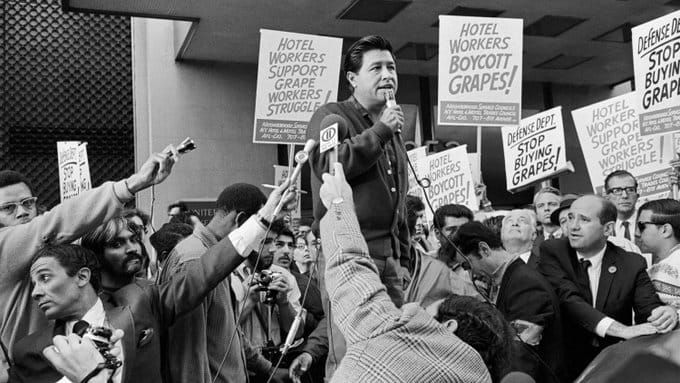
Chávez was not just a union organizer. He was proof of concept — proof that brown farmworkers could organize, that nonviolent resistance worked, that the dispossessed had power. His image hung in churches. His name was invoked at ordinations. He was, functionally, a saint.
This is the trap. When a political figure is elevated to sainthood, accountability becomes blasphemy. The women and girls he violated were not just silenced by institutional cowardice. They were silenced by a mythology. And mythologies, unlike institutions, are almost impossible to reform from within.
What the Chávez case demands — and what current political leaders are conspicuously failing to provide — is an honest audit of how many living icons are operating under the same protective canopy. How many city council members, state legislators, labor leaders, and community organizers currently enjoy the presumption of sainthood that makes their victims' accusations automatically unbelievable? How many times, right now, is a young woman or girl being told that speaking out would hurt the movement, embarrass the community, or hand a weapon to the opposition?
What Accountability Actually Requires
The cancellation of UFW events on César Chávez Day is a gesture. Removing his name from a street or a school is a gesture. These things matter symbolically, but they do not change the culture that produced the cover-up.
Real accountability requires something much harder: an acknowledgment, by the politicians and institutions that benefited from Chávez's legacy, that they participated — however passively — in the suppression of his victims. It requires a reckoning with how ideological loyalty functions as an abuse-enabling mechanism. And it requires the development of institutional structures within progressive politics that can investigate powerful people without the investigation being treated as a political attack.
None of that is happening. What is happening is a careful performance of shock by people who will, once the news cycle moves on, return to the same loyalty-above-accountability culture that kept Debra Rojas silent for fifty years.
Dolores Huerta — the woman who co-built the UFW, who marched and fasted and organized for six decades, who was herself raped by the man she stood beside at every podium — said it more plainly than any politician dared to: "There are no words strong enough to condemn those deplorable actions."
She is right. But words, however strong, are not the point.
The point is what the people who run American progressive politics choose to do next. Whether they treat the Chávez revelations as a contained historical catastrophe, or whether they have the institutional courage to look at their own networks — their own sacred figures, their own closed loyalties, their own cultures of silence — and ask the question that Huerta spent 60 years unable to ask out loud.
The saint was a predator. The movement knew. And the movement chose the movement.
That choice is still being made. Every day. By leaders who still have names you recognize.