The Teamsters wrote the Amazon bill. Mamdani backed it. You might pay $664 annually.
Grant the premise: delivery workers deserve protection. Now score the Delivery Protection Act against that goal. It raises household costs by $664, risks a workforce that is 84 percent non-white, and organizes for a union. Only one of those is worker protection.

Mamdani is backing a Teamsters-written bill that would force Amazon to directly employ delivery drivers. A consultancy study puts the cost at $664 per household. The contractors it would wipe out are, by opponents' count, 84 percent non-white.
Follow the sequence, because it is the same sequence every time. Organized labor wants a policy. The candidate that labor helped elect delivers the policy. The cost of the policy lands on someone who was not in the room. On Monday, Mayor Zohran Mamdani backed the Delivery Protection Act, Intro 518, a bill supported by the Teamsters that would bar companies like Amazon from subcontracting last-mile delivery and force them to directly employ the drivers.
Directly employ. That is the phrase to hold onto, because direct employment of that workforce is the specific thing the Teamsters have wanted for years. The union does not organize thousands of scattered contractor drivers easily. It organizes a single large employer's payroll easily. The bill converts the first into the second.
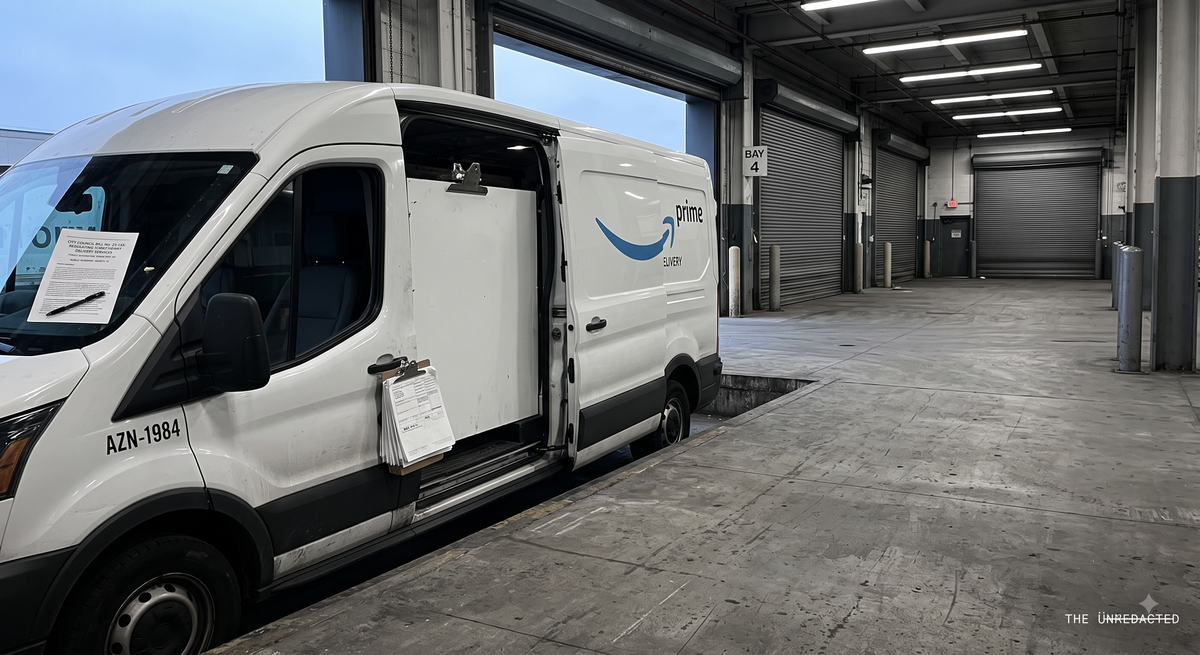
Now the cost, from the record. A study by the consultancy AKRF puts the added burden at $664 per year per New York household to get their goods. That is not Amazon's number. It is a consultancy's. The Business Council of New York State said plainly that the bill will raise prices for consumers. Amazon, which works with more than forty local Delivery Service Partners employing over 5,000 people in the city, has warned it could move delivery operations outside the five boroughs entirely, which AKRF has said would make deliveries both slower and more expensive.
Here is the part the "worker protection" framing is built to keep you from seeing. The workers this bill would protect are not the workers it would eliminate. According to the New York Delivers coalition opposing the bill, as many as 10,000 city delivery jobs are at risk, including an estimated 3,500 last-mile jobs in Harlem and four adjoining Council districts. The coalition says 82 percent of that last-mile workforce does not have a college degree and 84 percent is non-white. A bill sold as protecting delivery workers would, on the opposition's numbers, put thousands of non-white workers without college degrees out of the jobs they currently hold.
Put a name on it. Rudy Cazares is a New York City native who runs an Amazon Delivery Service Partner and also contracts for FedEx. He told the Post the bill would end him. "I would be shutting my business down. I have no business." He employs roughly 130 people, more during the holidays. His drivers start at $23.75 an hour and experienced drivers reach roughly $27. Every one of them, in his account, is a W2 employee, full or part time, with benefits, paying payroll taxes. This is the "exploitative subcontracting" the mayor's statement describes.
That is the tell. The bill's supporters had a show of force scheduled. So did its opponents: delivery workers and small-business owners at Thomas Jefferson Park in East Harlem, the exact neighborhood whose 3,500 jobs are on the coalition's list. One side is the union that wrote the bill and the mayor it helped elect. The other side is the workforce the bill claims to speak for, standing in the park, saying it does not speak for them.
The mechanism is not new to this administration, and it is not confined to this bill. In the antisemitism budget, the activists who lobbied the $26 million figure ended up administering the money. In the electoral operation itself, the DSA built a field machine designed to convert campaign labor into governing power. This is the labor tier of the same structure. A constituency delivers the election. The administration delivers the constituency's policy. The bill is written in the language of protecting the vulnerable, and the vulnerable are the ones who show up to oppose it.
Someone should ask the mayor a direct question and hold him to the answer. Not whether delivery drivers deserve good pay. They do, and by Cazares's account many already earn it. The question is why a bill written by the union that stands to gain the members, backed by the administration that union helped elect, is worth $664 a household and thousands of non-white contractor jobs, and why the people it names as beneficiaries were in the park on Monday arguing against it. Follow the bill to who wrote it. Follow the cost to who pays it. The two are not the same people, and that is the whole story.