Two Months After Indictment, Mamdani Gave BHRAGS $200M. Here's Why That's the Story.
The Mamdani administration awarded $200 million in city shelter contracts to BHRAGS Home Care two months after its leaders were federally indicted for bribery and embezzlement. The city calls it rehabilitation. The documents call it something else.

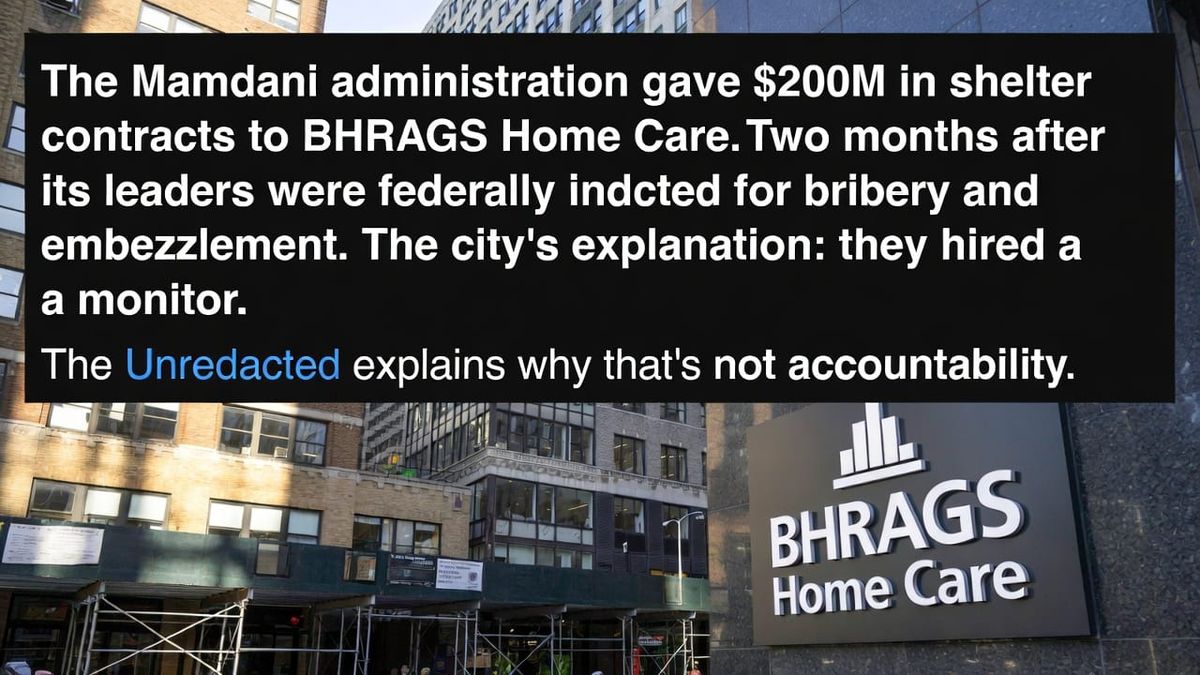
he announcement came with a monitor. That was the tell. The Department of Social Services spokesperson explained that the city had appointed an independent monitor, selected and managed by the Department of Investigation, so the city could "properly rehabilitate" BHRAGS Home Care. This is the formulation you reach for when you are trying to justify a decision you know looks bad. You build a frame around it and call the frame accountability.
What the frame was built around: a Brooklyn nonprofit whose executive director, Roberto Samedy, and former board chairman, Jean Ronald Tirelus, are accused of siphoning $1.3 million from the organization they ran and taking kickbacks. The federal indictment came down in March 2026, two months before the Mamdani administration signed off on at least two new contracts. One is worth $136 million, covering shelter facilities for homeless adults. The second is worth $50 million, covering social services in hotels. Combined: $200 million, flowing to a nonprofit that is the subject of an active federal criminal prosecution.
Samedy and Tirelus pleaded not guilty.
The political geography
BHRAGS did not arrive in the Mamdani era as a stranger. The organization had already collected more than $450,000 in discretionary funds from City Councilwoman Farah Louis, whose district covers parts of Brooklyn. In February, federal agents raided the home of Louis and her sister Debbie Louis, an aide to Gov. Kathy Hochul. Neither sister has been arrested or charged with any crime. The raid is a fact. So is the $450,000. So is the new $200 million.
The indictment against Samedy and Tirelus was unsealed in March alongside what prosecutors described as a broader federal investigation into city Democrats connected to the migrant shelter contracting world. BHRAGS was not a peripheral actor in that investigation. It was the center of it.
"By appointing a monitor selected and managed by the DOI, the city is better positioned to hold new leadership accountable and properly rehabilitate the organization." — Neha Sharma, DSS spokesperson
This is the logic being offered: because there is a monitor, the contracts are defensible. But the monitor is the city's own creation, managed by the city's own Department of Investigation, which answers to a mayor who just awarded the contracts. That is not independent oversight. That is one arm of city government watching another arm of city government watch a nonprofit that both arms have already decided to keep funding.
What accountability looks like
There is a simpler option. It happens. Cities pull contracts from vendors facing federal criminal prosecution. They put work out to bid. They run competitive processes. The Mamdani administration did not do any of that. It reviewed the situation, concluded that BHRAGS was worth rehabilitating, and signed $200 million in new contracts to that end.
The city's DSS told Gothamist, which first reported the contract awards Friday, that the monitor arrangement puts the city in a position to hold new leadership accountable. "New leadership" is doing significant work in that sentence. The old leadership is the one that was indicted. Whether genuinely new leadership is in place, and what that transition looked like, the city has not said.
BHRAGS runs shelter facilities and social services under city contract. Its residents are homeless adults, many of them migrants. They did not choose their shelter operator. They have no leverage over the contracting process. They are the people the city says it is protecting when it talks about continuity of services. They are also the people living inside an organization that federal prosecutors say was looted by its own executives for personal enrichment.
The pattern
The Mamdani administration is four months old. It inherited an entrenched nonprofit contracting ecosystem built over years of Democratic machine politics in Brooklyn and the Bronx, one where discretionary funds from sympathetic council members have long served as the seed capital for organizations that then land city contracts worth many times the original investment. BHRAGS fits that pattern cleanly. The question is whether Mamdani chose to break from it or chose to extend it.
The answer, documented in city records, is $200 million worth of extension.
The monitor will file reports. The reports will note compliance or non-compliance. The compliance or non-compliance will determine whether the city takes further action. By the time any of that produces a result, the contracts will be years along, the federal case will have moved through the court system at its own pace, and the Mamdani administration will have had ample opportunity to point to the monitor as proof that someone was watching.
Someone was always watching. The IRS was watching too. BHRAGS was on the IRS blacklist for nonprofits that failed to file required returns. The city knew that before March. It knew it before the indictment. It kept signing contracts anyway, and then it signed $200 million more.
Source reporting: Gothamist, New York Post, city contract records.